Iranian Official Defends Child Marriage Due to “Increased Sexual Displays”
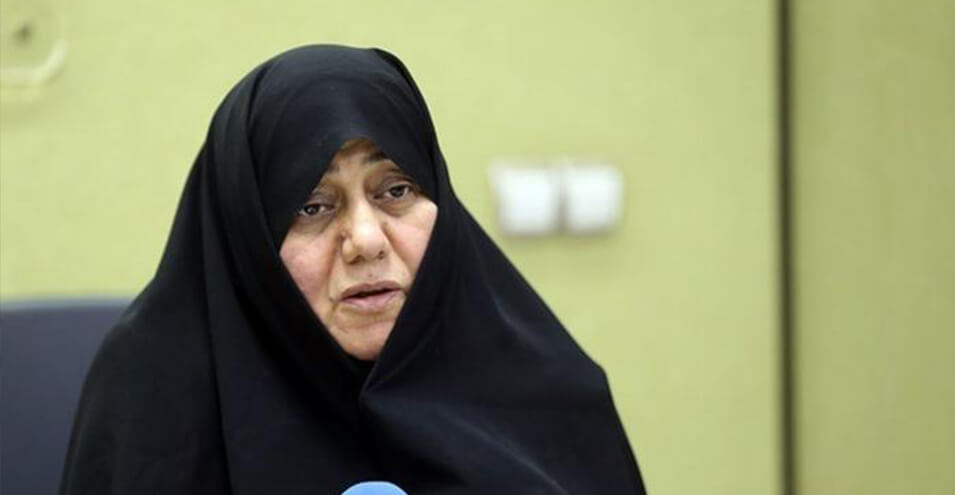
An Iranian official cited high “sexual displays in society” and reduced age of child prostitution as reasons for opposing a ban on child marriage. Limiting marriage age’s effect on “population decline” is also cited by child marriage advocates.
Farshte Rouhafzaa, director of planning and policy development at Iran’s Cultural-Social Council for Women and Family, on Tuesday, December 4th, cited high “sexual displays in society,” the large number of runaway girls, and decreased age of “prostitution” among them as reasons for her opposition to banning child marriage.
Ms. Rouhafzaa stated: “The highest age group of runaway girls is between 13 and 15 years old, and certainly the number of our runaway girls exceeds those who marry in childhood. My entire point is that with these laws [banning child marriage], the majority are sacrificed for a minority, which is illogical.”
This official affiliated with Iran’s Supreme Council of Cultural Revolution added: “Unfortunately, the age of girls’ prostitution, based on statistics presented, has decreased. Also, the age of friendship between girls and boys has decreased and reached elementary school ages. Therefore, girls at age 13 become aware of sexual matters and pursue them, and certainly at this age they need the opposite sex and a spouse.”
Farshte Rouhafzaa continued explaining her reasons for defending child marriage: “Sexual displays in society’s space are extremely high to the extent that television discusses the disadvantages and advantages of masturbation. Unfortunately, sexual stimulation for youth in society is high, and in magazines, newspapers, mobile phones, television, computers, etc., there are many displays of sexual stimulation. In many advertisements in cyberspace, sexual content appears with disclaimers that those under 18 should not watch, while this doesn’t happen in any country in the world, because it encourages people more to view it.”
Ms. Rouhafzaa attacked supporters of the law prohibiting child marriage, saying they “only do what the international community has told them to do and don’t know anything themselves.”
The director of planning and policy development at Iran’s Cultural-Social Council for Women and Family added: “When sexual displays increase in society and young girls see them and feel the need, if they want to marry, some say it’s wrong, but if the same girls want to become prostitutes, the same people say they should be issued a health card.”
Farshte Rouhafzaa, in another part of her remarks about the expansion of “illegal” abortion in Iran, said: “The rate of legal abortion in the country per year is very low compared to illegal and unauthorized abortions, and unauthorized abortions have high rates in the country, and those who perform this work are people with no expertise in the matter.”
Annually 40,000 Marriages Under Age 14
Sina Kalhor, director general of cultural studies at Iran’s parliamentary research center, also stated on the previous day during a session reviewing “the jurisprudential and legal dimensions of the marriage age limitation proposal” that “40,000 marriages under age 14 occur annually, with Zanjan, East Azerbaijan, North Khorasan, Razavi Khorasan, Ardabil, and Hamadan provinces ranking first through sixth respectively.”
Parvaneh Salehshouri, a member of the Islamic Consultative Assembly and advocate for raising the marriage age, had stated on December 10th: “We have 45,000 children under 13 who have married in the country. These children do not marry of their own will but are forced by their fathers to marry.”
According to the Student News Agency, Sina Kalhor, claiming that “the representatives who are pursuing the amendment to Article 1041 in parliament are not the designers of this plan but merely pursuing it,” added: “This plan was designed in NGOs and civil society institutions, and these institutions pressured representatives asking why you are not pursuing the demands of civil institutions?”
Article 1041 of Iran’s Civil Code permits marriage for girls under 13 and boys under 15 “with the permission of the guardian on condition of benefit and with the determination of the competent court.”
The director general of cultural studies at the parliamentary research center, in another part of his remarks, called age “an incorrect criterion” for marriage and said: “We are supporters of the conditions idea and say that whoever has the conditions for marriage should marry. Nevertheless, a very heavy public atmosphere has been created, and it is difficult to speak about this matter in this atmosphere.”
Kalhor also claimed that “according to my research, divorce of marriages under age 14 has the lowest divorce rate in the country, and this is contrary to what the designers of this plan say.”
Ghasem Jafari, a former member of parliament, also opposed the plan during the session reviewing “the jurisprudential and legal dimensions of the marriage age limitation proposal,” saying among other things: “Our first question is that God has made puberty a natural order and you have limited this puberty; where is your religious basis? What necessity is there for you to make lawful what God has made unlawful? The second point is that if religious puberty is permission for marriage and is prophetic tradition, a much stronger element and benefit must be presented to us that this benefit and prevention of such corruption is improper, which we have not seen. Another reason is that based on the rule of authority, jurists and fundamentalists believe that based on the rule of priority, one has the choice of their own life in the first place. A person has the conditions for marriage and let’s say is 16 years old and you say we don’t permit it? What is the reason?”
Investigation of “Population Control Infiltrators” Case in Parliament
One of the concerns of opponents of the plan to increase the minimum marriage age in Iran is the impact of the possible passage of this plan on the Islamic Republic’s leader’s intended policy for population growth in the country. According to the IRNA news agency, Sina Kalhor, director general of cultural studies at the parliamentary research center, in part of his remarks yesterday described the plan to “limit marriage age” as a factor for “population decline.”
Ayatollah Khamenei, leader of the Islamic Republic, in 2013, contrary to previous population control policies in Iran, called for implementing programs to increase the population to 150 million people and transmitted his order under the heading “General Population Policies” to the three branches of government. Following the announcement of population growth policy by the leader, Hassan Rouhani, president of Iran, also issued a four-article directive to explain the general policy of population growth to the country’s ministries of health and labor. Facilitating population growth was among the provisions of this directive.
Khamenei’s order extended population control issues to security domains, and after that, circles close to Iran’s leader, especially security institutions, viewed any movement toward controlling or reducing population in Iran with suspicion. For example, the Farsi news agency wrote on the sixth of December: “It is reported that one of the country’s security institutions, in cooperation with the judicial apparatus, has arrested and summoned a number of infiltrating elements in the population control sphere.”
According to this news agency affiliated with the Revolutionary Guards, “these individuals, through their network activities, under the guise of scientific activities, infiltrated various state institutions and created obstacles against the proper implementation of the system’s general policies in the population sphere.”
Shortly thereafter, the identity of one of the detainees in the “population control sphere” was revealed. She is Maimunah Hosseini Chavooshi, a demography professor and researcher at the Australian National University’s Public Policy Institute.
The government newspaper Kayhan on Saturday last week referred to this university professor by the name “M.H” and wrote that this “dual-national demographer” was “arrested by the ‘anonymous supporters of the Imam of the Age’ during a successful operation while leaving the country.” Kayhan described this arrest as “in continuation of dealings with enemy infiltrating elements” and emphasized Maimunah Hosseini Chavooshi’s dual nationality.
IRNAPlus, citing “an informed source,” reported that Ms. Hosseini Chavooshi’s case is to be placed on the agenda of Iran’s parliament’s National Security and Foreign Policy Commission. According to this “informed source”: “The matter [of Ms. Hosseini Chavooshi’s arrest] has not yet been formally raised in the National Security Commission, but we are waiting for an opportunity to ask them about these issues when the deputy minister of intelligence comes to the commission.” The university professor is reportedly denied access to a lawyer.
The “Dangers” of a Plan
Parvaneh Salehshouri had stated on November 20th that the plan to increase the minimum marriage age not only faces opposition “from men who are defenders of their interests,” but “even has powerful opponents among women.”
According to this reformist representative: “The notable point is that in the plan we proposed, we even had gentlemen from the principalist faction who voted for it. But on the other hand, some female representatives opposed it. You might even find it interesting to know that due to dangers it entailed, some supporters were unwilling to sign the plan and put their names under it.”
Tayyebeh Siavoshi, member of the women’s faction in parliament, had also stated on November 15th that the “plan to combat child marriage” or increasing the minimum marriage age, despite being approved in parliament’s open session on September 25, 2017, had “not resulted in initial talks with the Guardian Council.” According to Ms. Siavoshi, despite the fatwa of Nasir Makarem Shirazi, one of Qom’s Shia sources, the plan still faces opposition and resistance in parliament and the Guardian Council.
Fatima Zulqadr, a member of the Islamic Consultative Assembly, had also stated on August 11th: “Several sources were not very agreeable to raising the marriage age of girls and boys, but many of them have expressed agreement with this matter, and the plan to raise the marriage age has not yet been dropped.”
Source: DW