Iranians’ Angry Reaction to Cover-up of Plane Crash Deepens Rift in State Media
VOA Persian Service – After Iran admitted to its role in downing the Ukrainian airliner, contrary to its earlier false claims, coverage of the negative public reaction revealed a deepening rift in state media organizations.
State radio and television (IRIB) issued no apology for publishing false news about the incident, and thus faced severe criticism from smaller news websites that explicitly stated they had been misled by official authorities. They apologized to their readers.
This is the most striking example of contrasting editorial positions among state media outlets in recent years. Nevertheless, this contrast remains within the framework of control exercised by Iran’s Islamist rulers over news organizations.
Reporters Without Borders considers Iran one of the most oppressive countries for journalists and ranks it 170th out of 180 countries in the World Press Freedom Index.
Media observers in Iran, in interviews with the Farsi service of Voice of America, said the severe rift in coverage of the plane crash stems from management disputes between IRIB and several news websites.
On December 11, 2019 (January 11, 2020), Iran admitted three days later to firing missiles at the International Ukraine Airlines jet and said its forces mistook the Ukrainian passenger plane for an enemy threat hours after firing several missiles at a base hosting U.S. forces in Iraq. All 176 passengers of Boeing 737, mostly Iranian-Canadians, were killed in the crash. Many of the plane’s passengers were students headed to Canada with a stopover in Kyiv.
In the three days following the plane crash, state media outlets reported, citing responsible officials, that the cause of the crash was a technical fault. They also denied reports by international media about claims by Western intelligence organizations regarding evidence of Iran’s forces’ role in downing the passenger jet.
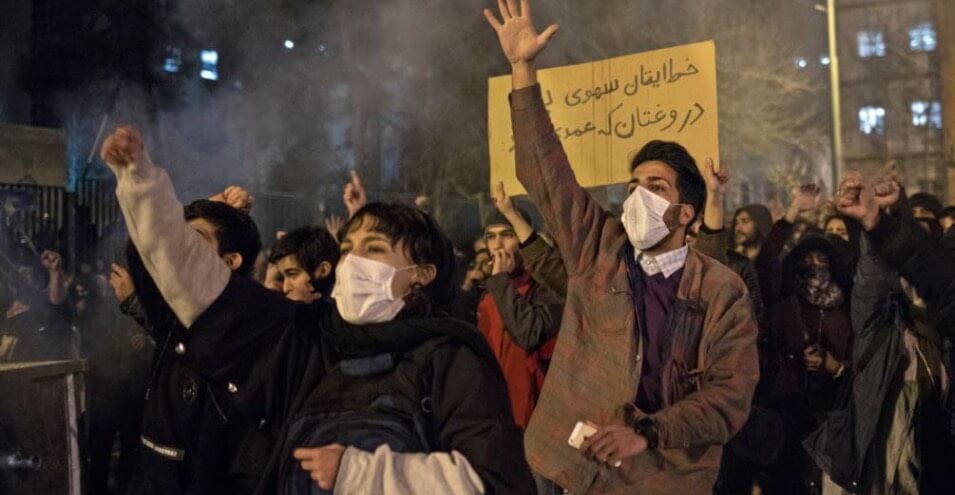
After Iranians realized they had been given false information about the cause of the plane crash, they reacted with anger. Hundreds of protesters took to the streets of Tehran and other cities, chanting anti-government slogans, and over several days expressed their discontent on social media.
Iranian students at Tehran University on December 24 chanted: “Our state media, our shame, our shame!” One day earlier, three well-known IRIB hosts resigned.
Golara Jabari, a former television host, in an Instagram post that was later deleted, said she would never return to IRIB: “It was very hard for me to believe that my countrymen were killed… I’m sorry that for 13 years I lied to you on Iranian television.”
Saba Rad and Zahra Khatami Rad, two other hosts who had recently worked for IRIB, told their Instagram followers that they could no longer continue working as hosts for IRIB.
The “Professional Association of Journalists of Tehran Province,” whose members work in various news outlets, warned that IRIB had destroyed its credibility.
On December 23, the association stated in a statement: “We are now conducting a funeral for public trust; the first coffins of it include the corpse of the official media, especially IRIB, and then the press and websites.”
“Voice of America” did not have the opportunity to conduct open interviews with these journalists because it would put them at risk of legal persecution in Iran. Iran’s authorities consider Voice of America a hostile institution.
These criticisms appear to have had no effect on IRIB. According to the “BBC Monitoring Service,” this state media outlet has shown little attention to protests and continues to strongly support the government and armed forces.
On January 26, IRIB continued to publish false information by airing what appeared to be a frivolous phone call with the American CBS television network to support groundless claims about inflicting hundreds of casualties on American forces in the missile attack on Ain al-Asad base. No one was killed in that missile attack.
However, “BBC Monitoring” says mainstream news websites that typically describe anti-government protests as sedition have taken a softer tone, and some have apologized to their readers for false reporting on the plane crash and blamed responsible officials for misleading them.
For example, the IRNA news agency fully published the statement of the “Professional Association of Journalists of Tehran Province.” According to “BBC Monitoring,” in another case, the Farsi news agency published an unusual report with details of public protests.
One reason for IRIB’s indifference to public anger compared to news websites is that this important institution is the most important media platform for Ayatollah Ali Khamenei. The appointment of the IRIB director is within his authority, and he uses that institution to convey his messages.
Shayan Sardarizadeh, from BBC Monitoring who worked at that network for four years in various roles, says: “IRIB is the primary point of contact for most people in the field of news, entertainment, and other programs. This is essentially the way to communicate with the government and stay informed about events in the country.”
Ahmad Jalali Farahani, a journalist and documentary filmmaker residing in Denmark, says IRIB is the only news outlet for many lower-class segments in Iran, especially those far from major cities who do not have access to computers, mobile phones, or the internet.
Farahani, who was previously an IRIB host and worked at several news websites, including Mehr News Agency, said IRIB viewers and listeners are a vital audience for Iran’s Islamist ruling system because most of them are religious and loyal to the ruling clergy.
Authorized news websites in Iran target a more affluent audience connected to the digital world who have access to competing information sources from social media to Persian-language media based outside Iran.
Farahani said a website like “Farsi” wants to show Iranians active in the digital sphere that their coverage of anti-government protests is credible: “Protests happen on the streets and internet users can follow these developments on social media. For this reason, you cannot lie to them. Instead, you must control and filter the news. For example, you must say: Yes, protests are taking place, but they are not large crowds.”
State news websites differ from IRIB in that their managers are not appointed directly by Khamenei.
Sardarizadeh from BBC Monitoring said this gave websites the freedom to respond quickly to news events to appeal to different segments of society and to be able to criticize and oppose elements of Iran’s ruling system. However, he said this freedom does not extend to coverage of Khamenei. Khamenei’s speeches and other activities are covered by all media in the same manner with language dictated by the leader’s office.
Majid Beheshti, a well-known former IRIB host and filmmaker residing in Britain, says IRIB and government websites do not differ on another issue: “The tone and phrasing of news websites may differ from IRIB, but all serve the common goal of strengthening the legitimacy of the Islamic Republic and work to the benefit of the system’s leader.”
Source: Voice of America