Khamenei: Broadcasting and Judiciary Not Under Supreme Leader’s Management
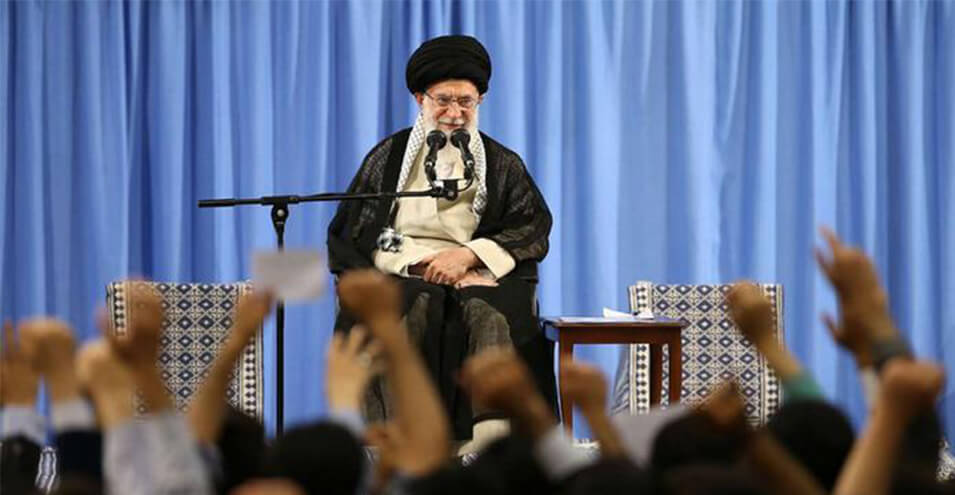
Sharp criticism from a student at an iftar ceremony hosted by Iran’s supreme leader regarding his subordinate institutions, economic conditions, and political freedoms prompted a response from Ayatollah Khamenei. Iran’s supreme leader stated he has no role in managing state broadcasting (IRIB) and the judiciary.
Ali Khamenei, Iran’s supreme leader, said on Monday evening (May 28/June 7) during a meeting with a group of students that although heads of the judiciary and broadcasting are appointed by him, he does not manage their operations.
He stated: “Management of institutions such as the armed forces is under the supreme leadership, but in the case of the judiciary and broadcasting, although their heads are appointed by the supreme leader, their management is not under the supreme leadership, and for example, I have consistently maintained—and maintain—a critical stance toward broadcasting in various matters, both in its current and previous management.”
Ayatollah Khamenei described the main solution to remedy “flaws and problems” in some state institutions such as broadcasting as “injecting young, active, faithful, and motivated elements into these organizations.”
During this three-hour meeting, Sahar Mehrabi, a representative of responsible managers in the central council overseeing university publications at the Ministry of Science, expressed sharp and direct criticism regarding the country’s political, social, and cultural situation, which was unprecedented in the presence of the Islamic Republic’s supreme leader when compared to similar past meetings.
In her lengthy list of criticisms and protests, the student referenced “weakening of legal structures through the creation of parallel political-security institutions, unlawful interference by military-security forces in the duties of elected national institutions, undermining people’s voting rights through arbitrary disqualifications and unlawful interference by the judiciary in the functions of other branches,” and concluded that this situation resulted in “progressively weakening the people’s sovereignty rights.”
She also criticized the restriction of civil liberties and said: “Restricting citizens’ rights and freedoms for forming political associations and professional unions and civil organizations, violating the right to hold gatherings, repeated violations of freedom of expression rights, increasingly limiting the right to free access to information through unlawful filtering and dealing with the press—all of these have created a situation where civil and lawful protest as a simple and possible option has become unavailable to citizens.”
Reference to “Unlawful House Arrest”
In her remarks, Sahar Mehrabi criticized the judiciary’s performance, citing “violation of the right to fair trial, repeated violations of defendants’ rights such as the right to defense or access to a lawyer” and “arbitrary restriction of personal freedom such as eight years of unlawful house arrest” as examples of “violations of basic human rights.”
She also referenced the inability to investigate and examine some institutions under the supreme leader’s supervision and, by naming institutions such as the Revolutionary Guards, broadcasting, and the Foundation of the Oppressed, deemed this situation problematic.
Addressing Iran’s supreme leader, the student said: “The serious question arises: what answer do you have—the government official responsible for executive institutions, or the head of the judiciary who possesses supervisory and judicial authority, or Your Excellency, whom some consider to hold the authorities stipulated in Article 110 of the Constitution—what answer do you have to people’s questions, criticisms, and protests?”
Source: DW