Khatibzadeh: Iran Submitted Proposals for Returning to Vienna Talks
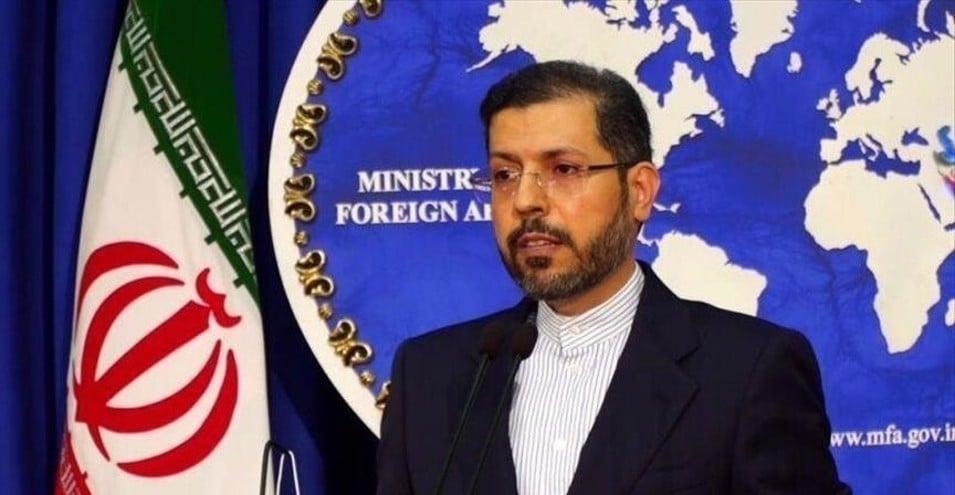
Iran’s Foreign Ministry spokesman stated that following Enrique Mora’s visit to Tehran, Iran submitted “proposals” regarding nuclear negotiations that could lead to all parties returning to Vienna. However, the condition for this return is the acceptance of these proposals by the United States.
Saied Khatibzadeh responded to questions about the progress of JCPOA negotiations, Enrique Mora’s visit to Tehran, and the contact between Iran’s Foreign Minister and the European Union’s foreign policy chief at a press conference on Monday, May 16.
According to ISNA, referring to a phone call between Hossein Amirabdollahian, Iran’s Foreign Minister, and Josep Borrell, the EU’s foreign policy chief, Khatibzadeh said that negotiations on the JCPOA issue have been conducted “seriously and with special initiatives from Iran,” and the Islamic Republic has proposed “solutions” that, if America responds to them, all parties could return to Vienna to reach an agreement.
Mora traveled to Iran on May 10, and after his return, Josep Borrell emphasized that Mora’s visit to Iran ended the “two-month stalemate” in nuclear negotiations between Iran and the West, and the reaction of Iranian officials to the visit and Mora’s messages was “sufficiently positive.”
Khatibzadeh also stated at today’s press conference: “It is not unusual if we have disagreements at one or two points in negotiations.” He added: “What is available today is several steps ahead of the situation before Mr. Mora’s visit to Tehran.”
Regarding recent talks between the foreign ministers of the United States and France on the JCPOA, Iran’s Foreign Ministry spokesman said Iran is awaiting Washington’s response to Iran’s “logical and principled” demands and the text that “Iran and 1+4 have agreed on,” and if “a political decision is made in Washington,” the negotiations file can be closed.
“Clear Agenda” for Mora
Saied Khatibzadeh, regarding Enrique Mora’s visit as the deputy responsible for EU foreign policy and European coordinator of JCPOA revival negotiations, said that Mora came to Tehran “with a clear agenda,” and Iran also employed “special initiatives” and “creativity” in these negotiations to “address the shortcomings and lack of political decisions from the other side.” According to him, Iran has not received a response to these initiatives and is still “awaiting a political decision in Washington.”
In recent months, Iran made the delisting of the Islamic Revolutionary Guard Corps from the US terrorist organizations list a condition in the negotiations, which has brought negotiations to a stalemate so far.
On Sunday, May 15, Ned Price, spokesman for the U.S. State Department, stated regarding a meeting between Antony Blinken, U.S. Secretary of State, with Annalena Baerbock, German Foreign Minister, Liz Truss, British Foreign Secretary, and Philippe Errera, Director General of Political and Security Affairs at the French Foreign Ministry, in Berlin that they discussed ongoing negotiations with Iran to reach an agreement for mutual return to full implementation of the JCPOA.
Russia’s “Constructive” Role in Vienna Talks
The Iranian government has always considered Russia’s role in JCPOA negotiations “positive,” a point Iran’s Foreign Ministry spokesman emphasized again at today’s press conference. Khatibzadeh said: “Russia’s role in Vienna negotiations has been constructive, and the Ukraine war may diminish Russia’s mediation role in Vienna talks.”
Khatibzadeh also stated in response to a question about remarks by Mikhail Ulyanov, Russia’s ambassador to Vienna, regarding JCPOA negotiations: “I do not speak about scattered tweets from individuals. The voice we hear is the one everyone heard during the meeting between Lavrov and Amirabdollahian in Moscow, and Lavrov declared from the podium that if an agreement is reached today, Russia has no problem.”
He was referring to a tweet from three days ago (Friday, May 13) by Mikhail Ulyanov, which stated: “If circumstances were different, Russia might have been able to help both sides (Iran and America) reach a final JCPOA agreement, but not now.”
Russia once again obstructed the current round of negotiations to reach an agreement and asked the United States to provide written guarantees that after the JCPOA revival, Western sanctions against Russia due to its attack on Ukraine would not affect Moscow-Tehran economic and military cooperation.
During Hassan Rouhani’s presidency, the release of an audio file from Mohammad Javad Zarif, Iran’s former Foreign Minister, also caused controversy. In the audio file, he criticized Russian policies regarding the Islamic Republic and accused Moscow of, among other things, obstructing nuclear negotiations and dragging Iranian military forces into military conflicts in Syria.
Many experts also believe that Russia does not want Iran to regain its place in the global oil market. Last week, Hamid Hosseini, head of the Oil and Gas Exporters Union and Petrochemicals, confirmed in an interview with the “Entekhab” website reports from international institutions about the decline in Iran’s oil exports to China and the increase in cheaper Russian oil imports to China.
In contrast, Russia’s oil exports to India, which were at the low figure of 20,000 barrels, have now increased to 600,000 barrels.
Iranian Media Controversy Over Mora’s “Detention” at Frankfurt Airport
Upon Enrique Mora’s return from his visit to Tehran, Iranian media outlets reported about a stoppage that occurred during Mora’s journey at Frankfurt Airport, claiming this was “Zionist obstruction in the Vienna talks process.”
The Foreign Ministry spokesman stated in this regard: “The notoriety of the Zionist regime is evident to all that it interferes in all processes.”
Mora, who traveled to Iran on the evening of Tuesday (May 10), tweeted that upon returning from Iran to Belgium, despite holding a “Spanish diplomatic passport,” he was detained without any explanation by German police at Frankfurt Airport.
The newspaper “Süddeutsche” reported, citing the German Interior Ministry spokesman, that this was “merely a border control procedure” and “had nothing to do with the three airplane passengers.” According to this report, this check was conducted following “an alert message from an electronic system.”
Source: DW