Lack of Access to Iran’s Nuclear Activities Creates Blurry Picture
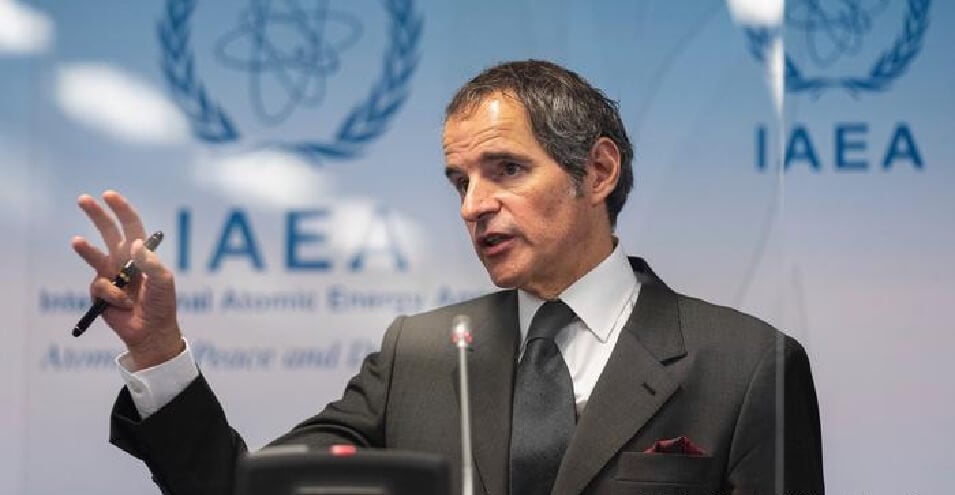
The director general of the International Atomic Energy Agency warned that restrictions Iran has imposed on inspectors have resulted in a “very blurry picture” of the country’s nuclear activities, as uranium enrichment appears to be at weapons production levels.
Rafael Mariano Grossi, director general of the International Atomic Energy Agency, in a detailed interview with the Associated Press, said that if the Islamic Republic of Iran wants to be “a respectable country in the international community,” it has no choice but to allow IAEA inspectors access to Iran’s nuclear activities.
Grossi, who traveled to Abu Dhabi, the capital of the United Arab Emirates, to visit that country’s first nuclear power plant, emphasized regarding Iran’s nuclear activities: “We must cooperate with each other. I will try to make them understand that we are their partners.”
Grossi’s emphasis that the International Atomic Energy Agency, based in Vienna, will continue to serve as an “inspector” for the world comes after the eighth round of Vienna talks aimed at returning to JCPOA commitments has reached an impasse.
Hours before these remarks by the IAEA director, the head of Iran’s Atomic Energy Organization emphasized that his country will not allow the agency access to sensitive centrifuges.
An incident occurred at the Karaj enrichment facility in June of this year, which according to Iranian officials was an act of sabotage. Tehran holds Israel responsible for this “sabotage.”
Since the United States, under former President Donald Trump, withdrew from the JCPOA agreement, a shadow war between Israel and the Islamic Republic of Iran has been escalating.
Since the Karaj facility incident, Iranian officials have blocked the agency’s access to the enrichment site, citing the replacement of broken cameras, and have suggested that hacking of the agency’s cameras may have enabled an attack on the facility.
Grossi said: “If the international community, through us, through the International Atomic Energy Agency, cannot clearly ascertain the number of centrifuges or the capacity they may have… the picture you get is very blurry.”
The IAEA director, regarding inspectors’ inability to monitor Iran’s enrichment levels and the importance of inspections, added that being unaware of the scale of uranium enrichment at the Karaj facility “gives you an imaginary picture of a real picture. But this picture is not real. This itself shows how important the issue is.”
Grossi rejected Iran’s claim that saboteurs used the agency’s cameras to attack the centrifuge site, calling it very “hollow.” He said Tehran has provided no evidence for its claim, and this has been one of the main points of friction between inspectors and Iran.
Following the United States’ withdrawal from the JCPOA in 2018, Iranian officials increased the concentration level of uranium enrichment with increasingly advanced centrifuges to 60 percent, and with several other technical steps will be capable of achieving 90 percent enrichment with the capacity to produce nuclear weapons. The use of advanced centrifuges has been in violation of JCPOA provisions.
Under the JCPOA, Iran is only permitted to enrich uranium to a concentration of 3.67 percent, which is sufficient for use in nuclear power plants.
Iran’s enriched uranium stockpile has been increasing day by day and has far exceeded the limits set in the JCPOA.
“We Are Dealing With a Different Iran”
Grossi clarified that he has no role in the Vienna talks, but Iran has made progress; therefore, the suspension of the JCPOA makes amendments to the original agreement necessary.
The IAEA director stated: “The reality is that we are dealing with a completely different Iran. 2022 is so different from 2015 that adaptive changes are necessary to include new realities, so that our inspectors can verify what countries agree to at the political table.”
While the Islamic Republic of Iran insists that the country’s nuclear program is for peaceful purposes, American intelligence and security agencies have informed the International Atomic Energy Agency that Iran has been systematically pursuing a nuclear weapons program since 2003, and this program continued for years.
Grossi told the Associated Press reporter about the objectives of Iran’s nuclear program: “There is no country in the world that reaches this level of uranium concentration unless it wants to produce nuclear weapons.”
Grossi added: “I have said many times that this does not mean Iran possesses nuclear weapons. But this level of enrichment requires extensive verification efforts.”
The Associated Press writes that Iran’s mission to the United Nations did not respond quickly to this news agency’s request for a position on the IAEA director’s remarks.
However, in Vienna, there is increasing severe concern among European countries participating in the Vienna talks.
Three European countries—Britain, Germany, and France—participating in the eighth round of JCPOA nuclear talks in Vienna announced on Monday, December 13, that “Iran’s positions in the Vienna talks are inconsistent with or go beyond the JCPOA, and this causes us to waste valuable time.”
These diplomats said: “We have interacted for hours and all delegations have pressured Iran to act reasonably. But so far we have not been able to reach actual negotiations.”
Ali Bagheri wrote on Tuesday, December 14, in a tweet about ongoing negotiations in Vienna between Iran and the P4+1 group (Germany, France, Britain, China, and Russia): “Some actors insist on their habit of blame-shifting instead of genuine diplomacy. We quickly presented our proposals and tried in a constructive and flexible manner to reduce differences.”
Bagheri, emphasizing that diplomacy is a two-way street, wrote that if there is a will to make up for the culprit’s error, the way to a good agreement will quickly be paved.
Source: DW