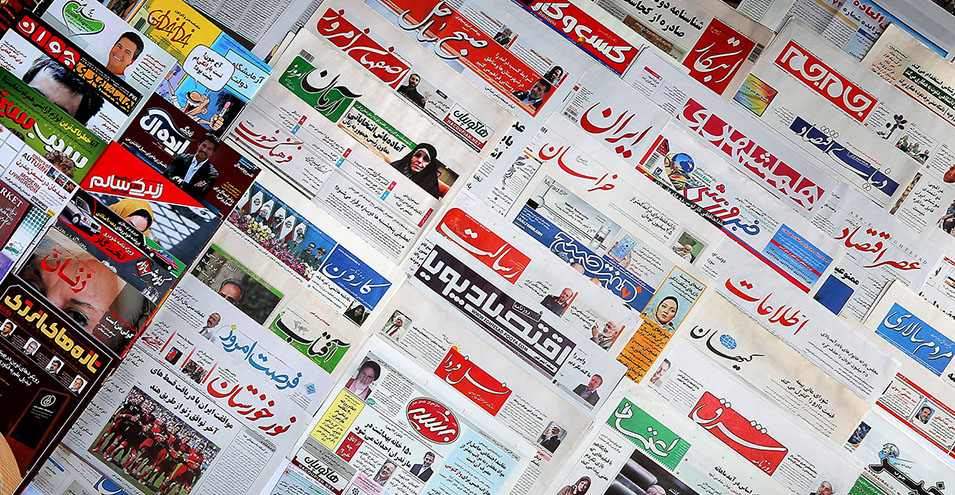
Three journalists working at Tehran newspapers confirmed in conversation with the International Campaign for Human Rights in Iran that they have been contacted by the Ministry of Intelligence in recent days and invited to meetings with officials from this ministry. One of these journalists explained these contacts: “I received calls two to three times a day from unknown numbers on my mobile phone. Eventually, after three days I answered, and a man who introduced himself as a colleague from the Ministry of Intelligence asked to have a ‘friendly’ meeting with me at Laleh Hotel restaurant in Tehran.” This female journalist, noting that the conversation focused on not crossing red lines, said the official told her: “Don’t be deceived again, no one will do anything for you, your place is not in prison, don’t think anything special has happened with the change in parliament composition in favor of reformists, you are under surveillance, you may not be arrested now but your writings will be recorded in your file.”
Another political reporter also told the campaign: “It’s strange to me that the Ministry of Intelligence under Rouhani’s government has summoned us and said don’t think that anything has changed with government and parliament being aligned, be careful with your activities. Why should you be a wedding and mourning bird? Who has ever done anything for you?” This reporter said he raised this concern with the official he met at Tehran Hotel and received this response: “The structure of the Ministry of Intelligence has nothing to do with its minister, the structure has been the same in all periods, the red lines are fixed.” This journalist also said most meetings with journalists he knows took place at Laleh Hotel and Tehran Hotel, while some were summoned to the Ministry of Intelligence’s follow-up office at Vali Asr Square.
This male journalist said: “I was also asked about four journalists who were arrested in November, they asked if I know them, which ones did I work with, and they said see, no one can do anything for them.”
His reference is to four journalists who were arrested last November. Isa Saharkhiz, journalist and political activist; Ehsan Mazandarani, journalist and editor-in-chief of Farhekhteagan newspaper; Afarin Chitsaz, columnist for Iran newspaper; and Saman Safarzaei, international editor of Andishe Pouya publication—all of whom except Mr. Saharkhiz have been tried and faced heavy sentences. In addition to these journalists, Davoud Asadi, brother of Hushang Asadi, a journalist residing in France, was also detained. Mahmoud Alizadeh Tabatabai, lawyer defending Ehsan Mazandarani and Davoud Asadi, told the International Campaign for Human Rights in Iran on the seventh of Ordibehesht that the revolutionary court sentenced journalist and editor Ehsan Mazandarani to 7 years, journalist Saman Safarzaei, international editor of Andishe Pouya to 7 years, Iran newspaper columnist Afarin Chitsaz to 10 years, and Davoud Asadi, brother of Hushang Asadi, one of RozOnline website managers, to 5 years imprisonment.
Maryam Azadpour, mother of Afarin Chitsaz, on the eleventh of Ordibehesht, in conversation with the campaign, noting that her daughter was harassed during interrogations, said: “While my daughter’s eyes were blindfolded, they hit her with a water bottle to make her confess. But this abuse was not from her main interrogator. The main interrogator treated her and us very respectfully. We will follow up on these behaviors by raising them with her judge.” Afarin Chitsaz’s mother, stating that her daughter’s condition is not good, said: “Afarin is very depressed and sick. She spent six months in a two-meter by 1.75-meter solitary cell where she had only two brief half-hour periods a day for air in the yard, surrounded only by walls. During these entire six months she wore only the same clothes she was arrested in. They didn’t even allow us to give her another set of clothes. Of course, she has now moved to the general ward which is much better compared to before. Besides her psychological turmoil, Afarin has severe kidney pain and heart palpitations. She’s been to prison medical several times but they only gave her painkillers.”
Journalist Hushang Asadi also spoke to the campaign on the eighth of Ordibehesht about his brother’s condition: “He was transferred to ward eight of Evin prison last week but before that he was in solitary confinement in block 2-A of Revolutionary Guards in Evin. I’ve heard that Davoud mostly stays in a corner of the ward and is even afraid of talking to other people. This young man who never had any social and political activity in his life has been kept in solitary confinement for months and is now so depressed and frightened that he refuses to communicate with others. This is the most blatant violation of human rights, this is the worst treatment to arrest someone who is not a political activist and punish him just to advance your goals.”
Aliazadeh Tabatabai, lawyer for Davoud Asadi, explained on the seventh of Ordibehesht to the International Campaign for Human Rights in Iran the charges against his client, saying he was charged with conspiracy against national security due to financial transactions between him and his brother. Mr. Tabatabai said his client stated in his defense at court that he was unaware of what purpose the money his brother was sending was for.
Hushang Asadi said in this regard that the amount sent to his brother was related to medical expenses for their elderly father: “Our account was not secret and we didn’t do anything covert. If according to the security apparatus this money was spent for other purposes, its documentation would show that. Since they themselves would have given it, this charge is completely false. I feel that by arresting my brother, they wanted to show me and other political activists outside the country that they can harass our family members instead of us.”
According to ILNA news agency, coinciding with “World Press Freedom Day” (14 Ordibehesht), 230 Iranian journalists sent an open letter to Hassan Rouhani, president of the Islamic Republic, calling for attention to and investigation of the situation of these detained journalists. The letter stated: “After more than 6 months, a total of 27 years in sentences was issued in primary court for 4 of our colleagues headed by Judge Moghisseh and another one of our colleagues has been hospitalized in Tehran Heart Hospital for more than two months fighting for his life.”
Less than a month after the detention of these people, Ahmad Khatemei, a member of the Assembly of Experts, claimed on Monday, the ninth of Azar that these journalists had made confessions and spoke of the charge of “complicity with America.” In his speech he claimed: “Recently journalists arrested for complicity with America, in their confessions mentioned they would take articles, pay money for them, then manipulate the article and place it at the disposal of American newspapers.”
Despite the silence of the judiciary on this case, Tasnim news agency affiliated with the Revolutionary Guards on Monday, the twelfth of Bahman, described the charges against detained journalists as “cooperation with hostile Western states.” Security-affiliated media like Fars had previously claimed that these journalists “were arrested among agents related to the enemy infiltration project in the country who were active in the press.” Ali Shirazi, representative of Supreme Leader Ayatollah Ali Khamenei in the Quds Force of the Revolutionary Guards, on the twelfth of Bahman, said: “Soon confession films of individuals arrested in the infiltration plan will be broadcast from national media and the Iranian people will see the behind-the-scenes infiltration of the enemy.”