On the Occasion of the International Day Against Capital Punishment; Annual Report on Executions in Iran
On the occasion of October 10, the International Day Against the Death Penalty, and through the efforts of the Iranian Human Rights Activists Organization, an annual report on executions is prepared and published each year to draw public attention to the situation of thousands of people currently awaiting execution of their death sentences,
According to the present report, during the period from October 10, 2016 to early October 2017, at least 508 people were executed by hanging in various parts of Iran. This figure not only shows no decrease compared to the same period last year, but has increased by at least approximately 1%. The issuance and execution of death sentences against citizens in Iran occurs while many defendants are deprived of access to a fair judicial process. It should also be noted that due to the prohibition of independent human rights advocacy groups from operating in Iran, the present report cannot be considered free of limitations.
The primary source of this report consists of reports prepared by the news agency of the Iranian Human Rights Activists Organization (IRANA) and other independent and credible sources. Another section of these reports includes news texts or statements that judicial authorities have officially made to state media regarding the issuance and execution of death sentences for citizens.
From October 10, 2016 to early October 2017, a total of 381 reports regarding executions were documented by the statistics and publication body of the Iranian Human Rights Activists Organization, including the sentencing of at least 223 people to death and the execution of at least 508 people. Of this number, 32 people were executed in public. Among victims whose identity has been confirmed, 6 of those executed were women, and 6 of those executed were under 18 years old at the time of committing the crime.
The execution of defendants under 18 years old occurs in cases where, in addition to the absence of valid evidence against the defendant, the court has sentenced them to death without regard to their physical condition and age.
During the aforementioned period, 7 child offenders were also sentenced to death. These convicts claim that in most cases they have been forced to confess under severe psychological pressure and torture.
The execution of death sentences during the examined period showed no decrease compared to the same period last year and even increased by approximately 1%. This increase in executions occurs while the issuance of death sentences has been accompanied by a 62% decrease. The number of public executions has decreased by 5% compared to the previous similar period, and executions of women show a 33% decrease.
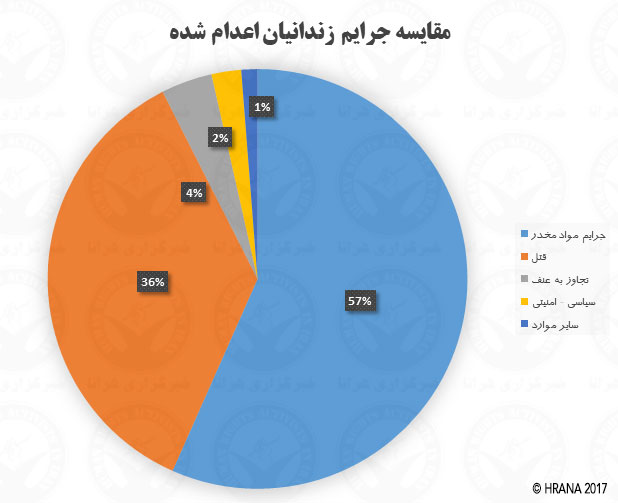
According to this report, 57% of those executed were executed on charges related to drug offenses in Iran, 36% on charges of murder, 4% on charges of sexual assault, 2% on political or security charges, and 1% includes other cases.
The increasing statistics of executions for drug crimes occur while the Iranian parliament has passed an amendment that makes the legal conditions for issuing death penalties in connection with drug crimes more restrictive, which could result in reducing the death sentences for thousands of prisoners. However, for it to become law, it requires approval by the Guardian Council.
As mentioned, despite all efforts and pressures, there is no comprehensive and accurate count of executions carried out, to the extent that one of the parliament representatives recently announced that the judiciary does not provide us with statistics on executions for drug crimes.
The chart below shows the ratio of crimes among executed prisoners, indicating that the rate of those executed for drug crimes is more than double other crimes.
Alborz Province, with three densely populated and important prisons in the country, which are primarily dedicated to holding defendants charged with violent crimes, with at least 127 executions during the aforementioned period, many of which were carried out in groups, is the leading province in the execution of death sentences.
Likewise, the largest number of executions in prisons has also been carried out in Alborz Province and in Rajai Shahr Prison in Karaj. During the aforementioned period, 73 people were executed in Rajai Shahr Prison in Karaj. Most of these executions were carried out in groups.
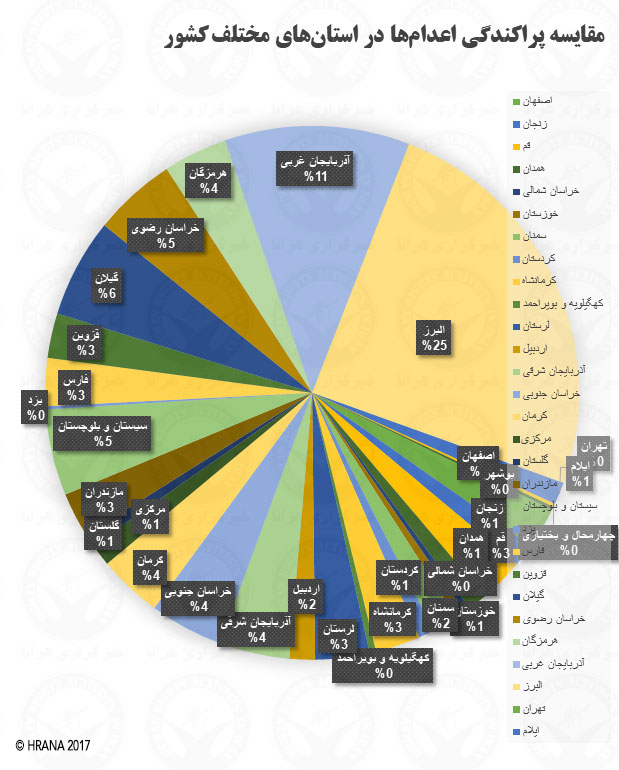
In the pie chart below, the execution of death sentences in different provinces of the country is examined. Accordingly, Alborz Province ranks first with 25%, while West Azerbaijan Province and Gilan Province rank second and third with 11% and 6%, respectively.
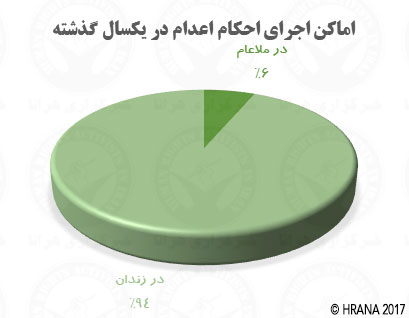
Based on the statistics presented, 6% of executions were carried out in public and under the eyes of the public.
The provinces with the highest number of public executions are: Hormozgan Province with 7 public executions ranking first, and Razavi Khorasan Province with 5 public executions ranking second.
Also, the largest number of executions on a single day corresponds to December 15, 2016 (25th of Dey 1395), when 18 people were executed in one day.
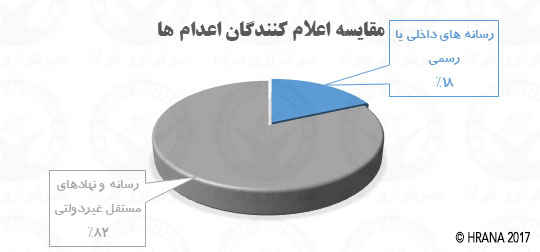
In this chart, which has a direct relationship with secret executions of prisoners, executions reported by independent and human rights sources are examined. According to this chart, 82% of those executed were executed secretly or without announcement in mass media.
Source: IRANA