Persian-Language Christian Media Listed on Official Registry of Islamic Republic’s Enemies
In its latest crackdown expansion, the Islamic Republic has placed the names of several Persian-language Christian media outlets on the official list of “hostile media” and warned that any collaboration, submission of news, photos, or videos to these outlets may result in legal prosecution and punishment. This decision adds Christian media to the government’s security targets and expands its scope of action against critics and independent movements far beyond previous levels.
In its latest move to close the final channels of free media, the Islamic Republic has placed the names of several Persian-language outlets, including a number of Christian networks, on the official list of “hostile media” and warned that any collaboration, submission of news, photos, or videos to these outlets may be accompanied by legal prosecution and severe penalties. This action, carried out simultaneously with intensified internal repression and pressure on opponents abroad, demonstrates that the government has extended the scope of its security measures beyond political activists and now designates religious and Christian media as part of the “enemy.”
According to this report, the Islamic Republic’s Ministry of Intelligence, by issuing a directive to the Prosecutor General, has advanced the implementation of Article 4, Note, of the law “Increasing Penalties for Espionage and Cooperation with the Zionist Regime and Hostile States Against National Security and Interests” to a new phase.
The text of this circular, published on Tir 21 in the official gazette and the national legal information database, released an official list of media outlets, networks, virtual pages, and individuals that the government deems “hostile,” establishing the basis for legal action against any cooperation with them.
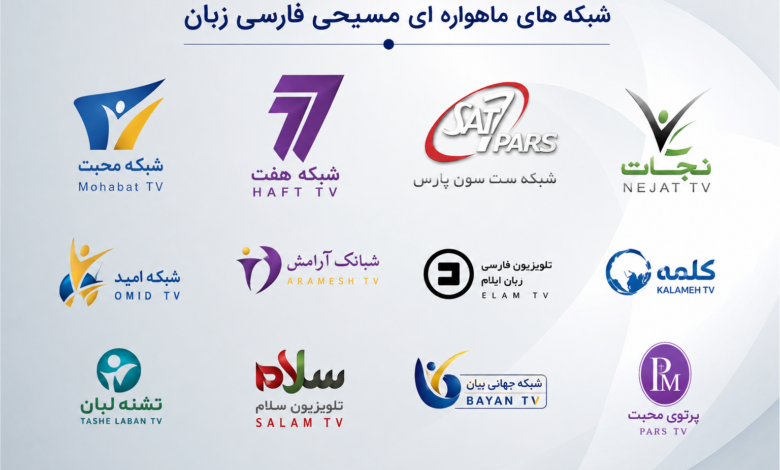
Among the 44 media outlets and networks listed, the names of several recognized Persian-language Christian media outlets are visible, including “Mahabbat Network,” “Sun (Seven) Network,” “Set Sun,” and “Salvation”—outlets that in recent years have become one of the few means for many Persian-speaking Christians inside Iran to access biblical teachings, worship programs, and connection with the Christian community, particularly after the widespread closure of Persian-language churches.
According to this circular, professional cooperation with these outlets is not the only target; sending photos, films, information, or any type of content to the designated media and pages may also, if legal conditions are met, be subject to legal prosecution. This directive effectively expands the scope of criminalization to ordinary citizens and places independent media space under greater pressure than before.
This decision has been made at a time when the Islamic Republic has noticeably intensified its control over information flow in recent months. Previously, the Ministry of Intelligence and the judiciary, through issuing statements and sending warning text messages to citizens, had announced that membership in channels or pages of media deemed “hostile” or sending any content to them, particularly during wartime conditions, could be considered a crime and subject to severe punishment.
The listing of Christian media alongside opposition political media, in the view of many observers, demonstrates the continuation of the Islamic Republic’s long-standing policy of securitizing independent religious activities. International reports have repeatedly emphasized in recent years that the Iranian government, particularly toward converted Christian citizens and house churches, takes measures based on security allegations, linking evangelical activities or organizing Christian gatherings to “actions against national security” or cooperation with “hostile” countries.
This process is effectively a continuation of the same policy that over the past four decades has resulted in the closure of most Persian-language churches, the arrest of Christians, raids on house churches, and the restriction of Christian organizations’ activities inside Iran. In such an environment, Persian-language Christian media outlets outside the country have filled part of the vacuum created by providing educational programs, sermons, biblical studies, and Christian hymns for audiences inside Iran.
Critics of this action believe that the publication of such a list is not merely an administrative or legal measure, but rather part of the Islamic Republic’s broader strategy to extend repression beyond Iran’s borders—a strategy aimed not only at political opponents but also at independent media, civil activists, and even religious media, placing them within the circle of security threats and making any citizen contact with them costly. From this perspective, by formalizing this list, the government is expanding its scope of action against any independent voice that challenges the Islamic Republic’s official narrative.