Press Freedom in 2019: Norway Best, Iran Near Bottom of Rankings
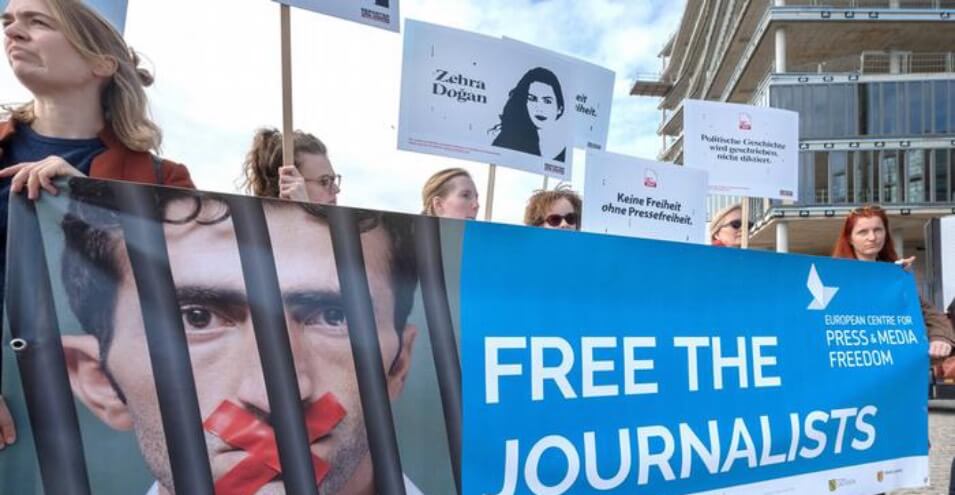
Norway ranked first for the fourth consecutive year in Reporters Without Borders’ 2019 press freedom index. North Korea, Eritrea, and China occupy the bottom three positions. Iran ranks 173rd among 180 countries.
Reporters Without Borders released its annual press freedom report for 2019. In this report, Norway ranks first among 180 countries with the freest press for the fourth consecutive year. Finland and Denmark follow Norway in second and third places.
At the bottom of the 2019 media freedom rankings is North Korea. The country has swapped positions with Turkmenistan; in 2018 Turkmenistan was last and North Korea was second-to-last, but in 2019 Turkmenistan’s situation has improved slightly, placing it at rank 179, while North Korea has fallen one position.
Iran has dropped three places compared to last year, falling from rank 170 to 173. Saudi Arabia, however, ranks 170th this year—three places above Iran. Iran’s press freedom situation is worse than all its neighbors; Iraq, Turkey, Afghanistan, Pakistan, and even the Republic of Azerbaijan have better conditions than Iran.
Eritrea and China rank 178th and 177th respectively.
The report was compiled based on questionnaires as well as the number of attacks on media outlets and media professionals.
Middle East and North Africa; Worst Conditions
According to Reporters Without Borders’ data, the situation for media in Asia has demonstrably worsened. North Africa and the Middle East have the worst media freedom conditions worldwide.
Journalists in war-torn countries in this region such as Syria and Yemen constantly face mortal danger. In countries like Iran, Saudi Arabia, and Iraq, censorship, arbitrary detention, and persecution and torture of journalists continue and have become routine. The situation in Algeria is also increasingly negative overall.
Turkey and Russia rank among the countries in the bottom third of the index. Russia, which widely suppresses critical reporting, ranks 149th, while Turkey has risen three places to rank 154th but remains one of the world’s largest jailers of journalists.
Coronavirus and Concentrated Authoritarian Crackdowns Against Media
Reporters Without Borders stated in its report that dictatorial, authoritarian, and populist governments continue in increasing efforts to suppress free and independent information flow at any cost.
The most prominent examples are the governments of China, Saudi Arabia, and Egypt; countries that have the largest numbers of imprisoned journalists and media professionals worldwide who have been arrested solely for their profession.
China in particular is making considerable efforts to establish a “new world order for media.” According to Reporters Without Borders, the effects of China’s nearly total and comprehensive control over news distribution during the coronavirus pandemic have been evident worldwide.
In other countries as well, press freedom has been openly suppressed in recent months. A spokesperson for Reporters Without Borders states that the coronavirus pandemic has acted like a magnifying glass, concentrating all authoritarian tendencies against press and media worldwide at a single point.
Nevertheless, Reporters Without Borders emphasized that the questionnaires were sent before the coronavirus outbreak, and therefore the results obtained from them do not directly explain the coronavirus or its impact on press freedom.
Germany’s Two-Place Rise
In the 2019 press freedom rankings, Germany advanced two positions compared to 2018, moving from rank 13 to rank 11. According to statistics from Reporters Without Borders, which has been regularly published since 2013, the number of attacks against journalists in Germany has noticeably decreased.
The reason for this decrease is that in 2019, populist groups held no violent demonstrations in which journalists were attacked, unlike 2018 when severe attacks against journalists occurred in just two cities, Chemnitz and Köthen.
The number of such attacks in Germany in 2019 was 13, whereas in 2018, 22 attacks against journalists and reporters were recorded in Germany.
Combating Fake News as a Pretext
In its latest annual rankings report on press freedom worldwide, Reporters Without Borders warned that many countries have restricted media freedom under the pretext of combating fake news.
The independent organization cited Singapore and the African country of Benin as examples.
In other countries such as Russia, the Philippines, and Vietnam, groups called “trolls”—which reporters refer to as “troll armies”—are employed by governments to spread false information and thereby divert public opinion and discredit critical media. These trolls are most heavily employed by the governments of three countries: Iran, China, and Russia.
In the United States and Brazil as well, presidents elected through democratic processes are engaged in hostility and spreading hatred.
According to Reporters Without Borders, in 2019 distrust of news media in many parts of the world has been incited by populist groups to turn into violence against journalists.
Even in countries such as Spain, Italy, and Greece, nationalists and far-right extremists have not hesitated to use violence and direct threats against journalists.
Reporters Without Borders also warned that revenue from sales and advertising has decreased significantly while production costs have risen. This has caused newsrooms to shrink continuously and media conglomerates to grow larger.
Reporters Without Borders concluded that anyone who wants to have free access to credible and reliable information must strive to provide better conditions for research and reporting by journalists during these difficult times.
Source: DW