Protests in Iran; Arrest and Transfer of Thousands of Protesters to Unknown Locations
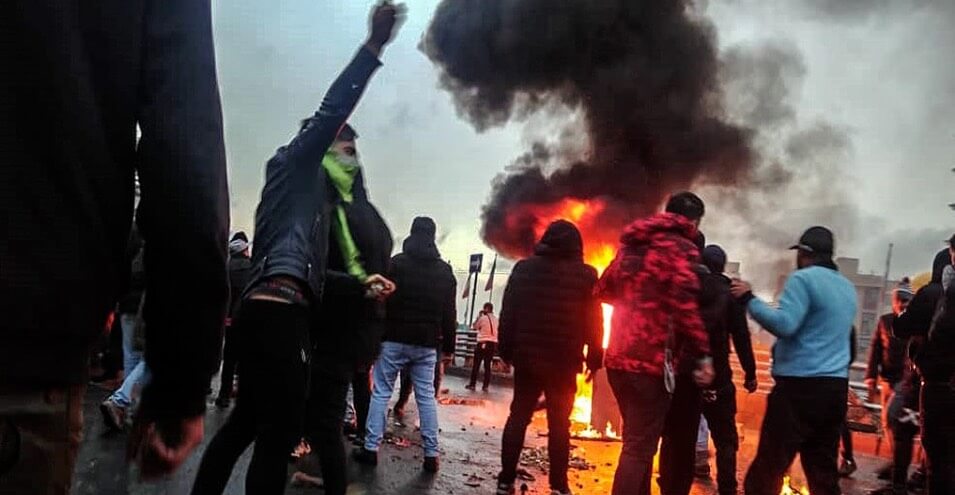
Judicial authorities have refrained from providing information about the status and detention locations of thousands of protesters arrested over the past week during demonstrations against the sudden increase in gasoline prices in various Iranian cities, and therefore there is no precise data on the number of those arrested and their detention locations.
Nevertheless, investigations by the Human Rights Campaign based on information released by authorities and official media, as well as informed sources in various cities, indicate that arrests carried out across the country amount to at least four thousand people, and given the lack of transparency and widespread street arrests that have been impossible to monitor, the actual number of detainees far exceeds this figure.
An informed source regarding the transfer of some detainees to Evin Prison told the Human Rights Campaign in Iran that “many people in wards related to the Ministry of Intelligence and the Islamic Revolutionary Guards have been suddenly transferred to general wards without prior planning to make room for new detainees.”
Protests in various Iranian cities, which began on Friday in response to the sudden increase in gasoline prices, continued in the following days while internet access in the country was cut off and information about arrests became difficult to obtain. However, based on statistics presented by security and government media outlets in Iran from various cities.
Islamic Republic officials have attributed the protest demonstrations in various parts of Iran to foreign countries and call the protesters rioters and troublemakers.
An informed source in Tabriz told the Human Rights Campaign in Iran that detainees are held in the intelligence detention center of the city, and on Thursday, November 20, when the families of the detainees visited Tabriz Prison and the intelligence detention center, they were told that judicial authorities would inform them whenever necessary.
According to an informed source in Shiraz, the quarantine section of Adel Abad Prison is where detainees from recent protests in the city are held. He told the Campaign that to date there have been no contacts from the detainees with their families and practically everyone is in complete ignorance. This situation exists in other cities as well, and according to Campaign sources, no response has yet been given to the families of detainees regarding the detention location, charges, and detention conditions of the detainees.
Concerns about the condition of detainees escalated after Kayhan newspaper, with editor-in-chief Hossein Shariatmadari, threatened the detainees with execution on Monday, November 17, writing that “judicial authorities consider the death penalty by noose to be definitive for the leaders of the recent riots. It has been stated that the crime of rioters is an example of baghi (apostasy/rebellion) and the legal and religious punishment for them is execution.”
Broadcasting of Confessions Only Days After Arrest
While the status and detention location of the arrested persons remain unclear and official authorities have not yet provided any explanation in this regard, Islamic Republic Radio and Television broadcast the “confession” of one of the detainees on Wednesday, November 19 at 8:30 PM news. “Fatema Davand,” a Kurdish citizen from Boukan in West Azerbaijan, whose confession was broadcast by state media claiming she was one of the main instigators of protests in Boukan and was arrested in one of the border cities while trying to flee the country.
Isfahan State Radio and Television also broadcast the “confessions” of three detainees under the title “Arrest of Perpetrators of Isfahan Riots” and claimed they attacked people with axes and engaged in destruction of public places. “Confessions” of several detainees in Shiraz have also been broadcast by state media.
These “confessions” were broadcast by state media while parliament representatives have presented a bill titled “Prohibition of Recording and Broadcasting of Confessions from State Media,” which according to it, “recording of confessions and their broadcasting from Islamic Republic Radio and Television and other mass media at any stage of prosecution and preliminary investigations is prohibited, and the perpetrators, whether producers or broadcasters, in addition to the obligation to restore the defendant’s reputation, shall be sentenced to imprisonment from 6 months to 3 years.”
The Islamic Republic of Iran Broadcasting Organization violates the rights of detainees, especially arrested protesters and political activists, in violation of Iranian laws and international laws that guarantee due process, prohibition of coercion, and prevention of torture. Detainees are often forced under torture or threats to themselves or their relatives to “confess” to crimes, and state media films these forced confessions and usually broadcasts them from its television networks for the purpose of intimidation and defamation of individuals. These “confessions” are part of a deliberate effort to discredit and defame protesters, human rights defenders, and activists. State media works hand-in-hand with interrogators and security, intelligence, and judicial officials to conduct, film, and broadcast these false confessions that are continuously documented by victims and numerous witnesses. These forced confessions then become primary evidence that is usually presented in courts to convict targeted individuals, generally for various crimes.
Arrest of Students in Tehran
On Wednesday, November 19, the Telegram channel of student unions across the country reported the entry of several ambulances carrying plainclothes forces into Tehran University at midnight on Monday, November 17, and wrote that the plainclothes officers arrested several students and put them in ambulances, and also arrested a number of students outside the university. According to this report, some of these students were transferred to Fashafouyeh Prison and some to Evin Prison. The number of arrests only on Monday evening at Tehran University was stated as “40 to 50 people” and security agencies have made threatening contacts over the past three days with many students and their families that if they are seen on campus they will be arrested. Also, personal homes of some students have been visited for arrest.
Yashar Darashshafa, a student of health and social welfare at the University of Social Welfare and Rehabilitation Sciences, is among those arrested, who was arrested on Thursday, November 21. His relatives said that his physical condition is not good, he has severe back and leg pain, and security forces beat him with batons on the way to prison.
Hassan Khalifaei, Kamiar Zouqi, Ali Nanoaei, Malika Gharagozlu, Marjan Ishaghi, Molieha Jaafari, Maryam Jaafari, Nadia Ghoulami, Amir Forsooti, Narges Bagheri, and Saha Mortazavi are among the arrested students. Mohammad Amin Hosseini, one of the arrested students, was released on Thursday, November 21.
While Gholamreza Ghaffari, Deputy Minister of Culture and Higher Education, and Mahmoud Nili Ahmadabadi, President of Tehran University, announced they have no statistics on arrested students, Ismail Soleimani, Head of Tehran University Security, claimed that “the number of arrested students has been small and arrests have only occurred at Tehran University and Allameh which are exaggerated in terms of these arrest figures.”
Sepideh Ghilian, a labor activist, remains in detention, and in Tabriz, Dawood and Ayoub Shiri, as well as Rouzbeh and Yashar Peiri, four civil activists in the city were arrested on Sunday, November 16.
Official Statistics
Although judicial and security authorities have refrained from presenting official and precise statistics on arrests and speak in interviews of arrests of a number of protesters, based on statistics presented by security and government media outlets in Iran from various cities. What is noteworthy about those arrested is that officials at various levels of the Islamic Republic, as well as security media, have referred to them as “rioters” and military and security officials in various cities claim that most of those arrested are non-residents. Fars News Agency has gone further and reported the arrest of a number of “foreign nationals” in Tehran and claimed they “are citizens of one of the eastern neighboring countries and had engaged in destruction and burning of five banks.”
Ahmad Nurian, spokesman for the police force, reported the “identification and arrest of a significant number” of protesters as “criminals and riotous elements,” and only by Monday, November 17, Fars News Agency reported the arrest of about a thousand people. However, in the following days, Mohammad Mousavi, the police commander of Gachsaran, announced the arrest of 150 people in this city by Wednesday, November 19.
Nourallah Taheri, Governor of Shahriyar, stated the number of those arrested in this city as 80 people and claimed that “the majority of those arrested were non-residents of Shahriyar.”
Gholamreza Shariati, Governor of Khuzestan, stated the number of those arrested in the province during the first three days of protests – Saturday, Sunday, and Monday – as 180 people, and Karim Dihimi, a human rights activist and Arab civil activist, in an interview with the Human Rights Campaign in Iran, stated the number of those arrested in Khuzestan by Wednesday, November 19 as more than 400 people.
Farsi Corps Intelligence reported arrests in Fars Province as 100 “opposition group leaders” and Alborz Corps Intelligence reported arrests as 150 and “security disturbers.” According to claims by security media, some of the detainees in Alborz Province hold dual citizenship from Germany, Turkey, and Afghanistan.
According to official statistics from the same media, 34 people in Rabat Karim, 30 people in Boomehen and Pardis, 29 people in Birjand according to Ibrahim Hamidi, Chief Justice of South Khorasan Province, 5 people in Islam Abad West, 30 people in Zanjan as announced by Ismail Sadoghi Niaraki, Chief Justice of Zanjan Province, 25 people in Islam Shahr according to Masoud Morsalpur, Governor of the city, 40 people in Yazd, whom Mohammad Hadadzadeh, Prosecutor of the city, called non-residents, 30 people in Tabriz, whom Mohammad Reza Pourmohammadi, Governor of East Azerbaijan, called non-residents, 35 people in Baharestan, 3 people in Rudehen that according to Alireza Taghian, head of the judicial district of the city, a summons has been issued for 25 other people. The manager of a Telegram channel with 23 thousand followers in Babol has been arrested.
In Javanrood, according to Kurdistan News Agency Kurdpa, three brothers named “Makvan, Loghman, and Arkan Soleimani” in Javanrood and Loghman Khurab, along with 15 other protesters in Marivan, have been arrested.
A local informed source told the Campaign that more than 20 people have been arrested in Javanrood and 42 in Marivan, 112 in Boukan, 51 in Sanandaj, and 39 in Kermanshah by Wednesday, November 19. This source told the Campaign that there are no precise statistics on arrests in Kurdistan and Kermanshah provinces and the number of those arrested is far higher than what has been announced so far, because on one hand, some families, due to security pressures, have not yet confirmed the arrest of family members, and on the other hand, due to internet cutoff and phone tapping, practically many communication channels are closed and there is no way to obtain information.
No statistics have been provided by judicial and security officials in Tehran, and Fars News Agency on Thursday, November 21 claimed that one of the people who closed the Imam Ali Highway in Tehran during recent protests was a “retired diplomat at Iran’s Embassy in Denmark” who was arrested and “from the search of his home, a belt weapon and related ammunition, spy camera, and some electronic equipment were found.”
A journalist in Tehran who witnessed widespread arrests in the city told the Campaign: “In the Sadiqieh area of Tehran, I witnessed the arrest of protesting people, they were hitting people on the head with batons and while beating them, they were taking them with them. I witnessed the arrest of at least 10 to 15 people within ten minutes, which shows that the number of arrests is very high. Now the concerns are about the condition of these detainees, as neither their identity, nor detention location, nor anything else about them is clear, and with the experience of December 2017 protests where several detainees died in prison or died suspiciously, and also the experience of Kahrizak in 1999, I think human rights organizations and international organizations should quickly follow up on the status of detainees. Here practically nothing can be done by anyone and it is not even clear what the outcome of the protests will be given the severity of suppression and violence.”
In the December 2017 protests, according to official statistics announced by the government, 25 people died.
Source: Human Rights Campaign