Recent Rainfall Flooded 16 Iranian Provinces; Damages from Farvardin Floods Still Persist
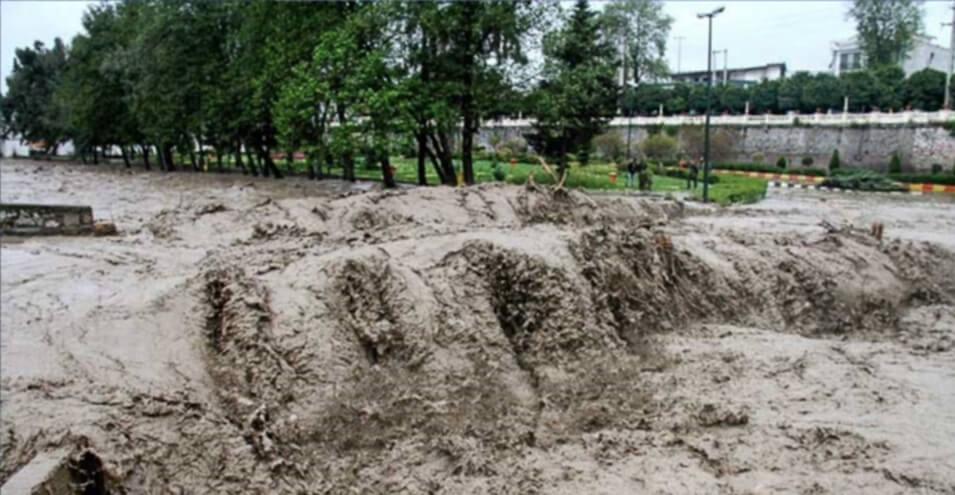
Following recent rainfall in various Iranian cities, the head of the Red Crescent Organization’s Relief and Rescue Service announced the occurrence of flooding and inundation in 16 provinces across the country. Reports indicate that flood-affected provinces from Farvardin month have not yet been reconstructed.
Morteza Salimi, head of the Relief and Rescue Organization, announced on Tuesday, November 7, that since the beginning of Aban month to date, 16 Iranian provinces including West Azerbaijan, Alborz, Isfahan, Bushehr, Tehran, Chaharmahal and Bakhtiari, South Khorasan, Zanjan, Semnan, Kurdistan, Kermanshah, Qazvin, Qom, Lorestan, Markazi, and Hamadan have been affected by flooding.
Reports indicate that due to rainfall overnight and throughout the day and rising water levels in rivers, the connection to the villages of Ban Lar and Ziudar in Mu’amlah district in Lorestan province was cut off, though Lorestan road authorities say that “traffic routes are currently restored.”
Additionally, images published on social media networks show flooding occurring in some cities of Lorestan province.
HamidReza Kazemi, representative of the people of Poldokhtar—a city that faced devastating flooding in Farvardin month—also said that “recent days of rainfall have caused damage to rural roads and bridges that were damaged in the previous flood and have not yet been fully reconstructed, and in some cases destroyed them.”
However, Gholamreza Agamirza’i, the general director of crisis management at Lorestan governorate, said on November 6 that “currently there is no budget allocated for paying compensation for damages from new and future floods.”
Autumnal rainfall has caused concern about a recurrence of the Farvardin month floods, while according to the national flood report of Esfand 97 and Farvardin 98, a total of 25 Iranian provinces including 200 cities and 4,304 villages were affected by flooding and river overflow, and more than 60,000 urban and rural units were destroyed.
In these devastating floods, more than 75,000 urban and rural residential units were damaged, and currently many affected areas have not been fully reconstructed.
In this regard, Saeed Taheri, secretary of the council of banks of Khuzestan province, despite promises made to flood victims on June 5, said that “given the absence of necessary mechanisms in this regard, the continuation of loan disbursement to flood victims has been postponed to after the issuance of special instructions and contracts.”
The Farvardin month flooding resulted in at least 76 deaths in Iran.
Environmental crises in Iran have long attracted the attention of the international community. United States officials have also repeatedly warned about Iran’s mismanagement of natural resources, widespread deforestation, and unnecessary and unplanned dam construction aimed at filling the pockets of corrupt officials of the Islamic Republic regime, and have identified it as one of the main factors in the emergence of various environmental crises, including devastating floods and unprecedented droughts.
For example, recently Brian Hook, the special US representative on Iran affairs, noting that 600 dams have been built “without any environmental assessment” after the revolution in Iran, announced that the Islamic Republic regime has squandered the country’s water resources through mismanagement over the past forty years.
Source: Voice of America