Researchers Close to Finding Location of Jesus Christ’s ‘Last Supper’
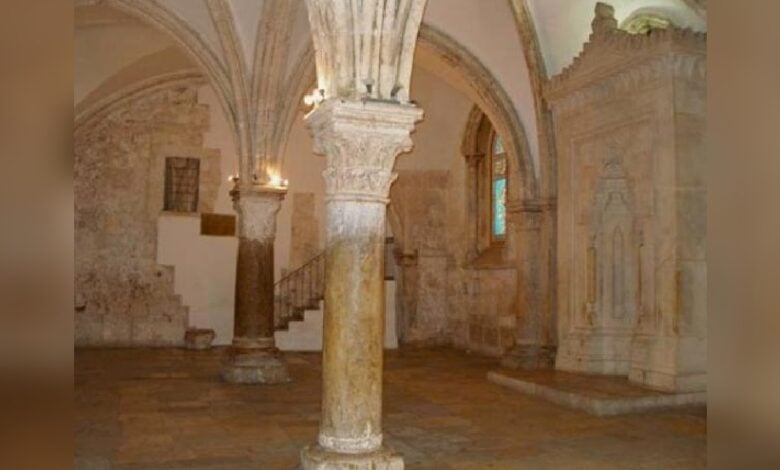
Searches and evidence by researchers indicate getting closer to the location of Jesus Christ’s “Last Supper.”
Biblical archaeologists had long ago begun their great historical search to find a room in Jerusalem where Jesus Christ held his “Last Supper” with his disciples, but since their excavations did not yield evidence that could answer their questions, researchers were forced to resort to other methods to find clues, as this place holds profound significance for the Christian community and archaeologists.
The Last Supper event, following which Jesus Christ was present with his disciples in this place for the last time before his arrest and crucifixion, sharing wine and bread with his disciples, is very well known to Christians and the entire world. For this reason, archaeologists and researchers have devoted their time to searching for this location and believe they have come closer to finding it than ever before.
They have focused on an ancient two-story structure located on Mount Zion and outside the walls of the old city of Jerusalem. The aforementioned building, which in the past has been claimed to be both the tomb of David and the location of the Last Supper ceremony, has a lower level that forms the earlier level and an upper room, also known as the “Cenacle” in Latin or “dining hall.”
Many Christians, in the fourth century AD, began to visit this two-story building with limestone walls and a red roof, and for various reasons became convinced that the upper room or Cenacle in this building was the place where Jesus Christ held the Last Supper ceremony with his apostles.
According to descriptions in the Gospel of Luke about this place, there are consistencies with a house located on Mount Zion; however, searches to prove that the Cenacle on Mount Zion was the location of the Last Supper have been hampered by restrictions on archaeological excavations at this cultural and historical site, creating difficulties for researchers.
Excavations planned for this site could prove whether the deepest foundation of the structure actually dates back to the time of Jesus Christ. Also, despite significant limitations, an analysis conducted in 2017 by religious researcher David Christian Claussen from the University of North Carolina at Charlotte presented evidence linking the Cenacle to the Last Supper.
In his research, Claussen analyzed a map of Jerusalem that was drawn in 560 AD. The map, which was discovered in 1884 by Greek Orthodox Christians who were constructing a new church in Jordan, depicted two sacred buildings at the southern end of Jerusalem outside the walls of Jerusalem, each with a red roof. When Claussen investigated this map, he realized that the images on the map completely corresponded to the location and architectural style of the ancient structure atop Mount Zion and was recognized as a sacred place.
The evidence obtained provided powerful reasons suggesting that the upper room of the aforementioned building could be the location of the Last Supper, but more evidence is still needed to definitively prove this hypothesis. It should be noted that two ancient artistic pieces recently examined have to some extent provided the necessary evidence. One of these images is from a sixth-century painting found in Italy in 1846, showing Jesus Christ riding a donkey through the southern gate of Jerusalem, and in the background of this artwork, a building is seen that refers to an early version of the Cenacle atop Mount Zion.
In 2019, Israel’s Antiquities Authority (IAA) began more extensive research on the Mount Zion site based on archaeologists’ growing interest in a possible connection between the upper room and the Last Supper. They used laser scanning technology and photographic imaging techniques to create a three-dimensional model of the Cenacle. This research disregarded all the updates and reconstructions that had been made to the structure over the centuries, and as a result, no definitive information was obtained from this study. However, this method allowed IAA researchers to create a more accurate map of the ancient version of the building and reveal some interesting and hidden features from the past. These features included symbols on the ceiling representing the Agnus Dei or “Lamb of God” and the Lion of Judah. Amit Reim, senior archaeologist of the IAA for the Jerusalem area, explained in an interview with Fox News in 2019: “The lion was a symbol of King David. The three-dimensional modeling project conducted by the IAA showed that the current version of the Cenacle was built in the twelfth century by Christian Crusaders. This structure was built above a fourth-century Byzantine church and incorporated features of the earlier church into the new one. The structure of this building may have been constructed on top of another building that existed from the time of Jesus Christ, however, researchers have said this hypothesis cannot be proven without traditional excavations at the site. They said about this: “Whenever time and opportunity become available to us, we will continue documenting other parts of the sacred complex and hope that perhaps in the future we will have the opportunity to conduct classical archaeological research on a small scale. Even if this never happens, we will continue searching for clues about the true origin of the legend that links the Cenacle on Mount Zion to Jesus’ Last Supper.”
What archaeologists have previously discovered strongly suggests the existence of some kind of connection, and further library, archival, museum research and searches in other locations that house ancient artworks and historical records could provide more evidence to confirm this relationship.