Review of JCPOA Revival Status at ‘Nowfdi’ Meeting; ‘Real Pressures’ Should Be Restored on Iran
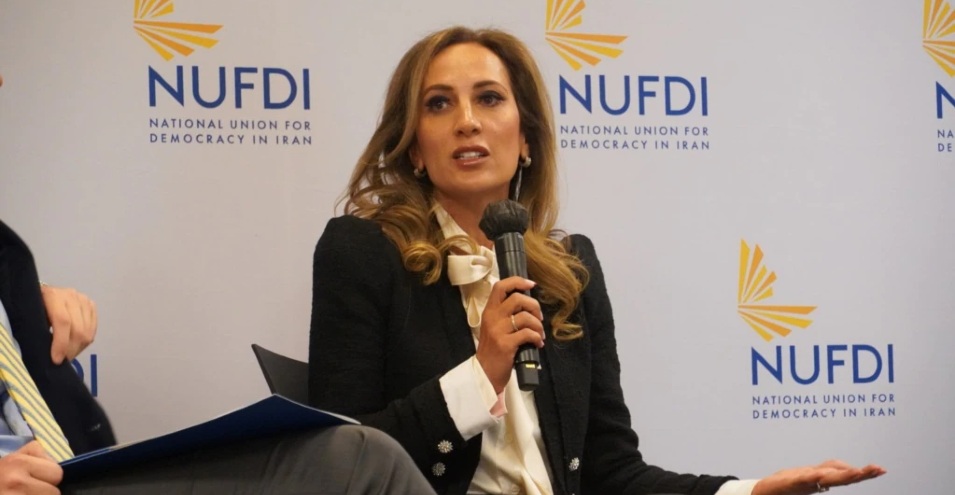
The National Union for Democracy in Iran held a meeting in Washington to discuss the status of Vienna negotiations regarding Iran’s nuclear deal, the JCPOA. Experts at this meeting recommended to the Joe Biden administration to act realistically regarding Iran’s nuclear deal and change its current policy.
The meeting was held on April 10th in two panels. Participants in this meeting, referring to approximately one year of negotiations to revive the JCPOA, announced that this agreement does not address security concerns about Iran.
Ellie Cohanim, former diplomat at the U.S. State Department, told the Farsi Service of Voice of America on the sidelines of this meeting: “It is clear that the United States government under Joe Biden has been open-handed regarding things that we have proposed to the Iranian regime, but the regime still refuses to reach an agreement. Therefore, it is time for the Biden administration to change course and think about next steps based on American national security and our allies in the region such as Saudi Arabia, Israel, and others.”
Ms. Cohanim added: “The right step for the United States is to restore real pressures on the Iranian regime, put the option of military action back on the table, and let the regime understand properly that the United States will not tolerate a nuclear Iran.”
Ellie Cohanim, who in the previous U.S. administration served as Deputy Special Envoy to Monitor and Combat Antisemitism at the State Department, said regarding the increase in human rights violations in Iran: “Since taking office as president, Joe Biden has promised to make human rights the cornerstone of American foreign policy. To this day, we have not seen him do this regarding the Iranian regime. And now it is time, while we witness people in Iran protesting in the streets due to hunger, that the U.S. government powerfully stands by the Iranian people so they know we are with them, and we support them in their quest to enjoy human rights and fundamental freedoms.”
At this meeting, the potential achievements of reviving the JCPOA were also reviewed. Experts believed that this agreement no longer has the benefits it had at that time.
Behnam Ben Taleblu, a researcher at the Foundation for Defense of Democracies, also said on the sidelines of this meeting: “I think since April 2021 and the start of indirect nuclear diplomacy, the Biden administration has been pursuing something even less than the JCPOA agreement. The Biden administration seemed willing to make more concessions and receive less in return, and now it may not even be able to get that.”
He added: “Throughout these negotiations, Khamenei has directed it and the ball has been in Iran’s court. It depends on what type of consequences Iran faces in return for its activities. From Tehran’s perspective, if you look at it, they are willing to take greater risks, which means continuing negotiations.”
Regarding why these negotiations have not reached a conclusion after nearly a year, Behnam Taleblu said: “I think there are three reasons that give Khamenei and Iran’s extremists the comfort to say no. One is tactics, another is economics, and the other is ideology.”
He continued: “Regarding tactics, the Iranian government knows that whenever it overreaches, the Biden administration does not pressure it, and they believe the current U.S. administration will not resort to pressure. For this reason, similar to what they did with the Obama administration, if possible they will overreach and may end up achieving something in the end. This is a negotiating tactic by Iran that keeps causing delays.”
Behnam Ben Taleblu added: “Second is the economics issue. Iran benefits from rising oil prices and also from approximately one and a half years of non-enforcement of sanctions by the Joe Biden administration, particularly in the areas of oil, exports, storage, transfer, shipping, insurance, and also other sectors that Iran has diversified in terms of investment including petrochemicals and other non-oil sectors. So there is an economic benefit here. Although it only benefits a particular class of the ruling regime, it allows them to implement their revolutionary and security policies.”
He continued: “Third is the ideology issue. Khamenei always wants to ultimately humiliate America, and this is part of their strategy. That a global power like America is brought down in this way has always been part of their goal, and if you look at how Khamenei has positioned himself, he has even downplayed the importance of the JCPOA nuclear agreement, and Ibrahim Raisi is doing the same. This means the regime has gained confidence, and whenever it has more confidence, its hostilities increase and it becomes more dangerous. All of this is a result of Washington not being able to properly convey what consequences would follow. For this reason, Iran continues stubbornly to delay and give negative answers.”
The nuclear deal between the P5+1 has been underway for about a year. In the latest move, Enrique Mora, the European Union coordinator in these negotiations, went to Tehran to find a way to advance it, but so far no result has been achieved.
While Enrique Mora, the chairman of the JCPOA Joint Commission, concluded his first day of talks in Tehran by holding meetings with Ali Bagheri, the head of Iran’s negotiating team, Ned Price, the spokesman for the U.S. State Department, in response to a question from the Farsi Service of Voice of America as to whether Mora has informed U.S. officials about the first day of talks with Iran, said: “I’m sure our team will be in contact with Enrique Mora and his team.”
Price, referring to the fact that Mora has been exchanging messages between Tehran and Washington for some time, added: “Of course, we cannot share much of those conversations with you.”
The State Department spokesman did not give a clear answer as to whether the last exchanged message was from Tehran or Washington, but added: “We have clearly said that direct communication in some respects could have facilitated diplomacy.”
Josep Borrell, the European Union’s foreign policy chief, had earlier told the Financial Times that Mora’s trip to Tehran might be “the last arrow in the quiver” to bring nuclear negotiations with Iran to a conclusion.
Source: Voice of America