State Media Attempts to ‘Exonerate’ Ayatollah Khamenei in Vaccine Import Crisis
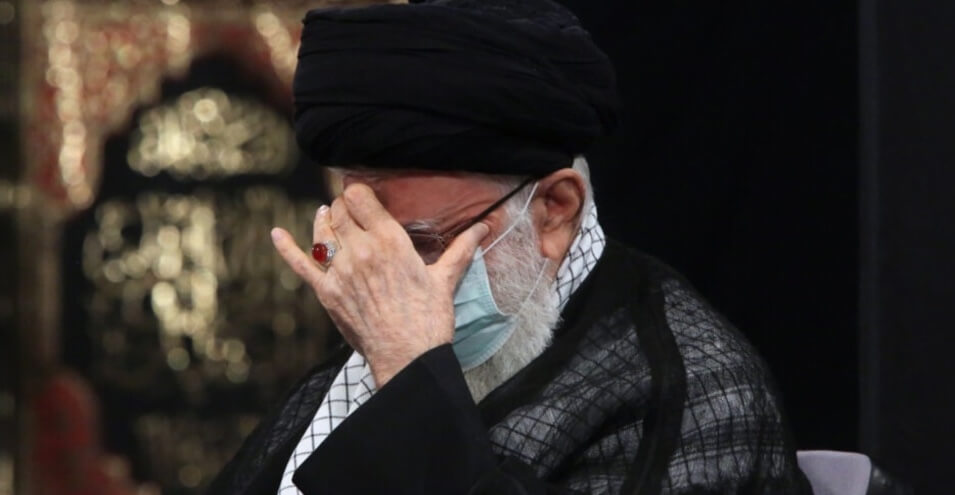
As coronavirus death tolls in Iran rise due to the initial ban on Western vaccine imports imposed by Ali Khamenei, state-aligned media outlets have recently been attempting to exonerate him and assign blame to others for the crisis.
Media outlets close to the Islamic Revolutionary Guard Corps, particularly the Fars News Agency, have recently attempted to reinterpret Ali Khamenei’s order banning the import of vaccines produced in the United States and Britain into Iran by suggesting he was only opposed to importing vaccines from America and Britain as sources, not vaccines produced by those countries.
Mehdi Fazaeli, a member of the office for the preservation and publication of the Supreme Leader’s works, tweeted on the matter, claiming that the Supreme Leader “has not banned any specific vaccine to date.”
He wrote: “From the beginning, the Supreme Leader emphasized buying reliable vaccines and had reasons for not trusting vaccine purchases directly from America, England, and France, which remain the same. However, the same vaccines, if produced in other countries, have faced and face no restrictions.”
The Fars News Agency also reported on Wednesday, citing an “informed source,” that “importing coronavirus vaccines with British, American, and French brands that are produced in other countries has never been banned, and this matter was communicated to government officials through an official letter from the Supreme Leader’s office.”
Pfizer vaccine, which received emergency authorization from the U.S. Food and Drug Administration in autumn 2020, is a product of Germany’s BioNTech and American pharmaceutical company Pfizer, with its exclusive production held by these companies. The American “Moderna” vaccine also received emergency use authorization in autumn of last year.
These two vaccines have the highest efficacy against coronavirus and have shown high effectiveness against mutated coronavirus strains.
The AstraZeneca vaccine was produced by Oxford University and AstraZeneca, with the majority of its injections occurring during the initial months of market entry in Britain.
Following Ali Khamenei’s ban on importing these vaccines into Iran, officials from Iran’s Ministry of Health announced that they would attempt to import vaccines from other countries, primarily China’s Sinopharm and Russia’s Sputnik V. However, these two countries failed to meet their commitments and delivered far less vaccine to Iran than promised.
Many analysts at that time stated that it appeared the primary reason for banning American and British vaccine imports into Iran was an attempt by the “Imam Khomeini’s Executive Decree Headquarters” to monopolize the domestic vaccine market through domestic vaccine production.
This headquarters, operating under the supervision of the Supreme Leader, launched extensive propaganda about the widespread production of Iranian “Barekat” vaccine, even promising to deliver 50 million doses by September of this year, effectively preventing widespread vaccine imports into the country.
Simultaneously, various institutions of the Islamic Republic, particularly those close to the Revolutionary Guard, unveiled several “vaccines” which they claimed would be produced, though there has been no news about their status since then.
These complications caused coronavirus death tolls in the country to sharply increase over the past month, ultimately forcing the Supreme Leader to state on August 10 of this year that vaccines must be secured “by any possible means.”
As the coronavirus crisis continues, some artists and political activists in Iran have in recent weeks and months called for Ayatollah Khamenei to be held accountable.
Jafar Panahi, a renowned Iranian filmmaker, on August 22 called for direct accountability from the Supreme Leader regarding his decisions and statements about coronavirus and the resulting crisis in the country.
Panahi posted excerpts from the Supreme Leader’s speeches in short video format on his Instagram page, asking: “Is it not time that he be held accountable for his contradictory statements even once, and are the lives of eighty-five million Iranians and the deaths of hundreds of thousands worth accountability?”
Abolfazl Ghediaini, a political activist and a figure in the Green Movement, also accused Ayatollah Khamenei of “turning coronavirus into a lethal weapon against the Iranian people.”
Narges Mohammadi, a human rights activist, previously attributed responsibility to the Supreme Leader for the rising coronavirus death toll and the slow vaccination process in the country.
In recent days, the record for coronavirus victims in Iran has been broken multiple times due to the spread of the Delta variant, and Mohammad Reza Zafarqandi, head of Iran’s Medical System Organization, emphasized that actual coronavirus figures are higher than official statistics from the Ministry of Health, stating that those who “issued statements restricting vaccine imports” should be held accountable.
Javan newspaper, affiliated with the Revolutionary Guard, acknowledged on September 1 that “coronavirus death toll figures are seven times higher than official statistics.”
The newspaper published an interview with Kurosh Holakouei Nini, an epidemiology professor at Tehran University of Medical Sciences, reporting: “According to what Iraj Harirchi said, death figures should be multiplied by two and a half to three times, but I say you can multiply death figures up to seven times.”
He said that based on statistics received from various regions of the country since the start of coronavirus, he determined that “in some regions we can multiply official figures up to seven times to reach actual figures, and in September of last year we had an estimate of 350,000 deaths.”
Source: Radio Farda