Support for “Freedom of Religion or Belief in a Troubled World”
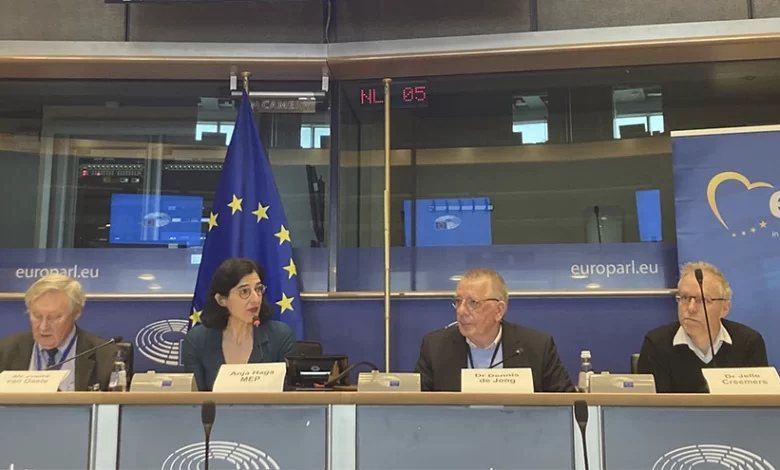
A conference was held in the European Parliament under the title of supporting “Freedom of Religion or Belief in a Troubled World.”
On April 5, a conference was held at the headquarters of the European Parliament in Brussels, Belgium, under the title “Supporting Freedom of Religion or Belief in a Troubled World,” hosted by “Anja Hazekamp,” a Dutch representative of the European Parliament from the Christian Democratic Party.
The report of this Dutch organization titled “Platform for Freedom of Religion or Belief Around the World,” published in 43 pages with the same title as the conference, was the subject of discussion at this gathering. This organization began its activities in 2010 with the aim of bringing together the perspectives of different religions and non-religious beliefs, has maintained close relations with the Dutch Foreign Ministry, and has declared itself politically neutral.
At this meeting, individuals such as “Frans van Daele,” the European Union Ambassador for the Promotion and Protection of Freedom of Religion, “Denis De Jong,” a ten-year representative of the European Parliament and member of the board of directors of this Dutch organization, and “Yiel Cramers,” a professor of religious studies at the University of Leuven in Belgium, were present and delivered speeches. While referring to the aforementioned reports, they emphasized the centrality of freedom of belief or religion for the European Union and the European Parliament.
In the original 43-page report of this organization distributed at the European Parliament meeting, recommendations were published only regarding 17 countries including China, India, Myanmar, and Qatar, while 41 countries including Iran were also examined in the academic review section and appendix of this report.
A representative of the Christian organization “Article 18” was also present at the meeting and during the question and answer session posed two questions to the European Parliament representative Denis De Jong, stating: “1. Has this Dutch organization taken any practical measures, proposals, or recommendations to the European Parliament or other European institutions to support refugees such as New Christians who have been persecuted in their country for their beliefs and are currently living in difficult conditions and even face the danger of deportation in Turkey or in European Union countries? 2. Why is the Iranian government, which has completely violated all the indicators mentioned in this report, including the right to change religion, and severely discriminates against Iranian citizens based on their beliefs and convictions, not included among the 17 countries in the main report and no recommendations have been presented?”
“Denis De Jong,” in response to the aforementioned questions, while emphasizing the fact that the rights of religious and faith minorities in Iran are severely violated, expressed sympathy with the Iranian people and added that the list of 17 countries mentioned was prepared so that recommendations could be effective. He, who is a member of the board of directors of the “Platform for Freedom of Religion or Belief Around the World,” did not provide an explanation regarding why he thinks recommendations to countries like Qatar, China, and Myanmar will be effective, but will not be effective for Iran and Saudi Arabia. “Anja Hazekamp” also stated in this regard that the activities of this Dutch organization do not examine issues related to asylum and refugee matters of religious and faith minorities.
The aforementioned Dutch organization, in the appendix of its report, using sources from Amnesty International, Article 18, and the Bahai World Center, wrote about the continuing suppression and discrimination of religious and faith minorities in Iran. In the aforementioned report, while referring to continued attacks on house churches, arbitrary arrests and detentions, and confiscation of personal belongings, it was noted that some Christian citizens have been accused of “actions against national security” and have been sent to prison and internal exile.
The name of “Anoushavan Avetyan” was also mentioned in these reports, an Armenian citizen who was sentenced to ten years in prison for peaceful religious activities and charged with “forming and managing an illegal group to take action against national security” and was transferred to Evin Prison from late September 1402.
This Dutch organization referred to pressure on Christian citizens to deny and repent of Christianity and return to Islam, and to legal provisions used against religious minorities, particularly Article 500 of the Islamic Penal Code. According to Article 500 of the Islamic Penal Code, “the commission of any deviant educational or propagandistic activity contrary to or disrupting the holy Islamic law in real or virtual space, or the creation of psychological and physical dominance over a person in the form of a sect or any other organized criminal group constitutes a crime.”
Although thought interrogation is prohibited in Iran’s Constitution, Christian citizens, particularly Muslims who have converted to Christianity, have repeatedly been victims of thought interrogation during interrogation and trial in courts.