Sweden Sponsors Human Rights Violation Resolution Against Tehran
Countries are not merely defined by their geographical image on maps that others recognize solely by dimensions and geographical angles.
Beyond geographical image, every country possesses a mental image in the international system.
In other words, this mental image reflects a “judgment” that others hold about a particular country. Countries’ behavior toward that specific nation is not solely based on its geographical dimensions but rather on its image. For example, what is your image of the Swiss government? Would you be willing to invest in Switzerland? One could ask the same question about Cambodia in Asia or Congo in Africa. Would you be willing to invest in these countries?
Whatever your answer to these questions may be, it is not solely due to the geographical image of that country but rather due to its image. This is the picture drawn of that country that leads you to judge it, to travel as a tourist there, to invest in it, to conduct trade, to choose it as a place of education or residence, and so on.
Such a characteristic of every country is called “international credibility” in political literature. Therefore, political systems spend enormous costs to have a favorable image in the international system. How is the Islamic Republic internationally?
The Islamic Republic on the International Stage
To answer this question comprehensively regarding the image of the Islamic Republic internationally, we would need to examine four decades of this system’s existence, which is beyond the scope of this note. For example, Mohammad Khatami’s proposal for dialogue among civilizations was an innovative initiative to present a different image of Iran, but it practically led nowhere amid internal disputes to the point that Khatami himself is now portrayed as prohibited. When dialogue and conversation are eliminated among members of a system and replaced by coercion and anger, what can that country’s international image be?
Since a comprehensive review of the international credibility of the Islamic Republic is beyond the scope of this note, only a “rare case” in recent days will be mentioned.
After a Visit to Tehran; Sweden Sponsors Human Rights Violation Resolution
Within seven days of a high-level Swedish delegation’s visit to Iran, Sweden became the sponsor of a human rights violation resolution against its host. Such a case is either unprecedented or extremely rare.
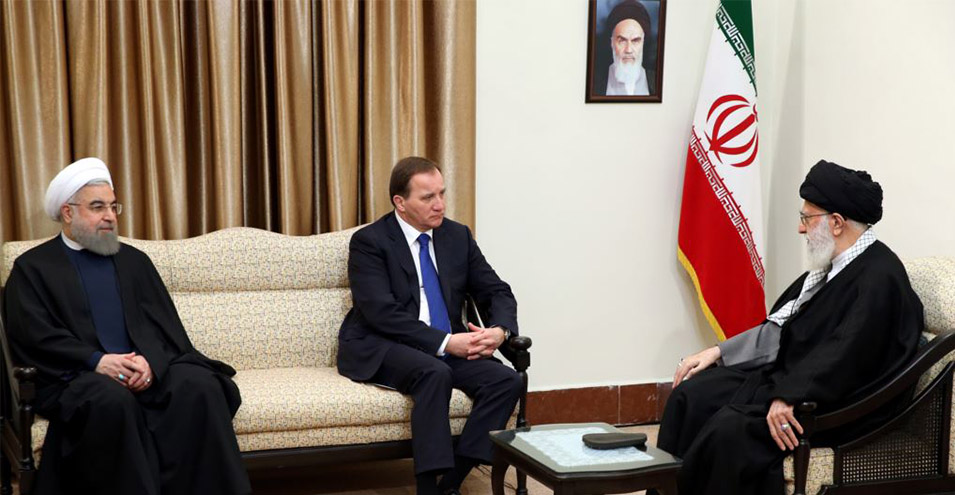
The story is as follows: On February 11 and 12, Sweden’s Prime Minister visited Tehran at the head of a high-level delegation. During this visit, in addition to meeting with Hassan Rouhani, he met with Ayatollah Khamenei. However, within one week of this meeting, the Swedish government has now submitted a draft human rights violation resolution against Iran to the UN Human Rights Council.
If such action were taken by any country against another, it would in itself carry an inappropriate message, but if this action were taken, for example, by Canada, at least Tehran could justify it by saying this action occurred in the context of severed Tehran-Ottawa relations. However, what is Tehran’s response now, when we recall that a prime minister of a country like Sweden is warmly received in Tehran during official ceremonies and is taken to meet the leader of the revolution, yet within seven days becomes the sponsor of such a resolution?
If Sweden had done this with North Korea, what would that be other than confirmation that North Korea’s image is tarnished?
Moreover, now that Sweden has taken such action, the next question is what level of response the Islamic Republic has had to this action. Was the Swedish ambassador summoned to the Foreign Ministry at the very minimum?
It is interesting to note that throughout the entire Islamic Republic governance (government, parliament, leadership, etc.), the only response came from Iran’s Foreign Ministry spokesman who said: “Submitting a human rights resolution draft is not a new issue and has no relation to the Swedish Prime Minister’s visit to our country(!).”
Sweden’s Condemnation of Saudi Arabia and Riyadh’s Response
Iran’s Foreign Ministry spokesman made such an incorrect and false position while well aware that countries are no less sensitive to protecting their international credibility than they are to protecting their geographical boundaries. Just one example below is sufficient for the Foreign Ministry spokesman to understand what a grave error he has made in concealing the truth.
In March 2015, a storm suddenly swept through Riyadh-Stockholm relations. Riyadh recalled its ambassador from Sweden, and Stockholm threatened to annul its military contract with Saudi Arabia.
The matter began when Sweden’s Foreign Minister, calling the Saudi government a dictatorship, condemned the flogging sentence for a government critic blogger named Raif Badawi. Saudi Arabia’s response to this meager criticism by a Swedish minister was so severe that after summoning Sweden’s ambassador, Riyadh recalled its ambassador from Stockholm. It prevented him from delivering a pre-scheduled speech at the Arab League and announced it would not grant visas to Swedish nationals. In support of Riyadh, several Arab countries, including the UAE, also recalled their ambassadors.
All this Saudi response was only to a verbal position of Sweden’s Foreign Minister, not an official position of the entire Swedish government. Now compare this with Sweden’s submission of a draft human rights violation resolution against the Islamic Republic to the UN Human Rights Council, all within one week of Sweden’s Prime Minister’s visit to Tehran.
What is even more interesting is that the tension between Saudi Arabia and Sweden ended within two weeks with Sweden’s retreat and the royal apology of this country to Saudi Arabia. Within two weeks, Riyadh announced that following Sweden’s apology, its ambassador returned to Stockholm.
Conclusion:
Stockholm’s pragmatic retreat from its human rights positions against Saudi Arabia at that very time faced severe protests from this country’s human rights organizations. Regarding Saudi Arabia, it also appears that this country has, so far, used its petrodollars to prevent its own condemnation (including on Yemen) in international forums.
However, this note was written to examine this “rare case,” which first shows how degraded Iran’s “international credibility” is and second demonstrates how weak and powerless the Islamic Republic’s “persuasive power” is, even in a face-to-face meeting with a European country, such that within seven days of Sweden’s Prime Minister’s visit to Iran, this country becomes the sponsor of a human rights violation resolution against its host.
This note was not written to attribute Sweden’s action to Swedish ingratitude, because based on the gross and systematic violation of human rights in Iran, such action was very justified and had previously been undertaken by Sweden.
What this note means is that this rare event first clearly demonstrates the tarnished image of the Islamic Republic, and second testifies to the sluggishness of an incapable system in defending its face on the international level, which has not shown any effective reaction, if it truly claims to have a clean and pure human rights record.
Source: Radio Farda