Tehran Explosions Ignite Israel’s Preventive War Operations Against Iran
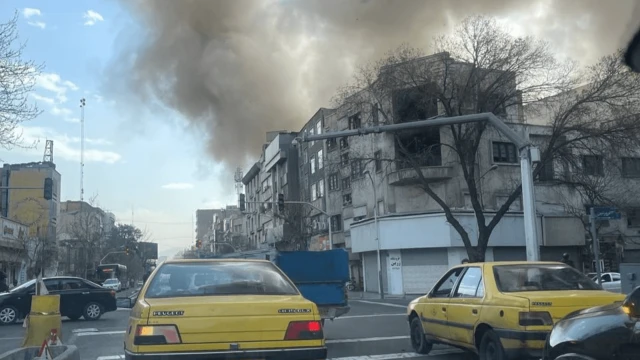
Tehran explosions amid Iran-US negotiations have brought the area around Ayatollah Khamenei’s residence to the brink of an abyss.
While indirect talks between Iran and the United States had once again become the lead story of regional media outlets in recent days, early Saturday morning, February 28th, corresponding to Esfand 9th, the sound of successive explosions in Tehran disrupted equations and cast a shadow of direct confrontation over the country.
Domestic media reported explosions heard in various parts of the capital, including Republic Street near Ayatollah Khamenei’s residence and Seyedkhandan. Some reports have suggested possible missile strikes, though at the time of this report’s preparation, official authorities had not released clear details about the precise origin of these explosions.
In an unprecedented development, Israel’s Defense Minister announced that the country has launched “preventive operations” against Iran. Simultaneously, the Israeli military reported a nationwide school closure; a measure that clearly indicates full security alert in occupied territories.
Israel’s Airport Authority also announced that the country’s airspace has been closed to civilian flights and citizens have been asked to refrain from traveling to airports. This level of restrictions is typically implemented only during wartime or immediate threats.
In Tehran, confirmed reports indicate that “the Leader’s Residence” (Ayatollah Khamenei’s headquarters) was targeted. No precise information about potential damage or casualties has been released yet, but international sources have reported the transfer of the Islamic Republic’s leader to a safe location.
Reuters reported, citing an official, that Khamenei was not in Tehran at the time of the attack. If these reports are confirmed, it could indicate prior anticipation of security threats at the highest levels of governance.
In one of the most sensitive aspects of the situation, an Israeli defense official claimed that operations against Iran had been in planning for months and the timing of execution had been determined weeks in advance. He also stated that this action was carried out “in coordination with the United States.”
Shortly after, a US official also confirmed that American attacks on Iran are underway; a matter that, if officially announced by the White House, would mean direct Washington entry into the conflict; a scenario that could push the entire region toward the brink of a wider war.
Concurrent with the spread of explosion reports, reports emerged of mobile phone service cuts in parts of east and west Tehran and severe internet disruptions. Experience from recent years has shown that in critical situations, the government’s first response is to limit information flow.
The Tehran Stock Exchange also suspended trading following reports of the explosions; a sign of sudden shock to the capital market and concern about an uncertain future in the country’s economic landscape.
Local reports also indicate explosions occurring in Qom, Isfahan, Karaj, and Kermanshah. If these attacks were coordinated and simultaneous across multiple provinces, they would indicate a large-scale operation with predetermined objectives; operations that could have targeted military infrastructure or sensitive centers.
In response to recent developments, Ibrahim Azizi, head of the National Security Commission in parliament, wrote on X: “We had warned you; now you’ve started a path whose end is no longer in your hands.” A statement that carries the tone of a mutual threat.
The country’s Civil Aviation Organization also announced that, based on issued NOTAMs, the airspace of the entire country is closed until further notice. This measure, in addition to its economic consequences, indicates anticipation of possible continuation of attacks or Iran’s reciprocal response.
The recent attacks occur as, over recent months, there have been efforts to revive communication channels between Tehran and Washington; negotiations that some considered the last opportunity to contain Iran’s nuclear crisis. Now, however, with claims of military coordination between Israel and the United States, the fundamental question is: Was diplomacy merely a cover for preparing a military scenario?
The Middle East once again stands at the threshold of developments that could transform the balance of power. If Tehran decides to respond directly, the scope of the conflict will extend beyond the borders of Iran and Israel and will compel regional and international actors to take sides.
While the full extent of these attacks remains unclear, one undeniable fact stands: the sound of Tehran’s explosions was not merely the sound of a military operation; it was an alarm bell for a future that may prove far more costly than either side imagines.