Tehran Police Arrest 29 Citizens Protesting Mandatory Hijab
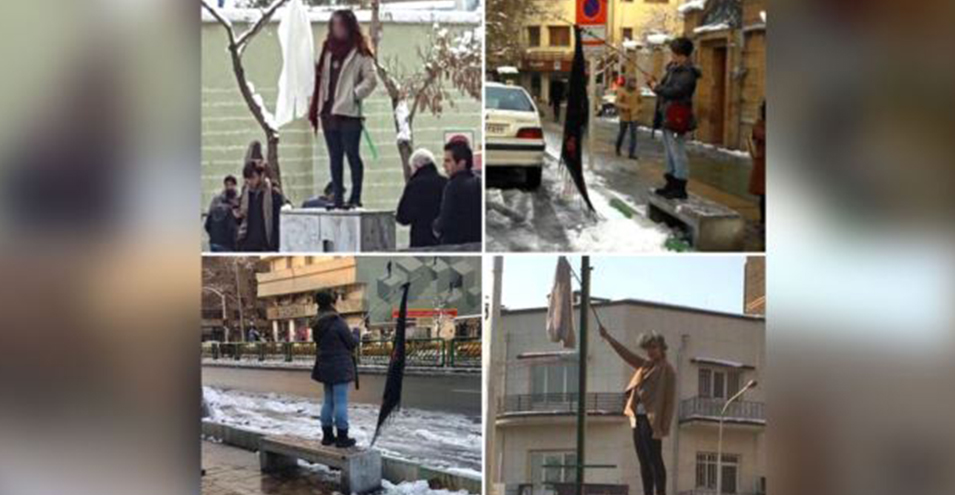
Tehran police announced the arrest of 29 people in the city who removed their headscarves in the streets in protest against mandatory hijab. Police stated that those arrested were connected to the “White Wednesdays” campaign.
According to a report on Thursday, February 1st, the Iranian news agency Tasnim reported that Tehran police announced that these individuals “followed calls from satellite networks under the title of White Wednesdays… and removed their hijabs as part of this campaign.”
However, this report provided no explanation regarding the location, time, and manner of arrest of these 29 people, and only referred to them as “deceived individuals.”
Based on this report, police have handed over those arrested to judicial authorities.
The Young Journalists Club also called these 29 people “victims deceived by the covert freedoms campaign” and wrote, quoting Tehran police, that they had disrupted the “social security” of citizens.
The covert freedoms campaign was launched by Masih Alinejad, a journalist living in the United States, in recent years to fight mandatory hijab in Iran, and has been welcomed by many Iranian women both inside and outside the country.
For several months, this campaign in the form of “White Wednesdays” has been asking its supporters to come to the streets every Wednesday with white headscarves, protest against mandatory hijab, and then send images of their protest to the campaign.
However, the new arrests come after a video was released on Wednesday, December 27th of this year on social media showing a young girl on Revolution Street in Tehran who attached her headscarf to a stick by climbing an electrical transmission pole and waved it like a flag. This girl, who became known as the “Girl of Revolution Street,” and whom some social media users identified as Vida Movahed, according to information provided by Nasrin Sotoudeh, a lawyer and human rights activist, was released after being arrested twice.
Masih Alinejad: Today’s Protest by Women is the Result of Repression Over All These Years
Meanwhile, Masih Alinejad emphasized in an interview with Radio Farda’s website that today’s protest by these women is due to the Iranian government’s continuous “repression” of them over all these years, which has now manifested in this form.
She stated: “The main reason why the girls of Revolution Street, on their own initiative, tied the symbol of mandatory hijab to a stick is that they are protesting their own arrest and repression by the morality police and security police and demanding their lost rights.”
Ms. Alinejad further referred to some official statistics presented by the Islamic Republic regarding its treatment of women. She stated: “The police itself formally announced that in just one year, it arrested or stopped 3.6 million people in the streets and filed cases against them for improper hijab. It sent 18,000 of these people to court. 40,000 vehicles were only confiscated in eight months due to not wearing hijab. Therefore, Iranian women were arrested and had cases filed against them before they even protested against mandatory hijab.”
Masih Alinejad concluded: “The peaceful protests of the girls of Revolution Street and the women of the White Wednesdays campaign were a kind of reaction to this repression and pressure and the violent behavior of the morality police.”
On Monday, January 30th, other images were released on social media showing that at least six people in Tehran and one person in Isfahan repeated this action by climbing electrical transmission poles.
The response to these girls’ actions was so widespread that the hashtag “Girl_of_Revolution_Street” changed to “Girls_of_Revolution_Street” and became one of the main trending topics on Twitter.
The next day, reports and images of open protest by several women against mandatory hijab in several other Iranian cities, including Mashhad, were released.
A protesting woman in Mashhad, while wearing a chador, had hung a headscarf on a stick and was waving it.
In addition to women, images of a number of men have been released on the internet who, by waving a headscarf or carrying placards, protest against mandatory hijab and express solidarity with women carrying out this action.
Before announcing the arrest of these 29 people, the German news agency, citing people it identified as “eyewitnesses,” reported the arrest of six “girls of Revolution Street.”
This is while Abbas Jafari Dolatabadi, the prosecutor of Tehran, only confirmed the arrest of one of the girls of Revolution Street.
Mohammad Jafar Montazeri, the prosecutor general of Iran, also described the actions of women who remove their headscarves in protest against mandatory hijab in Iran as “trivial and insignificant,” “childish,” and out of “ignorance.”
He said that “in my opinion, those who have done this have been mostly out of ignorance and emotional manipulation, which may have had external incitement as well.”
Abbas Jafari Dolatabadi himself was among the judicial officials who said in September 2016, noting that one cannot place “monitors” for every family and individual in the country, that “negative” measures regarding hijab in Iran have been ineffective.
According to subsection 638 of the Islamic Penal Code, “women who appear without proper religious hijab in public places and view will be sentenced to imprisonment from 10 days to two months or a fine of 50,000 to 500,000 rials.”
Sohila Jolodarzadeh, a member of the Islamic Consultative Assembly, considered the actions of the “girls of Revolution Street” as a result of “unnecessary constraints,” “pressure,” and “wrong behavior” by the government.
Ms. Jolodarzadeh said that “when we imposed restrictions on women and placed them under unnecessary pressure, this issue caused this pressure to overflow and the girls of Revolution Street put their headscarves on a stick.”
Source: Radio Farda