The Doll Dressed in Black From the Beginning
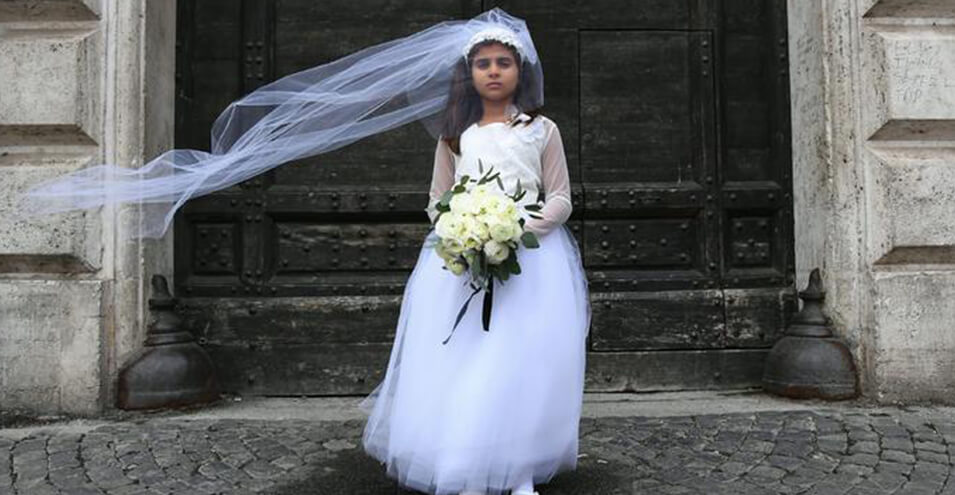
She is a child, and they are bringing her into marriage to a 22-year-old man, no less not secretly but in front of relatives and celebrations. The publication of a video on Twitter in which a child becomes a wife has sparked considerable reaction. Officials speak of nullifying the marriage contract.
It was the final days of 1397 when the story of a child’s life became entangled in the media; the story of an 11-year-old girl, a resident of Ilam, who had been married to a 50-year-old man. According to Imam Ali Society, this girl’s addict family had married her off for 15 million tomans to a 50-year-old man with seven children and another wife. The follow-up of this non-governmental organization and the welfare organization paid off, and the girl, to whom they gave the name “Raha,” was pulled out of this life.
But the story of “Raha’s” marriage was not the last tragic story in the book of child marriage in Iran, nor is it. From yesterday, the publication of a short clip on social media has once again turned the issue of child marriage into a heated discussion on the networks. In the film, which is said to be from a week ago, a young girl sits next to a young man, in the middle of gathered relatives who are celebrating and bringing the girl into marriage to that young man.
Javad Haidarian, a journalist in Iran who is one of the publishers of this film on Twitter, writes: “The film belongs to the ‘temporary marriage’ ceremony of an innocent girl in the Bahmei area in Kohgiluyeh and Boyer-Ahmad province.” In his tweet, he has asked the country’s and provincial prosecutor to “stop this catastrophe.”
While the governor of Bahmei city, in reaction to this video, called it a “bitter issue” that “for reasons prefers not to speak about,” the head of the judiciary of this city has announced the “nullification of this marriage contract.”
The publication of this video, however, sparked a wave of reactions. One Twitter user called child marriage a “crime,” and another asked the prosecutor to “enter as the public prosecutor and prevent this marriage.”
Tabnak news agency reports that the girl is 10 years old and the groom is 22 years old.
What do the statistics say?
Tayebeh Siavoshi, a member of the women’s faction in parliament, citing civil registry statistics, says that in the first six months of 1397, the rate of marriage of girls (10 to 14 years old) was about 7 percent of marriages, that is, 17,486 cases. According to a report by the Cultural Studies Office of the Parliament Research Center, between 1391 and 1395, between 4.9 to 5.6 percent of girls’ marriages were in the 10 to 14 age group. The director general of the civil registry of Kohgiluyeh and Boyer-Ahmad had previously reported registering 9 cases of marriage under 10 years of age in 1396 in this province.
Of course, there are no exact statistics on these marriages, as many of them are not registered.
What does the law say?
Marriage of girls under 13 years of age in Iran still has no legal prohibition.
Article 1041 (approved 1381/4/1) states that marriage of a girl before reaching the full age of 13 and a boy before reaching the full age of 15 is prohibited and is conditional on the permission of the guardian with the condition of observing the interest with the determination of the competent court.
The draft to amend Article 1041 of the Civil Code in the legal and judicial commission of parliament was rejected, and the bill to increase the legal age of marriage for children was rejected in winter 1397 due to “not being comprehensive and complete.” The commission stated that this draft has problems both from a jurisprudential and social perspective.
The latest status of legal efforts in this direction is that parliament representatives on July 24, 1398 in an open session agreed to refer the rejection of an urgent proposal to amend Article 1041 of the Civil Code regarding the increase of the age of marriage to the judicial commission.
What are the reasons for opposition to the bill?
Tayebeh Siavoshi, in a conversation with Iranian media, says the reasons for opposition to the child marriage bill “are not clearly defined.” She mentions “the political maneuvering of some representatives opposed to the bill,” “the assumption of a kind of social vulgarity by some institutions,” and “being called against Sharia by individuals who do not believe in the dynamism of jurisprudence” as some reasons for opposition to this bill.
By browsing Twitter, one can also become familiar with some views of opponents of this bill. Zahra Elohi, a former parliamentarian and member of the foresight and theorizing group of the Academy of Medical Sciences, is one of the opponents of raising the age of marriage. She believes that raising the age of marriage, or in other words, the prohibition of child marriage, will reduce the rate of marriage and consequently reduce childbearing.
Parvaneh Salehshouri, a member of the Hope faction and a supporter of raising the age of marriage, has criticized the Islamic Republic of Iran Broadcasting for “propagandizing to attack their critics by saying that supporters of the child marriage bill are opposed to population growth.” She points to the statistics of “eleven million unmarried boys and girls of marriageable age” in Iran and says: “Well, if you are looking to increase the population, think about these people. Why have you resorted to children to increase the population?”
Economic and cultural poverty and child marriage
Reza Jaafari, the head of social emergency who is constantly dealing with the cases and harms of child marriage, also says in a conversation with Iranian media: “Child marriage is not an acceptable solution for increasing marriage. Instead of age difference, perhaps it would be better to say generational difference. This is while the harms resulting from this marriage, which has gripped the collar of mostly vulnerable families, should be considered.” And according to a report by the Islamic Consultative Assembly Research Center, the center of such marriages is rural areas, nomadic areas, and the periphery of cities.
Azadeh Mokhtari, social secretary of Borna news agency, considers poverty to be the factor that “a child is sold every day and a bride!”
“Suicide is happening every day”
The publication of this video has reopened old wounds for many users regarding the physical and psychological harms that the phenomenon of child marriage brings with it. Many victims of child marriage have not yet reached the physical, sexual, and intellectual maturity necessary for marriage.
One Twitter user who works in the field of children in Kohgiluyeh and Boyer-Ahmad province writes about the suicide of rural women in this deprived region of Iran; about the suicide of 14-year-old girls and “about suicide that is happening every day.” This civil activist, in enumerating the factors of women’s suicide, “refers to numerous cases, including the illiteracy and low education of women, an extremely patriarchal system, and material poverty”; factors that can boldly be said, young age of marriage is also hidden in them.
Suicide is one of the bitter endings waiting for some victims of child marriage. Many experts warn about addiction, running away from home, and suicide as the most important dangers threatening these children after marriage. Experts in conversations with domestic media say: “Most of these children experience problems in their married life and because they have no way to return home, they move towards suicide or running away from home.”
One user writes: “The first thing that comes to my mind is reminding women who have repeatedly attempted suicide in childhood for this very reason of forced marriage or early pregnancy and domestic violence, and addicted women who when we ask what happened that you became addicted, have one common sentence: ‘They married me off early, my husband was an addict, and he made me an addict too.'”
Although many child marriages in Iran are not registered, although cultural work and education are needed to erase the stigma of the phenomenon of child marriage and to eliminate wrong customs in some areas of Iran, but according to many activists in the field of children’s and women’s rights, the approval of amendments to increase the legal age of marriage can prevent many cases of child marriage.
Masoumeh Ebtekar immediately after the video was published, in a comment on Twitter addressed to the publisher of the video, sought “more accurate information” for investigation.
The publisher of the child marriage video says: “The issue is on the serious agenda of government and judicial institutions, and Ms. Ebtekar, the vice president for women and family affairs of the president, was also pursuing it and we provided the information to them.”
At the last moment of preparing this report, Tabnak wrote: “Ali Saidi, the head of the judiciary of Bahmei city, announced the nullification of the temporary marriage of a 10-year-old girl with a 22-year-old boy in this city.” This official, with the news of the nullification of this marriage, said: “According to the tribal and clan customs and local customs that are common in Bahmei city, they named the girl for the boy so that after 6 years have passed when the girl reaches the legal age for marriage, they would marry.”
Perhaps with follow-ups, cultural work, economic development, and the approval of necessary laws, a day will come when “Fatima” (as this girl is called in the film) will be the last victim of this wrong tradition; a tradition that kills the body and soul of children in the early years of their lives.
Source: DW