The Story of Virgin Mary Station: When Tehran’s Metro Becomes a Place of Prayer
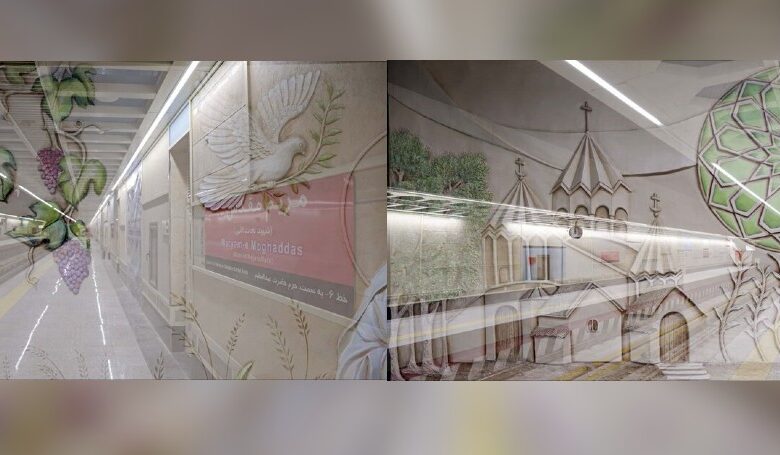
Amid urban congestion, Virgin Mary Station traverses the boundary between religion, art, and everyday life, and from the perspective of Christian media, it stands as a sign of living dialogue among faiths.
In the heart of Tehran’s bustling Karegar Street, amid the sounds of car horns and the roar of crowds, a station has been built that, with its silence and inner light, spreads an atmosphere of calm and reflection.
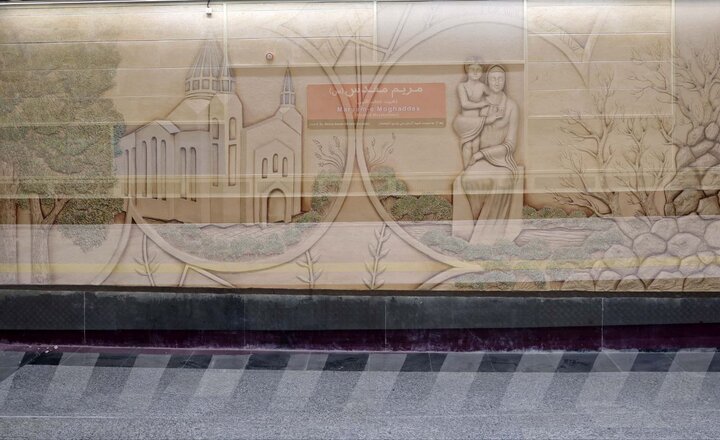
This is the Virgin Mary metro station, a point between earth and underground, designed not only for the passage of commuters, but for a spiritual pause in the heart of the capital. Across from the “Saint Sarkis Church,” a statue of the Virgin Mary stands within a glass enclosure—a face of faith and motherhood that is sacred and inspiring in both religious traditions.
The exterior design of the station was inspired by medieval churches: white walls, arched ceilings, and a niche-like entrance that brings the viewer to a space of prayer. At the entrance, the station’s name is inscribed on a pink background that creates a pleasant contrast with the white walls.
The interior space, however, is calmer and more colorful. The blue light of the walls recalls the niche of the Saint Sarkis Church across the street, creating a kind of harmony between two worlds of architecture and faith. Upon entry, the phrase “Bismillah ar-Rahman ar-Rahim” is written in four languages—Persian, Arabic, Armenian, and English; an artistic combination that, more than mere decoration, represents dialogue and mutual respect among cultures and divine beliefs.
In the lower section of the station, a stone relief artistically narrates the story of the birth of Jesus Christ—a work that recalls the commonalities between two great religious traditions and offers passing travelers a moment of pause and reflection.
Plaques featuring statements by Ayatollah Khamenei about the exalted position of the Virgin Mary have also been installed, as if to emphasize mutual respect between Islam and Christianity toward a woman who symbolizes purity and divine love.
Mohammad Amin Shabanyan, the project manager of Tehran Metro Company, discusses the design process of this station: “Initially, the station’s architecture was not planned this way, but following the request of the Armenian community and the Saint Sarkis Church, we decided to review the plan so that the cultural and religious identity of the area would be reflected in it.”
Priest Sahak Khosroyan, a member of the board of trustees of Saint Sarkis Church, also stated: “This design was the result of more than a year of collaboration between engineers, artists, and church representatives. We hope that such projects will pave the way for greater closeness and understanding among divine religions.”
According to project officials, the cost of building each metro station in Tehran is approximately 1,200 billion tomans, but the redesign of the Virgin Mary Station did not involve double the cost. Most changes were made in lighting, color, and materials to create a calm and inviting space—a space that, amid the noise of the city, reminds people of their inner self.
The opening of the Virgin Mary Station was accompanied by extensive international media coverage, but the strongest reactions came from Christian media outlets, which viewed this initiative as a sign of dialogue and respect.
British media outlet Premier Christian News reported under the headline “Tehran names metro station after Virgin Mary”: “Naming a station after Mary in the heart of Tehran is an unexpected but hopeful move. This action is a reminder of the shared values between Christians and Muslims.”
WANA News Agency also emphasized in an analysis titled “Holy Mary Subway Station: A Symbol of Religious Coexistence in Tehran”: “In a world sometimes filled with religious differences, the Virgin Mary Station presents a different picture of Iran—a place where faith and respect stand side by side.”
Media outlets such as Christian Post and Iran International also covered this topic and noted that this initiative could be a cultural step toward strengthening interfaith dialogue and mutual respect.
The Virgin Mary Station can be understood not merely as an infrastructure project, but as a kind of cultural and artistic statement. In a fast-paced society, this station, through its design and symbols, reminds people of faith, peace, and divine motherhood.
While some regard it as a symbolic gesture, its message is clear to many Christian observers: “Even in the heart of great cities, one can create a space that speaks of compassion and meaning rather than division.”
In an age when news often speaks of distance and difference among religions, the Virgin Mary Station presents a different narrative of coexistence—a place where trains pass, but faith remains.
This place is a reminder of a woman who, through her love, faith, and conviction, made her own name and that of her son known throughout the world. Perhaps from the heart of this very station, a new dialogue among the children of faith may begin.