Trump’s Claim of ‘Collapse’ of Islamic Republic; Strait of Hormuz Crisis and Plunge in Iran’s Oil Exports
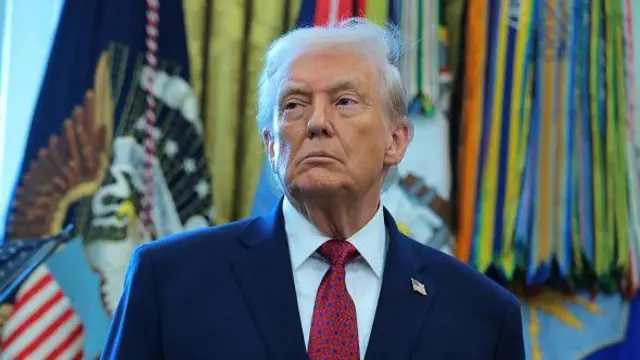
Donald Trump’s claim of “collapse” of the Islamic Republic has been raised at a time when the Strait of Hormuz crisis and the plunge in Iran’s oil exports have imposed unprecedented pressures on the country’s economy.
Amid escalating regional tensions and mounting economic pressures, the President of the United States has claimed that the Islamic Republic of Iran is in a critical condition and has even sent messages regarding its internal situation to Washington; a claim that, while not accompanied by details, has drawn the attention of analysts due to its simultaneity with field and economic developments.
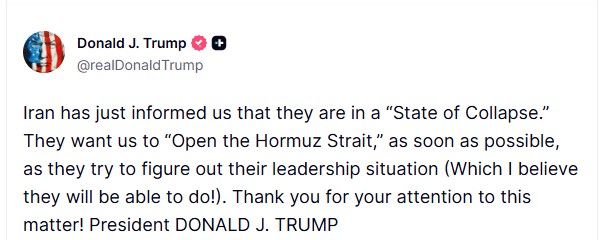
Donald Trump stated in a post on the social network “Truth Social”: “Iran recently informed us that it is in a state of collapse. They are asking us to open the Strait of Hormuz as quickly as possible, while they are trying to determine their leadership situation (which I believe they will succeed at!).” These remarks are made without any formal explanation being provided regarding the channel or content of this communication.
Meanwhile, the strategically vital Strait of Hormuz, considered one of the world’s most important energy transmission routes, has effectively become a point of crisis due to military measures by the Islamic Republic and reactions from the United States. This vital waterway was previously a thoroughfare for a significant portion of global oil and liquefied gas exports, but now faces serious disruption.
In response to this situation, the United States has implemented a naval blockade plan of Iranian ports; a measure that has had direct and severe impacts on Iran’s oil industry. Data from analytical institutions show that Iran’s oil exports have faced an unprecedented collapse, declining from a level close to two million barrels per day to less than one-third. This dramatic drop, coupled with maritime transportation restrictions, has effectively paralyzed the country’s export capacity.
Simultaneously, the crude oil storage crisis has also become a serious challenge. With storage capacity becoming full, Iran has been forced to reduce production, and this process is expected to intensify in the coming weeks. This situation has not only placed pressure on the country’s foreign currency revenues, but could lead to widespread budget deficits in the coming months.
Experts believe that the full effects of this crisis will become apparent with a time lag; since the oil sales cycle, from shipment to payment receipt, takes several months. For this reason, although pressures have begun now, the deeper financial consequences are likely to become apparent in the coming months.
Alongside these developments, the continuation of military tensions and reduced production in other regional countries have also added to the complexity of the situation. However, what distinguishes Iran’s situation is the simultaneous combination of external pressures, blocked export routes, and structural problems in the domestic economy.
Under such circumstances, the claim put forward by the U.S. President (regardless of its accuracy or exaggeration) reflects a crisis whose signs are visible in various economic and political spheres; a crisis that, if current conditions persist, appears likely to take on broader dimensions.