Turning on Flashlights Against Tyranny, Turning Darkness into Government’s Defeat
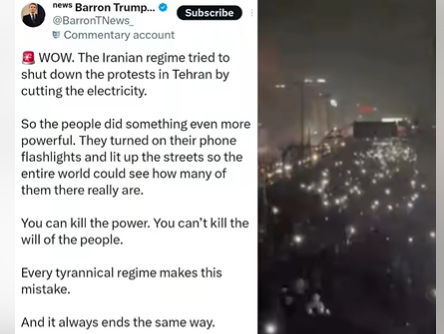
The turning on of flashlights by the people of Iran following a power outage proclaimed the failure of the government’s darkness policy and showed the world that the will of the Iranian people transcends darkness.
The circulation of videos from the dark streets of Tehran illuminated by the light of flashlights from protesters’ mobile phones has sparked widespread reactions on social networks and international political circles. One of the notable reactions belongs to “Baron Trump,” the son of U.S. President Donald Trump, who described this scene as a symbol of the failure of the Iranian government’s repressive policies.
Baron Trump, by resharing this video, directly referenced the government’s effort to contain protests through power cuts and explained: “Wow! The Iranian regime tried to shut down Tehran’s protests by cutting the power; but the people did something even more powerful. They turned on their mobile phone flashlights and flooded the streets with light so the whole world could see how many people there really are. You can cut the power, but you cannot kill the people’s will. All authoritarian regimes make this mistake and the ending is always the same.”

This statement comes at a time when the Islamic Republic, concurrent with the spread of protests, has increasingly resorted to infrastructural tools such as power and internet cuts; an approach that had been previously experienced during critical periods and met with criticism from human rights organizations. Nevertheless, images released from Tehran show that protesters, through symbolic and peaceful actions, have attempted to transform these limitations into an opportunity to demonstrate collective solidarity.
Analysts believe that turning on flashlights goes beyond a momentary reaction and carries a political message: “Protests cannot be stopped merely by shutting down infrastructure. This action has simultaneously become a tool to draw global public attention and has challenged the government’s official narrative of ‘controlling the situation.'”
The resonance of Baron Trump’s remarks, particularly with his emphasis on the shared fate of “authoritarian regimes,” shows that Iran’s protests remain at the center of attention of political figures and movements outside the country. Attention that can increase international pressure and raise the costs of repression for the government; even when power and internet are cut off, the voice of protest does not fall silent.