What Does “Elections” Mean in Rentier Governance?
A note by Ahmad Alavi: From the perspective of “public choice” theory, the primary goal of government officials seeking public management positions, even in conventional governments worldwide, contrary to their claims, is not public interests and welfare such as public well-being or progress. This is because government officials, when faced with a choice between personal or group interests and public interests, prioritize maximizing their own and their group’s interests first and foremost.
The likelihood and intensity of government officials prioritizing their personal and group interests over those of citizens, who are theoretically their constituents, is greater within the framework of rentier and authoritarian governance, since such governments lack transparency, accountability, political diversity, and consequently, citizen oversight.
Citizens are also unable to exercise oversight over institutions and government officials through organizing independent civil society organizations and civil society.
In the absence of a strong and widespread civil society, media outlets are also more or less trapped in censorship or self-censorship and fall short of their fundamental function of questioning and monitoring power institutions.
“Public Choice theory” is one of the theories in the field of political economy that uses tools, concepts, and analytical methods from economics to examine the political behavior of power institutions and their agents.
While this theory was initially applied to analyze the functioning of institutions and government officials in the structure of conventional societies, it simultaneously has the capacity to be used for examining the process of redistribution of political rent, which is called elections, in societies with rent-based and authoritarian governance economies.
In this regard, government officials who have gained privileges of power, wealth, and status in the shadow of rentier governance never jeopardize their own interests to serve the public interest. They behave in the political market as a merchant operates in the marketplace of goods and services, focused on increasing profits and reducing costs and risks. Government officials are motivated to serve society only if a particular policy or behavior first and foremost results in profit and benefit for themselves.
Public Choice Theory and the Meaning of Vote-Casting Display
From the perspective of “public choice” theory, the purpose of electoral activities of government candidates, especially in a rent-based and authoritarian economy, is to increase their own and their group’s and allies’ share in the distribution of power, wealth, and rentier status.
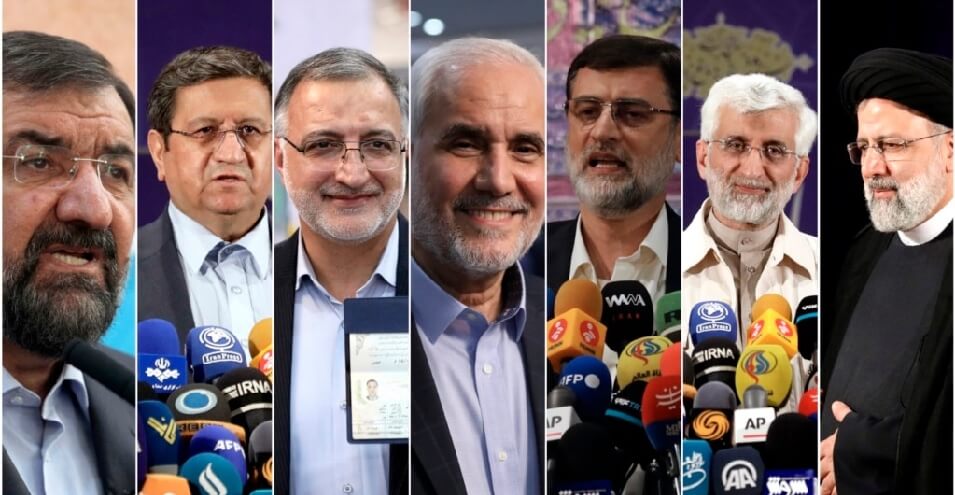
In this regard, the competition among vote-casting display candidates is aimed at increasing personal and group rent and profit while diminishing the chances of rent-seeking competitors. Meanwhile, higher-ranking authorities of the government manage and control this competitive arena to reduce the risk of deviation. Therefore, it is not surprising that five “main principlist and covering candidates” lined up against two “non-principlist candidates.”
Examining the background and also the rhetoric and advertising language and financial support of these “candidates'” activities shows that these individuals do not have independent party identity or follow certain political strategic lines. They are agents of this governance system and in exchange for this submission to the government, they enjoy the benefits of government privileges and rent. They obtained credentials under unequal conditions and have been assigned positions in intermediate management by higher authorities in a rentier manner.
In other words, these individuals neither have a history of party politics nor have a social base, nor have they even achieved remarkable accomplishments in solving the country’s economic or managerial constraints. Therefore, it is not surprising that they raise vague, obscured, and even contradictory concepts and their statements lack clear direction. The activities related to vote-gathering and the display of elections for these candidates are ultimately facilitated within the framework of mafia networks and the use of their public resources.
It is in the path of obtaining privileges and rent that these candidates gain the opportunity to engage in the public sphere, benefit from public media facilities, become media figures, and finance their activities.
The trips organized for this group are also made possible by government rent. The organization of staff and followers and the provision of costs for their electoral campaigns are also facilitated with the help of security, military, and administrative apparatus. These costs are paid from the public resource treasury and lead to budget deficit and inflation.
Promises of Rent Distribution as the Basis of Rentier Discourse
The statements of government candidates are approximately and more or less similar to each other. This is certainly not surprising since this group has acquired their knowledge and experience within the framework of the Velayat regime. Most of these candidates’ promises are promises of indiscriminate distribution of various subsidies or financial and economic resources, and they have no scientific, rational, executive, or even ethical backing.
What is absent in these candidates’ statements is a fundamental strategy toward de-rentification of government leadership institutions such as the Executive Headquarters of the Imam’s Order, the Astan Quds, large and small foundations, and security, military, and religious institutions. These candidates do not even allude to the abolition of tax exemptions for various leadership, religious, and political institutions.
Consequences of Rentier Vote-Casting Display
From an economic perspective, the function of elections should be to increase citizen participation in power, determine the direction of the country’s macro policies, increase legitimacy, and enhance the efficiency of public administration. Citizens, in an organized manner within the framework of civil society and party organizations, do not participate in this electoral display. These elections neither encompass all political tendencies of society nor fully reflect public opinion in an organized and partisan manner, nor are they competitive, transparent, and fair.
Simultaneously, the candidates have all failed their test and do not possess new policies for managing society. Moreover, even if they did possess political innovation, they legally and practically cannot bring about major structural changes in the economic sphere, since the powers and capabilities of the head of the executive branch are monopolized and held hostage by the government leader and his related institutions. For example, without an opening in foreign policy, which is the exclusive domain of the government leader, any opening in the economic sphere is a myth.
Source: Radio Farda