From claims of support to arresting Christians and holding Ali Khamenei's 40th birthday ceremony in a church
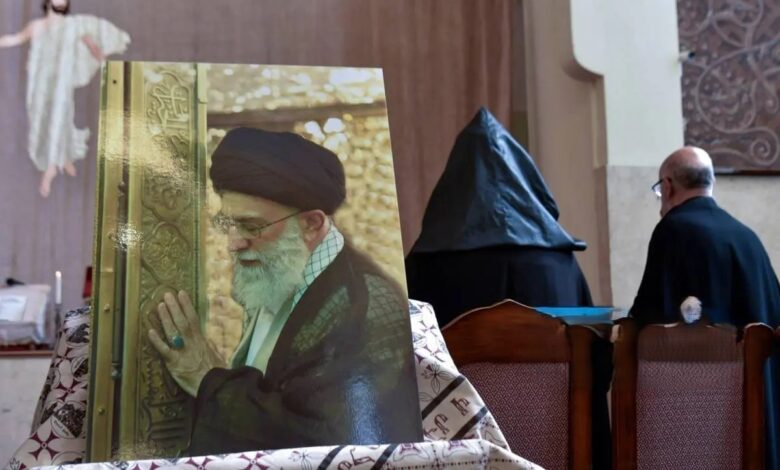
Holding Ali Khamenei's 40th birthday ceremony at the "Holy Sarkis" Church is a clear contradiction of the Islamic Republic's treatment of Christians and their repeated arrests.
While there have been numerous reports in recent years of pressure, restrictions, and even arrests of Christian citizens in Iran, holding an official ceremony in a church with government officials present presents a contradictory and questionable picture of the policies of the Islamic Republic. This ambivalence has once again brought the issue of selective treatment of religious minorities into the spotlight.
The ceremony, which was held yesterday, April 8, to mark the 40th birthday of former Islamic Republic leader Ali Khamenei, was ostensibly an attempt to show solidarity between different religions in Iran. The ceremony, held at the Church of St. Sarkis, was also attended by representatives of religious minorities, each of whom expressed their views. However, critics believe that such events are more of a show than a real respect for religious freedom.
As part of the ceremony, a message from the Armenian Archbishop Caliph was read, which stated: "In this war, the Leader of the Revolution, the girls of the Shajareh School, and a group of other officials and people were martyred. I wish their souls peace. During my 27 years of responsibility in Tehran, I recognized him as a wise, Iran-loving, and patriotic leader. He never allowed the unity of the people and the integrity of the country's currency to be jeopardized in any way. As one of the minorities in Iran, we acknowledge his wise leadership."
The representative of the Armenian community also mentioned holding similar programs in other cities and said: "At the same time as this program in the Eastern Church of Urmia, the Armenian community will also hold the same program, and this evening the Assyrian community and next Sunday the Armenians of Isfahan will also have a program."
He continued: "Forty days have passed since the powerful martyrdom of Ayatollah Khamenei, a leader who joined the caravan of martyrs after years of struggle in the defense of the homeland. We also consider this loss as a loss, the bond between the Armenian community and us is unbreakable. The families of the Armenian martyrs welcomed them with surprise. This great sorrow is not limited to the borders of Iran, but they are also grieving this loss in Lebanon and Armenia."
In another part of the ceremony, the representative of the Iranian Jewish community also stated: "We are in the Jewish days, and during these days, the Jewish community is not allowed to mourn or mourn, because in this month there is a need for the souls of all the deceased to rest. For this reason, the Jewish community was unable to hold the fortieth ceremony of the martyred leader, which is why I convey the greetings of the Jewish leader to everyone."
He also added: "Many thought that with the martyrdom of the Iranian leadership, Iran would collapse. I thank the Iranian military and armed forces and hope that our young leader will also take his father's place. I remember that during Mr. Rafsanjani's presidency, the Iranian Broadcasting Corporation mistakenly mentioned Judaism instead of Zionism several times. We wrote a letter to the leader and he read the letter within three days and he also ordered that there should be no insult to the Jewish community. Respecting all minorities was very important to the martyred leader."
Bishop Vanian, the clergyman of the Assyrian community of Tehran, also said: "We love Iran and we will die for our beloved country. Those who sit across the water and judge, their judgment will be with God. May God grant the souls of the Imam and the martyrs peace."
Subsequently, some members of parliament also gave speeches in support of national unity. Among other things, it was said: "The people of Iran, of every religion, ethnicity, and sect, have shown over the past forty days that they support dear Iran and the regime."
What makes the event so controversial, however, is not its mere holding, but the contrast between this show of unity and ongoing reports of religious restrictions. The main question for critics is how a government accused of cracking down on Christians and restricting their religious activities can simultaneously use church space to hold its own official ceremonies.
This contradiction highlights, above all, the need to reconsider practical approaches to religious freedoms, because symbolic displays cannot answer these questions without real changes in policies.