Protests in Iran; Thousands of protesters arrested and transferred to unknown locations
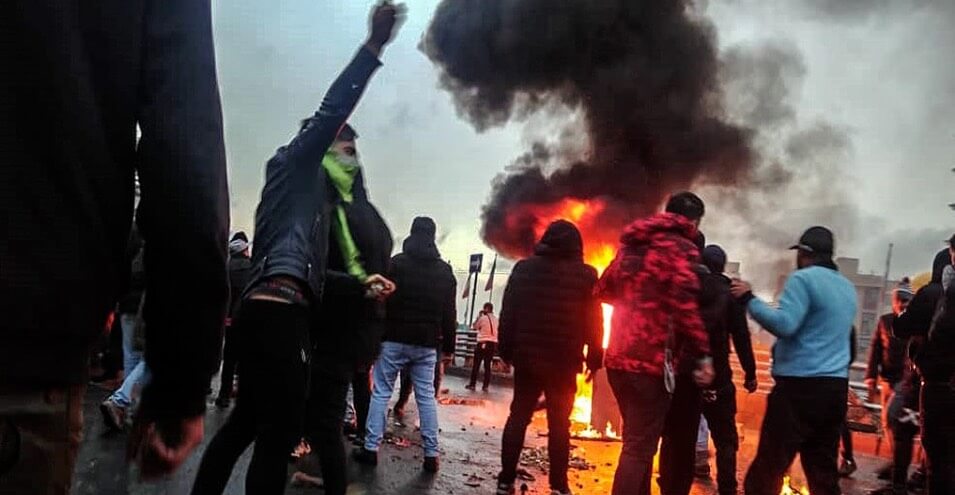
Judiciary officials have refused to provide information about the status and whereabouts of thousands of protesters who were arrested in various cities in Iran over the past week during protests against the sudden increase in gasoline prices, and for this reason, there are no accurate statistics on the number of detainees and their whereabouts.
However, the Human Rights Campaign's review of information published by officials and official media, as well as informed sources in various cities, indicates that the number of arrests made across the country is at least four thousand. Given the lack of information and widespread street arrests that were not possible to monitor, the actual number of detainees is far higher.
A source familiar with the transfer of some detainees to Evin Prison told the Campaign for Human Rights in Iran that “many people in wards associated with the Ministry of Intelligence and the Revolutionary Guard have been transferred to the general ward suddenly and without prior planning to make room for new detainees.”
Protests in various cities in Iran, which began on Friday in protest of the sudden increase in gasoline prices, continued in the following days, while internet access in the country was cut off and information about those arrested became difficult. However, a review of statistics provided by security and government media in Iran from various cities.
Officials in the Islamic Republic attribute the protests in various parts of Iran to foreign countries and call the protesters agitators and troublemakers.
An informed source in Tabriz told the Campaign for Human Rights in Iran that the detainees are being held in the city's intelligence detention center, and on Thursday, November 20, when their families visited Tabriz Prison and the intelligence detention center, they were told that the judicial authorities would inform them whenever they deemed necessary.
According to an informed source in Shiraz, the quarantine area of Adel Abad Prison is where detainees from the recent protests in the city are being held. He told the campaign that so far no contact has been made by the detainees with their families and practically everyone is in complete ignorance. This situation exists in other cities as well and according to the campaign’s sources, no response has been given to the families of the detainees regarding the location, charges, and status of the detainees.
Concerns about the condition of the detainees have risen after the Kayhan newspaper, with editor-in-chief Hossein Shariatmadari, threatened the detainees with execution on Monday, November 17, and wrote that "judicial authorities consider the death penalty by hanging for the leaders of the recent riots to be certain. In this regard, it has been said that the crime of the rioters is an example of rebellion and their legal and religious punishment is execution."
Confessions released just days after arrest
While the status and whereabouts of the detainees are unknown and official authorities have not yet provided an explanation, the Islamic Republic of Iran Broadcasting (IRIB) broadcast one of the detainees in its 8:30 p.m. news segment on Wednesday, November 10. Fatemeh Davand is a Kurdish citizen from Bukan, a city in West Azerbaijan, who the IRIB claims was one of the main factors behind the Bukan protests and was arrested in one of the border cities while fleeing the country.
The Isfahan Broadcasting Corporation also broadcast the "confessions" of three of the detainees under the title "Arrest of the Isfahan Riots," claiming that they had attacked people with machetes and destroyed public places. The "confessions" of several of the detainees in Shiraz were also broadcast by the Broadcasting Corporation.
These "confessions" were broadcast by the IRIB while members of parliament have submitted a bill titled "Prohibition of Recording and Broadcasting of Personal Confessions by the IRIB," according to which "the recording of personal confessions and their broadcasting by the IRIB and other mass media is prohibited at any stage of the prosecution and preliminary investigation, and the perpetrator, whether producer or broadcaster, will be sentenced to imprisonment from 6 months to 3 years, in addition to the obligation to restore the dignity of the accused."
The Islamic Republic of Iran Broadcasting (IRIB) violates the rights of detainees, especially protesters and political activists, in violation of Iranian and international law that guarantees due process, prohibits the use of force, and prohibits torture. Detainees are often forced to “confess” to crimes, often under torture or threats from themselves or their relatives, and IRIB films these forced confessions and broadcasts them on its television channels, often in an attempt to intimidate and humiliate individuals. These “confessions” are part of a deliberate effort to discredit and defame protesters, human rights defenders, and activists. IRIB works hand in hand with interrogators and security, intelligence, and judicial officials to stage, film, and broadcast these false confessions, which have been repeatedly documented by victims and witnesses. These forced confessions then become key evidence, usually presented in court to convict the targeted individuals, generally of various crimes.
Arrest of students in Tehran
On Wednesday, November 19, the Telegram channel of the country's student union councils reported the arrival of several ambulances containing plainclothes forces at Tehran University at midnight on Monday, November 17, and wrote that the plainclothes officers arrested a number of students and put them in the ambulances, and arrested a number of students outside the university. According to the same report, some of these students have been transferred to Fashafoyeh Prison and some to Evin Prison. The number of detainees at Tehran University on Monday evening alone was stated to be "40 to 50 people," and security agencies have made threatening calls to many students and their families in the past three days, stating that they will be arrested if they are seen on campus. The private homes of a number of students have also been visited for arrest.
Yashar Daral-e-Shifa, a health and social welfare student at the University of Social Welfare and Rehabilitation Sciences, was among those arrested on Thursday, November 20. His relatives said that his physical condition was not good, he had severe back and leg pain, and that security forces had taken him to prison with a cane.
Hassan Khalifai, Kamyar Zoghi, Ali Nanavaei, Malika Ghareghozloo, Marjan Eshaghi, Maliheh Jafari, Maryam Jafari, Nadia Gholami, Amir Forsati, Narges Bagheri, and Soha Mortezaei are among the arrested students. Mohammad Amin Hosseini, one of the arrested students, was released on Thursday, November 20.
While Gholamreza Ghaffari, Deputy Minister of Culture of the Ministry of Science and Mahmoud Nili Ahmadabadi, President of the University of Tehran, have announced that they do not have statistics on the number of arrested students, Esmail Soleimani, Head of Security at the University of Tehran, has claimed that “the number of arrested students is small and there have only been arrests at the University of Tehran and Allameh, which are exaggerated in relation to the figures for these arrests.”
Labor activist Sepideh Gholian remains in detention, and in Tabriz, Davood and Ayub Shiri, as well as Roozbeh and Yashar Piri, four civil society activists in the city, were arrested on Sunday, November 16.
Official statistics
Although judicial and security officials have refused to provide official and accurate statistics on those arrested and in interviews speak of the arrest of a number of protesters, a review of the statistics that security and government media in Iran have provided from different cities. What is noteworthy about the detainees is that officials at various levels of the Islamic Republic as well as security media have referred to them as “rioters,” and officials of the military and security forces in different cities claim that most of the detainees are non-natives. Fars News Agency went further and wrote about the arrest of a number of “foreign nationals” in Tehran, claiming that “they are nationals of one of the eastern neighboring countries and had attempted to destroy and set fire to five banks.”
Ahmad Nourian, a spokesman for the police force, announced the "identification and arrest of a significant number" of protesters labeled as "thugs and rioters," and Fars News Agency reported the arrest of about a thousand people as of Monday, November 17. However, in the following days, Mohammad Mousavi, the police commander of Gachsaran, announced the arrest of 150 people in the city as of Wednesday, November 10.
Noorullah Taheri, the governor of Shahriar, put the number of people arrested in the city at 80 and claimed that "most of those arrested were non-natives of Shahriar County."
Gholamreza Shariati, the governor of Khuzestan, stated that the number of people arrested in the province during the first three days of the protests, i.e., Saturday, Sunday, and Monday, was 180. In an interview with the Human Rights Campaign in Iran, Karim Deihimi, a human rights activist and Arab civil society activist, stated that the number of people arrested in Khuzestan as of Wednesday, November 10, was more than 400.
The Fars IRGC intelligence has identified 100 of the detainees in Fars province as “leaders of hostile groups,” and the Alborz IRGC intelligence has identified 150 detainees as “leaders who disrupt security.” According to security media, some of the detainees in Alborz province have dual citizenship from Germany, Turkey, and Afghanistan.
According to official statistics from these media outlets, 34 people were arrested in Robat Karim, 30 in Bomahan and Pardis, 29 in Birjand, according to Ebrahim Hamidi, the head of the South Khorasan Justice Department, 5 in Islamabad Gharb, 30 in Zanjan, according to Esmail Sadeghi Niarki, the head of the Zanjan Justice Department, 25 in Islamshahr, according to Masoud Morsalpour, the governor of this city, 40 in Yazd, whom Mohammad Haddadzadeh, the city's prosecutor, called non-natives, 30 in Tabriz, whom Mohammad Reza Pourmohammadi, the governor of East Azerbaijan, called non-natives, 35 in Baharestan, and 3 in Roudhen, for whom an arrest warrant has been issued for another 25 people, according to Alireza Taghian, the head of the city's judicial district. The administrator of a Telegram channel with 23,000 followers has been arrested in Babol.
In Javanrud, Kurdpa News Agency reported that three brothers named "Makvan, Logman, and Arkan Soleimani" were arrested in Javanrud and Logman Khorab along with 15 other protesters in Marivan.
A local source told the Campaign that more than 20 people had been arrested in Javanroud, 42 in Marivan, 112 in Bukan, 51 in Sanandaj, and 39 in Kermanshah as of Wednesday, November 10. The source told the Campaign that there were no accurate statistics on those arrested in Kermanshah and Kurdistan provinces, and that the number of detainees was much higher than what had been announced so far because, on the one hand, some families had not yet confirmed the arrest of their family members due to security pressures, and on the other hand, due to internet outages and phone tapping, many communication channels were effectively closed and it was impossible to get news.
In Tehran, no statistics have been provided by judicial and security officials, and Fars News Agency claimed on Thursday, November 20, that one of the people who blocked Tehran's Imam Ali Highway during the recent protests was a "retired employee of the Iranian Embassy in Denmark" who was arrested and "a handgun and related ammunition, a spy camera, and some electronic equipment were discovered during a search of his home."
A journalist in Tehran who witnessed widespread arrests in the city told the campaign: “In the Sadeghieh district of Tehran, I witnessed the arrest of protestors. They beat people with batons and took them away. I witnessed at least 10 to 15 people being arrested within ten minutes, which shows that the number of arrests is very high. Now, there are concerns about the situation of these detainees, whose identities, where they are being held, and nothing else is known about them. Given the experience of the protests in January 2017, when several detainees were killed or died suspiciously in prison, as well as the experience of Kahrizak in 2019, I think that human rights organizations and international organizations should immediately follow up on the situation of the detainees. Here, practically nothing can be done, and it is not even clear what the outcome of the protests will be, given the severity of the repression and violence.”
According to official statistics announced by the government, 25 people died in the protests in January 2017.
Source: Human Rights Campaign