Isfahan Protests and Officials’ Efforts to Link Them to Foreign Powers
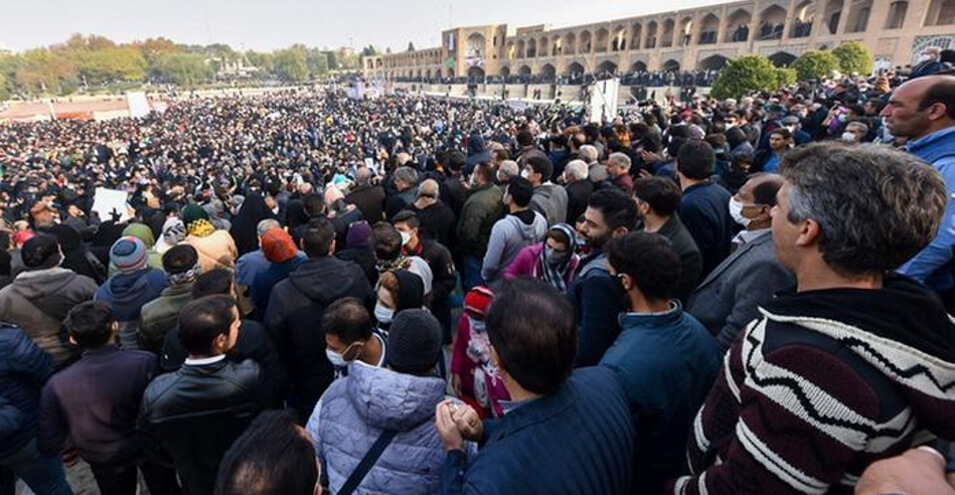
The head of Isfahan’s judiciary announced action against those arrested during water shortage protests. A Qom representative claims there are “codes” showing the protests were designed by foreigners, while Isfahan’s Friday prayer leader mentions the possibility of completely cutting off Isfahan’s water supply.
Asadollah Jafari, the head of Isfahan’s judiciary, announced special handling of cases for those arrested in recent protests in the province. He referred to “a group” who, according to him, “initiated disruption of public order, deprived people of peace and comfort, destroyed public and private property, and clashed with government and security officials,” saying: “Undoubtedly, the province’s judicial system will seriously and without any consideration deal with such individuals according to the law.”
Jafari distinguished the “account of hard-working farmers who were pursuing their legal demands from those behind these incidents.”
The Iran Human Rights Organization announced that approximately 120 people were arrested during Friday, December 5th protests in Isfahan. The commander of NAJA’s special units reported the number of arrests as 67 people.
Protest gatherings over water shortage and management of the country’s water resources were held in Isfahan for two weeks in the dry bed of the Zayandeh River. However, on Thursday, December 4th, farmers’ tents were set on fire and special units prevented the continuation of protests.
Mohseni Ejei, head of the judiciary of the Islamic Republic, had previously stated regarding peaceful protests by the people of Isfahan and Chaharmahal and Bakhtiari due to officials’ mismanagement of water resources: “If ignorant or deceived individuals want to disrupt people’s security, the people and military, security and police forces should confront them.”
With the suppression of protests in the riverbed, the security forces’ confrontation with protesters, and the extension of protests into the city, now, as always, officials are attempting to attribute these protests to foreign factors.
“Foreign Hands in Isfahan Protests”
Mojtaba Zolnouri, representative of Qom’s people, referring to recent unrest in Isfahan following water problems, said: “It is commendable that people can peacefully convey their pain and problems to officials.” However, Zolnouri simultaneously alludes to the enemy’s role, saying: “In such cases, the enemy tries to derail the peaceful protest path and invests in this field to gain the necessary benefits.”
Qom’s representative continued: “In the recent Isfahan unrest, we have many codes showing that the design behind these movements was done by foreigners, and unfortunately at some point they managed to bring some people with them.” Like the head of Isfahan’s general judiciary, he emphasized: “Farmers who had entered the scene to express their demands, as soon as they witnessed violence with intent of revenge against the system, separated their ranks from counter-revolution and foreigners.”
Abbas Abdi, in an article published by the Etemaad newspaper, states that Isfahan’s protests differ in several important ways from other protests. He attributes these differences to, among other things, the predictability of these protests from months before, the traditional, religious and sectarian nature of the protesters (generally older than youth), the location of the protests, and most importantly, how officials dealt with them. An approach that, according to this writer, was promising to end this tension, even if temporarily, through dialogue.
A hope that, according to the writer, not only failed to materialize, but took on a different character with “setting fire to protesters’ tents,” extending protests into the city, and the presence of younger protesters with different slogans. He then criticizes the police and security measures in dealing with protests and “the insistence of official policies in linking these protests with foreigners,” writing: “Perhaps it has temporary effect on convincing some groups or justifying certain behaviors, but it leads protesters to the conclusion that the solution is external.”
Abbas Abdi emphasized that how to deal with protests should be based on internal variables and factors “even if hands from outside are also seen in it.” Calling on officials for “restraint” toward protesters, he described the publication of images of confrontation with protesters as “a kind of rubbing salt into the wound.”
“Within Two or Three Months, Isfahan’s Drinking Water Should Also Be Cut Off”
This is talk of wounds that are expected, with improper management of protests, resort to violence and suppression, to become “festering wounds” like all previous protests.
The problem of water scarcity and shortage, alongside climate change, resulting from incorrect management of water resources and adoption of wrong policies in this field, is not something that can be resolved overnight. Even Youssef Tabatabai Nejad, Friday prayer leader of Isfahan, has come to this conclusion: “Right now, I think they cannot do anything immediately.”
The Friday prayer leader of Isfahan says: “I mean, you cannot return Yazd’s water, you cannot tell Chaharmahal and Bakhtiari not to use water because they themselves have water scarcity, and water behind dams cannot be given to farmers. I mean, I think if it doesn’t rain, within two or three months Isfahan’s drinking water should also be cut off.”
Source: DW