Mass Iranian protests in Washington: A structural error, not a personal one
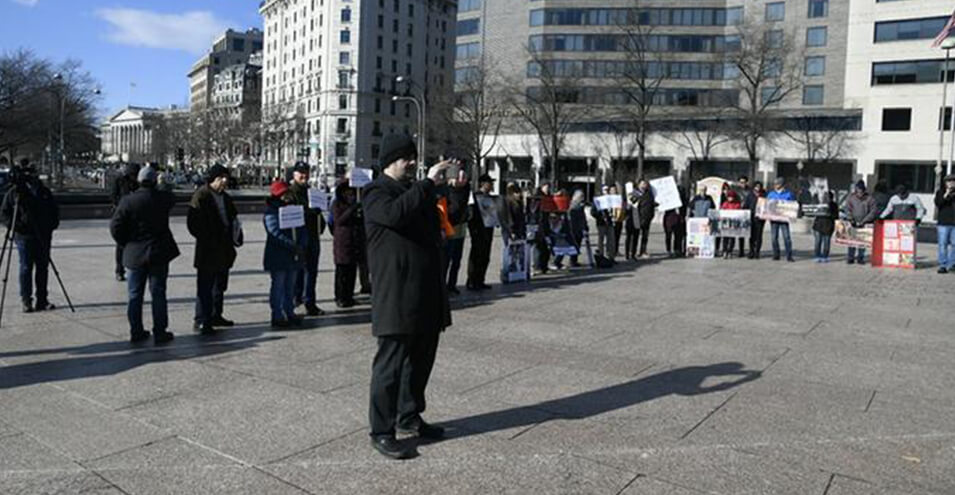
A group of Iranian Republicans expressed their condolences to the survivors of the Ukrainian plane crash at a rally in Washington, D.C. Speakers at the event called the crash another sign of a structural problem within the Iranian government.
On the afternoon of January 19, a number of Iranians living in Washington and its suburbs gathered to pay their respects to those killed in the Ukrainian passenger plane crash in Iran. The rally, which was organized at the invitation of the Iranian Republican Association in Washington, D.C., began in front of the Azadi Building in the city and continued to the US Capitol after a short march by the participants.
After the “O Iran” anthem was played at the beginning of the program, Ms. Maria Rohilli, an American civil activist, recalled the changes that have occurred in the slogans and demands of the Iranian people over the years, and emphasized that today the people’s demand is fundamental changes in the structure of the government. For example, she pointed to the change in the slogan “Don’t be afraid, don’t be afraid, we are all together” to “Be afraid, be afraid, we are all together,” and considered it a sign of direct confrontation with the oppressors. In Ms. Rohilli’s opinion, the decrease in the slogan “Allahu Akbar” is another manifestation of fundamental changes in the protest ideology. She recalled that in 2009, religious slogans were part of the main slogans of the protests, but today these slogans have been marginalized. Ms. Rohilli also considered the direct slogans against the Leader of the Islamic Republic to be an important change in the direction and direction of the protests.
She also emphasized in another part of her speech that what exists in Iran under the claim of an Islamic government is not actually a government, but a mafia gang and a group of criminals that have no signs of the reality of a responsible government. According to her, the fact that a high percentage of young people are addicted to drugs or are unemployed, that the economic structure is corrupt, or that the environment in Iran has been severely damaged and that water shortages and air pollution have become part of people's daily lives are signs that this mafia group is unable to govern the country, because according to Ms. Rohily, the first duty of any government is to govern the country and fix these problems, while Iran's rulers are unable to do so. Ms. Rohily continued that for this reason, there is basically no government in Iran and only a mafia rules it. She considered the crash of a passenger plane to be another sign of this inability to govern, because it reveals its structural inability. Ms. Rohily, while re-emphasizing the lack of a government in Iran, added that this issue leads to the use of only tools of repression in response to people's protests, and killing protesters or imprisoning and torturing them is this gang's only response to the people.
“The importance of attracting public opinion”
At the end of his speech, he discussed the difference in the way the "ruling gang" in Iran dealt with the November protests and the protests of the past few days, and attributed the widespread repression in November to the fact that the voices of the Iranian people were not heard abroad and that the media and public opinion did not pay attention to them. According to him, this difference shows how important it is to attract public attention, because the rulers of Iran do not have the possibility of widespread repression under international scrutiny.
After Ms. Rohily's remarks, the crowd chanted slogans against the Iranian government. Among these slogans was the demand for the destruction of the Islamic Republic and the establishment of democracy in Iran. They shouted: "No to theocracy, yes to democracy," as well as "The Islamic Republic must be destroyed," "Political prisoners must be released," "Women's rights are human rights," "Equal rights for all women," and "Freedom of the press for Iran."
Following the ceremony, Ms. Fariba Rad, a representative of the Iranian Republican Association in Washington, D.C., read the group's statement. Part of the statement read: "The Iranian government once again committed a major crime to add to its long list of crimes by firing a missile at a passenger plane. As usual, they tried to deceive the people and the world with lies and secrecy, but this time the arrival of officials from other countries and the vigilance of people on social media took away this opportunity." Another part of the statement, referring to the people's protests in November and the protests after the plane crash, emphasized: "The people's slogans this time directly targeted the institution of the Supreme Leader and Khamenei, along with his repressive arm, the Revolutionary Guards. The people again shouted loudly that they were tired of both factions of the government, both reformists and fundamentalists, and were looking for a bright future in the shadow of democracy, justice, and freedom." The statement concluded with: "We, the Republican Association of Iran - Washington, D.C., while expressing our condolences to the families of the victims of the passenger plane crash, stand with the Iranian nation and say loudly that the path to prosperity and happiness of the Iranian nation can be summed up in just one demand: the Islamic Republic must go."
After reading the statement of the Republican Association, Mr. Jalil Azadikhah, an independent Kurdish political activist, took the podium and at the beginning of his speech expressed his sympathy for the Baloch people who have been facing many problems due to the flooding in the region these days and a number of them have lost their lives. He also expressed his sympathy for the families and survivors of those killed in the Ukrainian passenger plane. Mr. Azadikhah emphasized that these people were actually murdered and assassinated, but this action was called human error by the government.
Referring to the living conditions of the people in Iran, who face new problems and crises every day and are unable to live in peace, and who are expecting a new crime or massacre every day, he added that this situation has existed for a large part of the people since the beginning of the victory of the revolution and the establishment of the Islamic Republic, and is not a new occurrence. Mr. Azadikhah emphasized that the resignation of a few people within the government is not the solution for Iran, but rather everything related to this government, from political and legal structures to economic and cultural ones, must be completely changed in order to enable the well-being of the people. According to Mr. Azadikhah, the government of the Islamic Republic always lives with crises and its survival depends on crises, which is why these crises will continue in the future. He considered smuggling, corruption, discrimination and massacres to be an inseparable part of the identity of the Iranian government, and at the same time expressed hope that the Iranian government has lost a large part of its class of supporters and, as a result, its social capital. Mr. Azadikhah called for the establishment of a secular democratic government based on universal human rights standards in Iran and emphasized that the departure of the Islamic Republic would be beneficial for all the nations living in Iran, including Kurds, Turks, Arabs, Persians, and Baluchis, and that the survival of this government is a greater harm to the people every day. Mr. Azadikhah also considered it the duty of Iranians abroad to be the voice of the people inside the country for change and not to neglect this duty for a moment.
“The bond between the people of Iran and Lebanon”
After these speeches, the audience once again chanted slogans in protest against the Iranian government. Some of the slogans included by people inside Iran, such as "We did not kill to compromise, I praise the killer leader" and "Khamenei, shame on your deceit, let blood drip from your colorless face." The slogan "Bread, Work, Freedom" was also chanted several times.
Then, the crowd that had gathered in front of the Washington Freedom Building moved toward the U.S. Capitol. In the cold weather of Washington, the slogans of the attendees, the placards they held, and the crowd moving toward the Capitol on the sidewalk attracted the attention of passersby, and a number of citizens asked those present at the program the reason for the gathering and the meaning of the Persian slogans.
It was around 2:30 pm when the crowd arrived in front of the US Congress. There, the attendees observed a minute of silence in honor of the lives lost in the downing of the passenger plane, and then slogans were chanted. After that, Mr. Nizar Zaka, an American-Lebanese citizen who had been imprisoned in Iran for several years, addressed the audience. In his short speech, Mr. Zaka, referring to the long four-year period he had been imprisoned by the Islamic Republic without any guilt, said that he was concerned about those who remained in prison and were forgotten. He spoke about those who had committed no crime and, according to Mr. Zaka, they were educated, literate, and among the best people in this society. While expressing renewed concern about the fate of those still in Iranian prisons, he expressed hope that the United Nations would pursue their rights. Because, according to Mr. Zaka, these people are not only citizens of one country, but also citizens of the world. In another part of his speech, he referred to the historical closeness of the two nations of Iran and Lebanon and said that the desires of both nations are the same.
“The Case of the Enlightened, Salvationist and Charismatic Leaders in Iran”
Following the ceremony, a message from Representative Ghazala Hashemi, a Virginia State Senator, was read. In her message, Ms. Hashemi sent her deepest sympathies to the families and survivors of this great tragedy. Referring to the diverse nationalities among the victims of the disaster, she emphasized that the families deserve clear answers about this and the causes of the incident. She added, "Let us remember these people, their names, their voices, and their faces, and assure their families that what they have lost is what we have lost too."
At the end of the program, Mr. Ali Afshari, a member of the Republican Association of Iran, said in a speech that we have gathered today to mourn the innocent passengers who perished due to the tragic mistake of the government. He emphasized that this tragic tragedy is not a human error, but a systematic error of an autocratic, corrupt, and inefficient government that has committed major crimes directly and indirectly in its four decades of existence. Mr. Afshari added that in addition to this tragedy, our protest is against the context that created the disaster and that this flawed structure will continue to cause disasters. Afshari emphasized that, in a deeper look, what causes such tragedies is the lack of respect for humans and humanism in the intellectual and practical structure of the Islamic Republic, and the way in which this issue is being dealt with shows how worthless human life is from the perspective of the Iranian rulers, because no one in any part of the government has been willing to accept responsibility.
Afshari also said that the “autocratic leader” of the Islamic Republic “brazenly” downplayed this very painful incident in his speech and tried to show his anger at why public protests against the secrecy and concealment of the truth have led to the marginalization of the government’s maneuver of power in the funeral of Qassem Soleimani, the “commander of the province of tyranny.” Afshari considered this behavior another sign of the government’s disregard for human life. He also said that the people who ordered and carried out the downing of the plane, “which may even have been intentional,” must be tried according to the standards of justice. According to him, this is not only a national demand, but also an international demand.
In another part of his speech, Mr. Afshari emphasized that the people present in this gathering, like many Iranians, are calling for a non-violent transition to democracy. According to him, the Iranian people are a united people who must resist together until the structure of oppression is dismantled and surrenders to the will of the nation. Mr. Afshari emphasized that what maintains the unity of the people is not “traditional institutions with a bygone era related to past ages,” but rather the agreement and consent of all members of Iranian society, the mortar of national solidarity. He considered the current Iranian society to be composed of a people in which “superhumans” no longer have a place, and the legitimacy of its government is not in the sky or outside the will of the people, and in this society, average people have gathered who have equal citizenship rights. According to him, despite all the social, cultural, religious, and ethnic diversity, the Iranian people have reached a stage in the 21st century where they can solve their problems by relying on themselves and do not need a savior. Mr. Afshari expressed hope that the case of charismatic, savior, and charismatic leaders in Iran will be closed.
Source: DW