Sugar is "rare" in Tehran's market, and prices have reached "five digits"
On Sunday, May 12, Iranian news agencies published various reports about the "scarcity" of sugar and its "five-digit" price on the black market.
Tasnim News Agency reported in this regard that in addition to chain stores, sugar has also "become scarce in Molavi Bazaar and the Free Bazaar and is being sold illegally at five-figure prices."
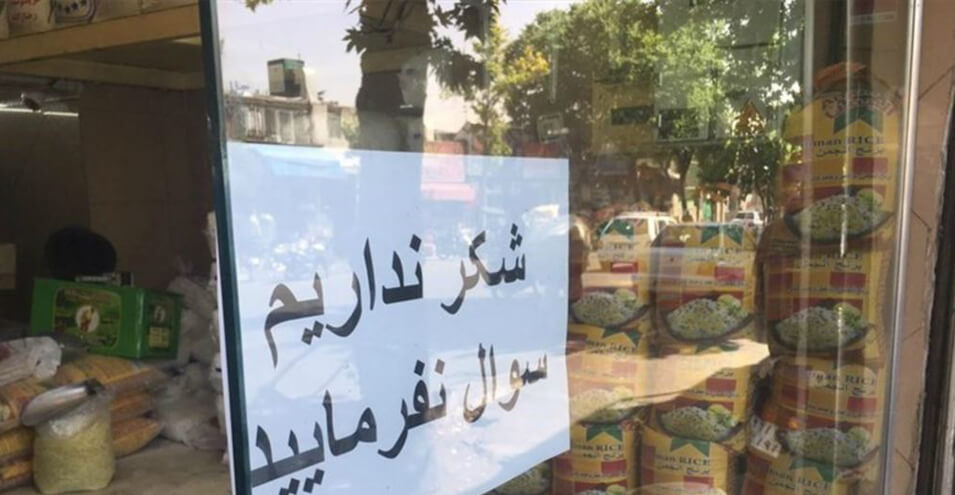
According to the news agency, "not even a kilo of sugar can be found" in the Molavi market, and vendors have written on a sign on the shop windows, "We don't have sugar; please don't ask questions."
Recently, Iranian media, including Fars News Agency, reported that the price of sugar had increased from 3,400 tomans per kilogram in March last year to over 10,000 tomans.
This price increase comes despite the fact that the Director General of Supervision of Agricultural Products and Food of the Consumers and Producers Protection Organization had promised on May 9 that the market would "reach equilibrium" next week with the distribution of sugar as part of the market regulation plan during Ramadan and the import of sugar.
Alireza Rostami had announced that sugar consumption in Iran is about 180,000 tons per month, and that 200,000 tons of sugar will be distributed at a price of 3,400 Tomans in the market regulation plan for the month of Ramadan.
Statistics indicate that two million and one hundred thousand tons of sugar are consumed in Iran annually.
Meanwhile, Bahman Danaei, secretary of the Sugar Industries Association, while announcing the unloading of several sugar shipments at Iranian ports, expressed "hope" that the price of sugar would reach the price set by the Market Regulation Committee, which is 3,400 Tomans, within the next 20 to 30 days.
Recently, the Statistical Center of Iran reported that the increase in the price of sugar, candy, and sweets in April 2019 was only 64 percent compared to April 2019.
Last April, the price of sugar was below 2,950 Tomans.
Iran's official inflation estimates have always been met with skepticism from experts.
Iran banned sugar imports last year, but domestic production has apparently declined to a level that does not meet consumer demand.
In mid-March 2018, Mehr News Agency, citing an unnamed Ministry of Agriculture official, reported that sugar imports had been liberalized and that permits had been issued to import 400,000 to 600,000 tons of sugar in 2019.
He said that due to the failure to provide the rights of Khuzestan farmers, sugarcane production has decreased from 900,000 tons to 600,000 tons, which would meet the needs of the first quarter of 2019, but imports would have to be made for the second quarter.
Last year's drought caused a significant drop in sugar production in Khuzestan, a province that produces half of Iran's sugar. This year, farmers in the province have also faced flooding.
Meanwhile, Mr. Danaei told Fars News Agency that the recent flood has destroyed 30 to 35 percent of the country's sugarcane fields and sugar production is expected to decrease by 200,000 tons.
There have been numerous reports of shortages of essential goods in the market over the past few months, including red meat and poultry, onions, tuna, pasta, and paper.
Source: Radio Farda