Ali Khamenei: "Reza Khan the bully destroyed our national identity and changed our national dress"
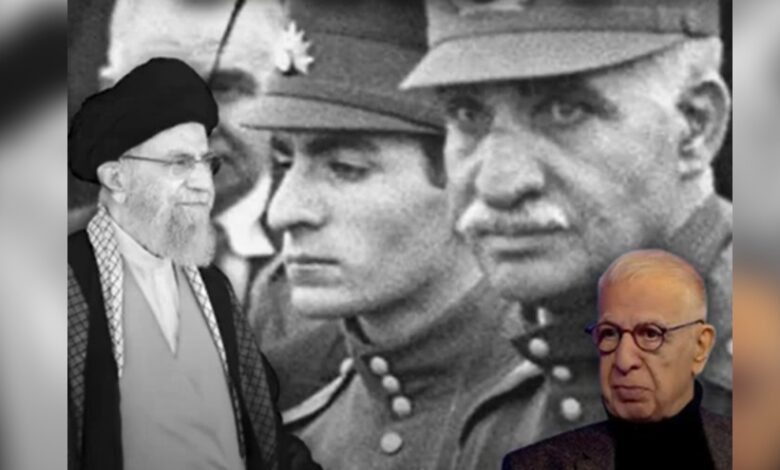
On the birthday of "Reza Shah the Great," Ali Khamenei held him responsible for destroying national identity and changing national dress.
Esfand 24 was the birthday of Reza Shah Kabir, the king of Iran. He was born on this day in 1256 AH in the village of Alasht, a part of Savadkuh, into a military family. His father, Abbas Ali Dadashbeg Savadkuhi, served as an adjutant (lieutenant) in the 7th Regiment. Reza Shah was the youngest child in the family, and his father died a few months after his birth.
Reza Shah was the Minister of War from 1300 to 1304 and also served as the Prime Minister of Iran during the Qajar period from 1302 to 1304. He eventually became king in 1304, with the end of the Qajar period. He had joined the system at the age of 12 and had been able to achieve high levels of promotion during his years of service.
During his reign, Reza Shah created a new order in Iran and established modern institutions for a better life in Iran, the most important of which are the "New Army", the "New Judiciary", the "University of Tehran", and the "National Railway".
In order to secure his power, he violated the constitution and declared independent parties dissolved, and then removed the parliamentary immunity of the members of the National Assembly. He wanted Iran to be free from the influence of religious clerics, foreign intrigues, and ethnic divisions. On the other hand, he wanted Iran to have European-style educational institutions, modern and employed women, a modern economic structure with state-owned factories, communication networks, investment banks, and chain stores. To achieve his goal of rebuilding Iran, he embarked on de-secularization, the elimination of tribalism, the spread of nationalism, the development of education, and state capitalism.
In 1941, he was forced to resign and leave Iran with a British ultimatum, handing over the throne to his son Mohammad Reza Pahlavi, and died three years later in Johannesburg at the age of 66. His supporters consider him the "father of modern Iran," and in 1949, with the approval of the National Assembly, he was given the title "Reza Shah the Great."
Every year on the birthday of the late Shah, Ali Khamenei has tried in various ways to portray him in the minds of the public as a despot and dictator, a title he and his agents used to rule the Iranian people for about half a century. He spoke about him in different terms in the new year.
On the birthday of these deceased people, Ali Khamenei said: "Reza Khan was a bully who was infatuated with the West. He destroyed our national identity and even changed our national dress." His use of the terms "national identity" and "national dress" instead of "Islamic identity," which he often referred to in the past, means that he is trying to rely on this word (national) to move with the wave of nationalism that is growing stronger every day.
His remarks about "Reza Shah changing the national dress" came while he believed that the dress chosen by the Shiite clerics was the national dress of the Iranians, while history says otherwise. In fact, the dress that Ali Khamenei and his followers refer to as the national dress is called "dashdasheh" in Arabic, which belongs to the same Arabs and was not the national dress of the Iranians.
The national Iranian dress since ancient times has been trousers and a type of vest or sardar for men, and half-length dresses and loose trousers in cheerful colors for women. After centuries, the chador, chaqchur, piche, niqab, burqa, and other types of hijab were slowly imposed on some urban women, but they never took on a "national" role.
Ali Khamenei had also repeatedly referred to the "Pahlavi cap" in his speeches. In fact, the Pahlavi cap was not intended to prevent believers from covering their foreheads with a scarf while praying, because they could remove it from their heads while praying or, with a twist, place the scarf behind their heads.
During his speech on his birthday about the destruction of national identity by Reza Shah, Ali Khamenei did not state which part of Iran's national identity was destroyed by him. Because during his reign, Reza Shah gave new life to Persian literature, which had been in decline since the 18th century, so that through compulsory education, millions of people sought it and Persian was introduced as the national language. Other Iranian languages, which were in decline, also had their decline stopped or slowed down.
The first Kurdish-Persian dictionary was prepared and published during his reign, and researchers prepared and published their scientific reports and grammars of the languages and dialects of the Iranian people, which were very reliable. The late Saeed Nafisi also said in this regard: "We remembered where and when we had been." When we read various books and articles about the history of Iran, the statement of the late Nafisi, which reminds us of a deep love for the homeland, becomes clear.
Ali Khamenei used the word "tyrant" for Reza Shah even though he did not seek government control over religion and, with the reforms he introduced, removed large parts of the political, social, and judicial structures of the Iranian people from the domination of the Shiite clerical network and transferred their responsibilities to the government, including endowments, justice, education, the University of Theology, and even religious sciences.
By establishing a modern nation-state and expanding power and legal jurisdiction throughout the country, Reza Shah was able to reconstruct Iran's national identity, which had been threatened for nearly 150 years by imperialist powers, including Britain and Russia, with the help of domestic factors, in a context of patriotic understanding.
He also took back parts of Iranian territory that had been separated during the Qajar era and reminded the whole world that Iran would continue to be called Iran and that it would not be acceptable to refer to it with words like "Persia" or "Pars". He even declared the word "religion", which means a way of life, to be a part of the whole. This is an issue that Ruhollah Khomeini and Ali Khamenei tried to impose on the Iranian people, meaning that they replaced Iran, which is the whole, with religion and sect, which are parts.
Reza Shah, whom Ali Khamenei called a bully, took over a poor and half-starved Iranian people, but he also took over a growing Iran. He tried to keep Iran from war, but with the Russian and British invasion and the British ultimatum, he preferred to suffer exile and sacrifice himself to prevent the destruction of Iran, a problem that, with the coming to power of the clerics and founders of the Islamic Republic, dragged Iran into war, leaving millions dead and disabled, a war that is still ongoing.
Ali Khamenei's attack on the Pahlavi dynasty, Iranian history, culture, and national identity led Iranian compatriots to compare the words of the late Nafisi: "Where were we and who were we?" with the current situation, where we have reached and who we are.
Ali Khamenei's recent remarks on the eve of Nowruz and the birthday of Reza Shah the Great caused widespread reactions from the Iranian people, with many Iranian compatriots expressing their protest against Ali Khamenei's remarks by publishing pictures of Reza Shah and writing texts on social media.
In response to this speech, Karbi posted a photo of Reza Shah and a message on social media, writing: "In fact, in these 46 dark years of history, the Iranian nation has paid the price for the unkindness and ingratitude of the countless services of Reza Shah Pahlavi and his successor, Mohammad Reza Shah Pahlavi, in the most heinous ways possible."
This ingratitude and unkindness is not limited to the ten percent who caused the madness of 1957, but rather the ninety percent who remained silent in the face of the ingratitude and unkindness of that ten percent and allowed Iran, which was rapidly taking fundamental steps towards progress and development, to suddenly rush in the opposite direction with the same speed towards regression and regression in all economic, cultural, and scientific fields, share in this ingratitude and unkindness.
The fact that Reza Shah the Great used force to achieve the goal of a prosperous, free, and advanced Iran was called a "dictatorship," they trumpeted it, and they cowardly ignored all of his services, and they did not even once ask themselves that a hundred years ago, to save the people who, due to the Qajar inefficiency, were not only illiterate, but also half of them had perished due to disease, and the other half suffered from gonorrhea and syphilis, and were struggling in poverty and misery, there was no way but to rule and force. Basically, there was no use for something called democracy among the people at that time, and the people of Iran a hundred years ago could not understand what democracy meant and what it meant.
Now, after about a century of Reza Shah's reign and nearly half a century of the blessed rule of Mohammad Reza Shah Pahlavi, we are faced with an extract of the blessed existence of those two ungrateful servants, named Prince Reza Pahlavi, whose democracy and democracy are crystallized in every single cell of his body. With the intelligent ideas he has in mind, continuing the services of his grandfather and father, he can save Iran from the abyss of destruction in the shortest possible time, and his rise to power in Iran can be the greatest blessing for a nation that, out of lack of love and ingratitude, interrupted the line of progress of Iran in the insane rebellion of 1957.
Unofficial statistics show that more than 90 percent of the current Iranian society hates the destructive clerical regime and more than 80 percent of the people support the ideas of Prince Reza Pahlavi. My question is this! Will the Iranian people come together in the 90th minute to make up for that lack of love and ingratitude and save themselves and their country, or will the gray stratum continue to stifle what they have in their hearts?