Second 1400 Election Debate: A Contest of Confused Rhetoric and Accusations
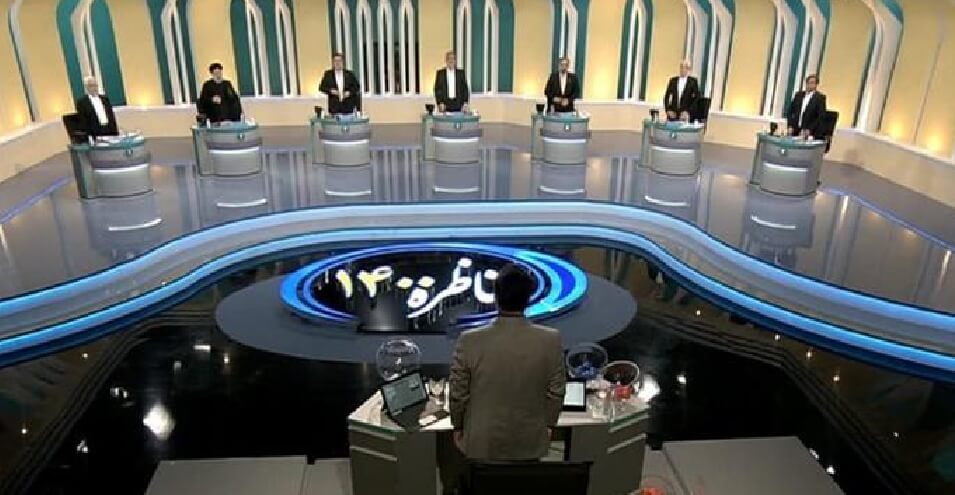
The second round of debates among candidates in the 1400 presidential election was held regarding social, political, and cultural issues. The first round of these debates, focused on economic issues, had been met with minimal reception. The second round was also a repetition of the same confused rhetoric.
The second round of debates among candidates in the 1400 presidential election took place on Tuesday, the 18th of Khordad (June 8th) and lasted a total of three and a half hours.
In the second round of the debate, the rules were predefined and the structure was somewhat similar to the previous round. After each candidate’s speaking time ended, the microphones were turned off.
The second round of the debate was divided into two sections. At the beginning of each section, questions were distributed among the candidates by lottery, and then the candidates had the opportunity to answer these questions.
After that, in the first section each candidate had two opportunities to respond to issues raised by other nominees, and in the second section after answering the questions and presenting opinions, each candidate had a four-minute opportunity to present a summary of their views.
A common theme among the participants in this debate was confused rhetoric and straying from the questions asked. Most criticisms, particularly in the statements of Ebrahim Raisi, Mohsen Rezaei, Alireza Zakani, Amir Hossein Qazi-Zadeh Hashemi, and Saeed Jalili, were directed at the performance of the Rouhani government.
Abdol-Nasser Hemmati, like Hassan Rouhani, sought the root of problems in the White House, and Mohsen Mehralizadeh focused on the performance of other representatives of power branches in the Islamic Republic of Iran.
What Did They Say?
Ebrahim Raisi, defending his “level of education” plan, accused other candidates of “bad conduct.” Rezaei also criticized the behavior of current officials.
Mohsen Rezaei considered “talk therapy” ineffective in his remarks. He said “hope” is something visible and claimed that his government would “return hope to the people’s table and smiles to their faces.” He said: “I promise the people that 1400 is a year of opening.”
Mohsen Rezaei called the Rouhani government a “sleepy” government that sleeps at night and gasoline prices rise in the morning.
Saeed Jalili, in response to the cause of public distrust in the government, called for an end to shows and said real work must be done. However, he provided no explanation about what real work means.
Confused Rhetoric
One of the most striking examples of confused rhetoric could be seen in Mohsen Mehralizadeh’s response. He was asked about Trump’s maximum pressure policy and what plans he had for lifting sanctions.
In response, he merely contented himself with saying that the JCPOA should be saved; and spent the rest of his time attacking Raisi and the issue of “bad conduct.” Mehralizadeh asked how we should define morality and immorality? Then again announced that Raisi had attended six grades and state radio and television censored five minutes of his campaign film; he said “state media has become infatuated.”
Abdol-Nasser Hemmati also preferred to hide behind general slogans and said he is opposed to monopoly in economics, culture, and media; he said the choice is not between bad and worse, good and better, but between opening and closure. He then claimed that he would be the “voice of the voiceless” and the “power of the powerless.”
The Debate and Ethnic and Religious Minorities
Like previous debates, candidates again remembered ethnic, religious, and linguistic minorities before holding the election. They praised Azerbaijanis and called for increasing the share of “Sunni brothers” in executive positions.
Raisi thanked the support and appeasement of Azerbaijani speakers, and Mehralizadeh replied that Azerbaijani language does not exist in Iran and they speak Turkish.
Qazi-Zadeh Hashemi displayed a map of the unemployed in Iran’s border areas in front of the camera and said the situation has reached a point where Baloch citizens have had to resort to fuel smuggling and Kurdish citizens to human smuggling.
Rezaei also spoke of the necessity of major “surgeries” to combat poverty in Iran. Both he and Raisi considered combating poverty possible through strong implementation of policies. Rezaei spoke of “jihadi management.”
The Debate and the Youth and Women Issue
Women and youth were also among the issues that presidential candidates addressed in many parts of their statements.
Zakani said young people are tired. Hemmati also said that 60 percent of young people will not vote. He spoke of youth migration abroad.
Regarding women, each candidate tried to outdo the other. Hemmati condemned the sending of “terror messages.” Mehralizadeh said he would increase the number of women in the cabinet. He spoke of three female ministers in his cabinet and claimed that if parliament does not give them a vote of confidence, he would use them at the level of vice ministers.
Hemmati went a step further and said he would allocate five cabinet ministries to women. And Qazi-Zadeh Hashemi said: “When we get close to elections we remember women and human smugglers.” He said so that no one can raise their hand against him, and sarcastically added that he would form the entire cabinet from women.
Rezaei said he would provide salaries for housewives. In this debate, elimination of university entrance exams and military service were discussed, and to encourage young people to marry, it was even mentioned that a loan of 500 million tomans would be provided.
Attacks on the Rouhani Government
Zakani spoke of the self-victimization of those responsible for the current situation. He spoke of inflation of 49 and 52 percent and blamed the Central Bank and Abdol-Nasser Hemmati for it.
Zakani even reported the arrest of 26 spies in the Rouhani government; he considered the government’s performance as causing corruption and rent-seeking; and blamed the high price of diapers on the Rouhani government’s performance.
He considered housing price increases among the causes of the decline in marriage rates in Iran and called it a disaster created by the Rouhani government; he said 28 percent of people’s salaries in other cities and 56 percent of Tehran citizens’ salaries go to housing.
Zakani in another part of his remarks said the country cannot be run “like a cartoon.” He claimed he could eradicate poverty within a year.
Rezaei also spoke of dirty profit and mafia, and Zakani said that 95 percent of smuggling is injected through channels affiliated with the government. Smuggling that involves both imports and exports.
Zakani criticized Hemmati’s statements that he said he is the voice of human smugglers, and said that 25 billion dollars of smuggling is transferred through human smuggling, and complained that the Rouhani government and those who worked in that government had taken no action against it.
Ebrahim Raisi also asked Hemmati to be accountable for the country’s economic problems and said every day a bomb explodes on the people’s table, but no action has been taken.
Qazi-Zadeh Hashemi also criticized the government’s unsuccessful performance in controlling coronavirus and said the government has failed in importing coronavirus vaccines.
He compared the number of Iranian coronavirus victims with South Korea, Vietnam, and China and held the Rouhani government responsible for the high number of coronavirus deaths. Even the health ministry mafia was mentioned in this debate.
Hemmati, in defending himself and the Rouhani government, said Iran’s foreign exchange revenue last year was 5 billion dollars and pointed to the negative rate of investment and production in Iran.
Zakani also accused officials of “elitism” and said if he wins the election he will force officials to serve the people; said he will prevent profiteers from breathing; he will end tribalism and gangs.
He accused the Central Bank and Hemmati of illegally transferring 1200 billion tomans before Nowruz from the Central Bank to a private bank at the end of business hours.
Summary of the Second Debate
Shafeghnna website, referring to a poll, said that out of every ten people, three had watched the first debate. Mental confusion and confused rhetoric, lack of clear programs, and accusations against each other are among the issues that likely diminish the possibility of greater public reception of this debate.
Again, on the eve of elections, discussions emerged about eliminating university entrance exams, removing military service duties, providing 450 thousand toman subsidies, greater participation of minorities in decision-making, freedom of speech, lifting filtering, opening political space, and respecting women’s rights.
Evaluation of the statements of the 1400 presidential candidates might perhaps be expressed in words that Mohsen Rezaei uttered. In this debate, he said that people’s problems cannot be solved with “slogans, empty talk, and magic tricks.”