Hook: Military option to prevent Iran from producing nuclear weapons is always on the table
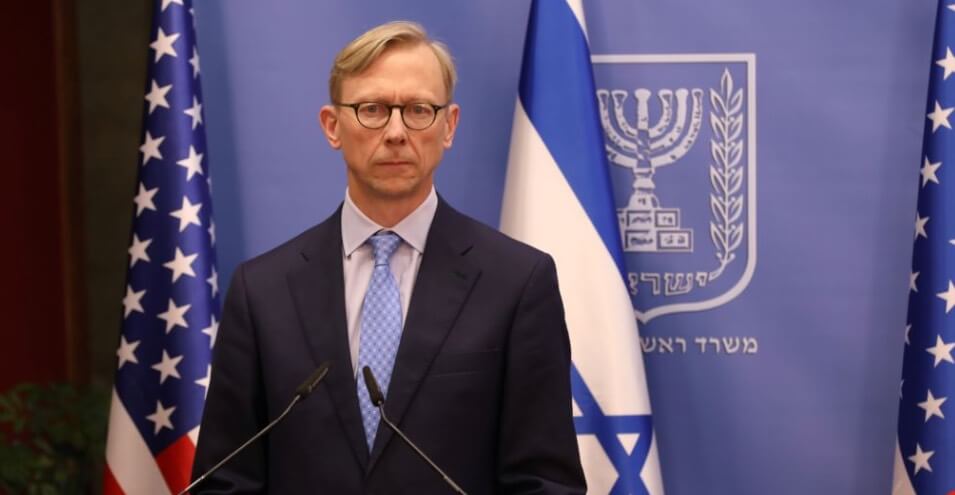
The US special representative for Iran said during an interview in Israel, "As the US President has emphasized, Iran must not obtain nuclear weapons, and the military option is always on the table in this case."
Brian Hook, in response to a question from an Israeli Channel 13 reporter, "Is that so?", emphasized, "Of course [this option] exists."
The US State Department's representative for Iran, in response to the issue that Islamic Republic officials may be waiting for the US presidential election, says, "This is an issue that the Iranian government must answer."
He then added, "But the American and Israeli people should know that the President [Trump] will never allow them (Iran) to obtain a nuclear weapon."
Hook's interview with Barak Ravid, a diplomatic correspondent for Channel 13 in Israel, took place during the US special envoy's trip to the region, a trip to Saudi Arabia, Bahrain, the UAE and Israel that is part of Washington's efforts to extend international sanctions against arms sales to the Islamic Republic.
Iranian officials insist they are not seeking to build nuclear weapons. They have also said they will be able to buy and sell weapons once arms sanctions are lifted.
The Donald Trump administration withdrew from the nuclear deal reached under the previous administration, Barack Obama, and has implemented severe sanctions against Iran.
But what is at the center of Washington's efforts these days is preventing the end of the arms embargo, which was in place for five years with the achievement of the "JCPOA" and based on UN Security Council Resolution 2231, and will end on October 17 of this year.
On July 1, at a UN Security Council meeting to consider extending these sanctions, the US Secretary of State called ending them a "betrayal of the UN's mission."
Mike Pompeo said Tehran could "hold the sword of Damocles over the economic security of the Middle East" by purchasing fighter jets from Russia, updating and expanding its submarine fleet, and equipping groups affiliated with the country.
Before him, Brian Hook had emphasized in Israel that "the arms embargo on Iran will not end."
China and Russia, both of which have veto power in the UN Security Council, had already announced that they would not support extending the arms embargo on Iran.
China's representative reiterated Beijing's position at Tuesday's Security Council meeting, stressing that Washington "cannot legally reverse UN sanctions."
Brian Hook told Channel 13 that his country's preference is to extend sanctions rather than resort to the mechanisms foreseen in the JCPOA.
Although Donald Trump's administration has withdrawn from the JCPOA, it says that because the United States is named as one of the signatories of the agreement in the UN resolution, it can reimpose sanctions on Tehran by resorting to the mechanisms foreseen in the JCPOA.
In his interview with Channel 13, Mr. Hook says that the United States has legal mechanisms: "We are using the legal options available to extend the sanctions. We can take the easy way or we can take the hard way. We prefer the option of extending the sanctions. If our side A succeeds, we don't have to go to plan B."
Iranian officials have yet to respond to Brian Hook's latest remarks. Yesterday, Foreign Minister Mohammad Javad Zarif said, "Any new restrictions by the Security Council would be contrary to the fundamental commitments made to the Iranian nation, and in such a scenario, Iran's response would be decisive."
Tensions between Washington and Tehran have escalated again in recent months. On January 4, 2018, Qassem Soleimani, commander of the IRGC's Quds Force, was targeted and killed in Baghdad on the orders of Donald Trump.
Source: Radio Farda