Hassan Rouhani’s Promise: Everyone Will Be Vaccinated by End of Tirdad
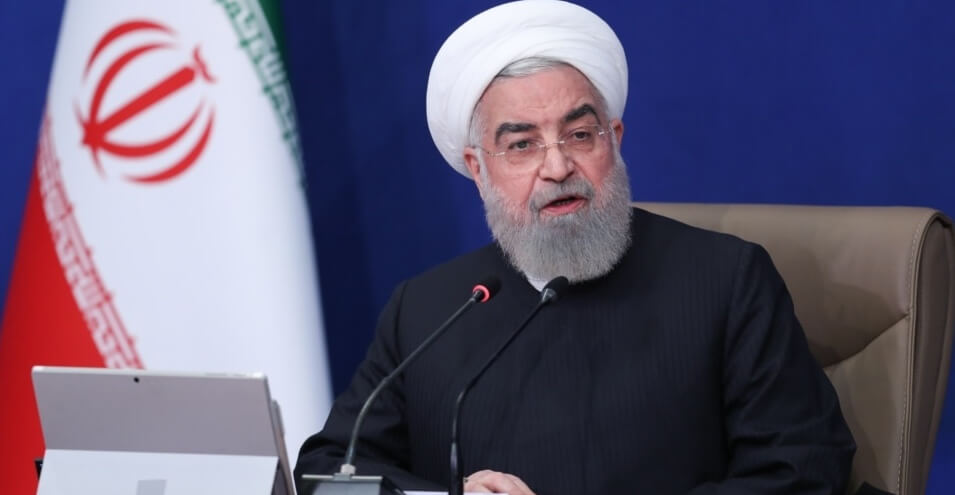
Iran’s President on Wednesday, April 5, made general statements promising that everyone in Iran will be vaccinated by the end of Tirdad (June 20) of the current solar year.
Hassan Rouhani meanwhile announced the arrival of “tens of millions of vaccine doses in the coming weeks.”
Without referring to details, he only said that Iran has taken an “important step” in the path of coronavirus vaccination and “private companies have entered the field and by the end of Tirdad everyone will be vaccinated.”
Rouhani’s promises came at a time when Jalil Kohpaie Zadeh, Head of Iran University of Medical Sciences, announced that Tehran province alone needs 20 million doses of coronavirus vaccine.
According to official statistics from the Ministry of Health, since the start of vaccination in Iran with a population of over 80 million, until April 4, slightly over 1 million 314 thousand doses of vaccine have been administered in the country, and the total amount of imported vaccine to Iran has been only 3 million 200 thousand doses.
According to Alireza Raisi, spokesman for the National COVID-19 Taskforce, to achieve herd immunity in Iran, people over 18 years old, numbering around 64 million, need to be vaccinated, which requires 128 million doses of vaccine.
In another part of his remarks, Iran’s President emphasized giving free rein to the private sector to import coronavirus vaccine and said this would allow “all people at risk to be vaccinated.”
Rouhani did not specify under what conditions this product would be made available to citizens if the private sector succeeds in importing coronavirus vaccine to Iran, and whether all people at risk have the financial means to obtain it.
Previously, it was said that with Hassan Rouhani’s approval, the issue of importing coronavirus vaccine by the private sector was raised and approved.
Kianosh Jahanpour, head of Iran’s Food and Drug Organization, has made contradictory statements on this matter.
While claiming that private companies can obtain vaccine from “sources that the government cannot afford to buy from,” he also says: “Most of the world’s vaccines are bought and sold through government negotiations; therefore, many claims about private companies’ ability to purchase vaccine are incorrect.”
Alongside numerous criticisms of how the coronavirus disease was managed and controlled, as well as the import and distribution of coronavirus vaccine, criticism of importing this vaccine by the private sector has also intensified.
Critics say that importing coronavirus vaccine at subsidized exchange rates will fuel corruption and bribery in this field.
The head of Iran’s Food and Drug Organization, among other things, stated in this regard that a four-dollar vaccine was invoiced at 50 dollars, a figure more than 12 times the actual price.
So far, 49 private companies have applied to import coronavirus vaccine in Iran, of which 35 companies have been approved but their names have not been disclosed.
Furthermore, there has been no accurate information dissemination regarding domestic production of coronavirus vaccine, with only slogans, generalizations, and exaggeration in this regard.
Hassan Rouhani, continuing his remarks, without referring to a specific time, raised the promise of “entering the field” of domestically produced coronavirus vaccine and added: “We hope that in the coming weeks tens of millions of vaccine doses will be made available to people.”
Iran’s President provided no explanation as to which country the millions of vaccine doses were to be imported from or which domestically produced vaccine has reached the stage of approval and mass production.
He only referred to the point that the “goal” of his government in its final months of activity is “lifting sanctions and defeating coronavirus.”
According to Rouhani, “the Central Bank has also announced that I will promptly pay funds for vaccine.”
This is while Abbas Aghazadeh, Head of the General Assembly of the Iran Medical Council, had previously stated “we have not dealt effectively in relation to providing necessary vaccine” and “waiting for domestic vaccine production has left Iran behind the speed of the epidemic.”
Iranian officials, after American and British vaccines were banned from entering by Ayatollah Ali Khamenei, Supreme Leader of the Islamic Republic, conducted extensive propaganda about producing coronavirus vaccine, which also led to disagreements in the Ministry of Health.
Source: Radio Farda