Mike Huckabee’s Statements on Israel’s Biblical Right to the Middle East and the Wave of Reactions
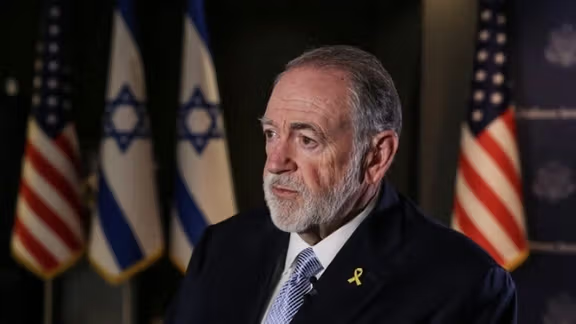
Controversial remarks by “Mike Huckabee,” the U.S. Ambassador to Israel, in which he describes Israel’s right to sovereignty over vast portions of the Middle East based on the Bible, have provoked severe political and diplomatic reactions.
A group of Arab and Islamic countries, in response to the controversial statements made by Mike Huckabee, the United States Ambassador to Israel, who stated in a recent interview that based on his interpretation of the Bible, Israel could occupy a large portion of the Middle East, have condemned these remarks by issuing official statements.
In response to a question from conservative American broadcaster “Tucker Carlson” about the meaning of a verse from the Book of Genesis, Huckabee said that according to his interpretation, the Promised Land given to the Jewish people spans “from the Nile to the Euphrates,” encompassing extensive portions of the Middle East, and when asked whether Israel has the right to take it, he replied: “If they took it all, that would be fine.”
These statements have been described in media and analyses as unprecedented and inflammatory, and have been met with severe reactions from Islamic and Arab countries, who have called them dangerous, inflammatory, and contrary to the principles of the United Nations Charter and international law.
Countries such as Saudi Arabia, Egypt, Jordan, the United Arab Emirates, Qatar, Kuwait, Oman, Bahrain, Lebanon, Syria, Palestine, Indonesia, Pakistan, and Turkey condemned these statements in joint or separate statements. Many of these countries stated that Huckabee’s remarks not only threaten regional security and stability but also violate the national sovereignty of countries in the region.
Some of these reactions included:
- Saudi Arabia called Huckabee’s remarks “irresponsible” and “unacceptable,” and called for clarification from the U.S. State Department.
- Jordan described these statements as an attack on the territorial integrity of countries in the region.
- Egypt emphasized that Israel has no sovereignty over occupied Palestinian territories or other Arab lands.
Following this diplomatic pressure, the U.S. Embassy in Israel announced that Huckabee’s remarks were “taken out of context” and do not represent any formal change in American policy. According to this statement, Huckabee emphasized that Israel is not seeking to occupy or take over other countries, and the subject of discussion in the interview pertained to the country’s current security and lands.
Huckabee, an appointed ambassador in the U.S. administration and a prominent activist in the Christian Zionist movement, has previously expressed views that, based on religious-political perspectives, emphasize broad support for Israel. Some analysts have noted that these views cause his opinions on sensitive Middle Eastern issues to be excessively harsh and outside the scope of conventional diplomatic approaches.
This controversy has occurred while political and military challenges in the region continue, particularly the instability associated with the war in the Gaza Strip and tensions between Israel and Iran, a matter that international analysts also refer to when analyzing the strategic views of the United States and its allies.
In total, Huckabee’s remarks have caused Arab and Islamic countries to once again emphasize the necessity of respecting national sovereignty and international law, and have asked the international community to reject views that could potentially fuel religious and political tensions.