Visual Propaganda or Satanic Ritual? The Truth Behind the ‘Baal Idol’ and Claims of Sacrifice to ‘Moloch’ on February 11
Amid widespread dissemination of videos related to the “Baal idol” at the February 11 ceremonies, some Instagram posts have gone further, speaking of “satanic rituals” and “sacrifice to Moloch (Molek)”; but what is the reality?
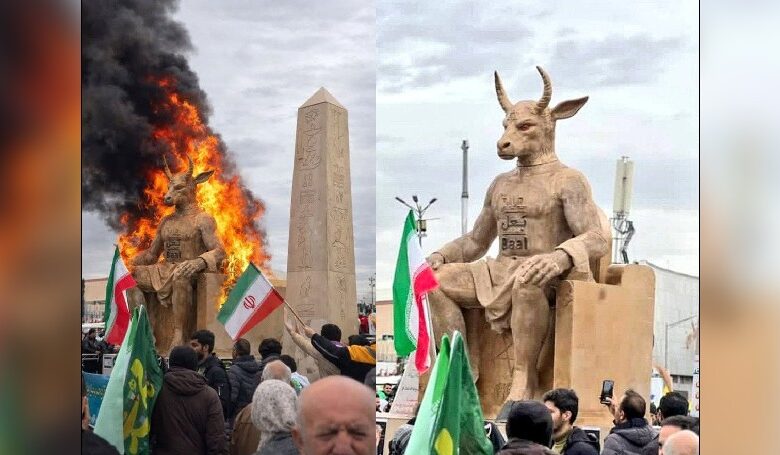
Coinciding with the government ceremonies of February 11, 2025 in Iran, videos were published on social networks showing a statue with a mythical appearance (which some media outlets referred to as the “Baal idol”) being set on fire during a procession. These images quickly spread across social media and sparked widespread reactions.
A review of Persian and English news media shows that the basic facts of the burning of a symbolic statue on the sidelines of the ceremony have been confirmed. However, no official or credible media report has been published about the staging of a “satanic ritual” or “sacrifice ceremony to the god Moloch or the Molek idol,” and what the reason for burning this statue was at the Islamic Republic’s revolution victory ceremony remains unclear.
But where did the claim of sacrifice to Moloch or Molek come from on social networks? Following the spread of these videos, some Instagram user accounts claimed that the Islamic Republic sacrificed revolution martyrs “to Moloch” in this ceremony. In these posts, it was claimed that the constructed statue was a symbol of “Moloch” and writings with satanic meanings were inscribed on it, while the name “Baal” was written on the statue’s chest.
However, field reports suggest that such claims are not documented. No credible news source, either within Iran or in international media, has published a report of the performance of a sacrifice ritual or the offering of people to “Moloch.”
In Old Testament texts, “Baal” and “Molek” are two separate designations for ancient gods of the Levantine and Canaanite regions. The Bible repeatedly forbids the Israelites from worshipping these gods. In some historical accounts, Molek has been associated with human sacrifice rituals; a matter that has always been severely condemned in prophetic literature.
However, in the February 11 incident, what is seen in the images is the burning of a symbolic statue, an act that is more political and propagandistic in nature than a religious ritual in the strict sense of the word. To date, no document has been presented showing that a ceremony of a “religious sacrifice” nature took place.
Media experts believe that in the polarized environment of social networks, symbolic images are quickly combined with eschatological or theological interpretations. Particularly among some Christian users or opponents of the Islamic Republic, references to concepts such as “Moloch” or “worship of Baal” carry significant semantic weight and can lead to the formation of shocking narratives.
Nevertheless, it is necessary to distinguish between field reality and ideological interpretations. What has been documented so far is merely the construction and burning of a symbolic statue at a government ceremony, not the performance of a satanic ritual or the offering of people killed in protests.
The claims raised in some Instagram posts about “sacrificing the martyrs to Moloch” lack journalistic backing and credible documentation. In a space where narrative warfare intensifies daily, it is the responsibility of Christian media outlets to maintain the boundary between spiritual analysis and documented news, while being theologically sensitive to symbols of idolatry.