Media Audacity at the Peak of Mourning; Mockery of Protesters’ Bodies and the Farcical Display of Government ‘Justice’
Media audacity and mockery of protesters’ bodies are not an individual mistake, but rather a reflection of the true face of a regime that both kills and ridicules the wounds it inflicts.
While families of those killed in the December 2025 protests are still mourning loved ones taken from them by bullets and government suppression, the media outlets affiliated with that same power structure have, instead of accountability and taking responsibility, resorted to open mockery and insult of the victims—behavior that has not only provoked public outrage but inflicted fresh wounds on grieving families.
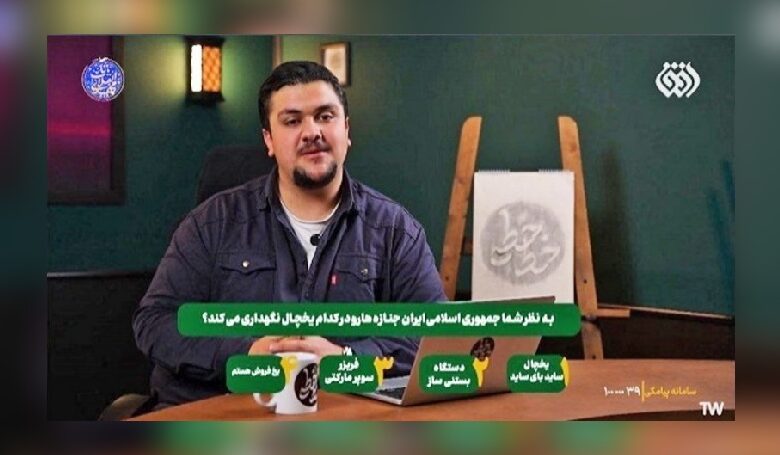
A video circulated on social media on Sunday, Bahman 12, in which a program host, with a mocking smile and a tone mixed with ridicule, posed a question that lays bare the moral depravity of state-controlled media. He asks viewers: “In what refrigerator does the Islamic Republic store bodies?” Then he offers multiple-choice answers, as if discussing the corpses of human beings whose families are still living in shock, fear, and mourning were nothing more than material for television jokes and victim humiliation.
Today, Monday, Bahman 13, 2025, the “Mizan” news agency, affiliated with the Islamic Republic’s judiciary, announced that the Tehran prosecutor has filed charges against the director of Ofogh network at the time, its officials, and a television program presenter, and a legal case has been opened against them. This announcement came following the widespread circulation of a video from the “Khat-Khati” program on the “Ofogh” network affiliated with the Islamic Revolutionary Guards Corps—a program that blatantly mocked the killing of protesters.
After the wave of public anger escalated, Mizan news agency wrote: “Additionally, investigation and inquiry into the possible motives that may underlie the production and broadcast of this insulting program are on the agenda of the relevant judicial authorities.”
Shortly after, the Islamic Republic of Iran Broadcasting Organization’s public relations announced that “Sadegh Yazdani,” the director of Ofogh network, has been removed from his position following the broadcast of a program with content that was “insulting to martyrs and those killed in the December events,” and the broadcast of the “Khat-Khati” program has also been suspended.
However, what the regime is attempting to frame as a “judicial response” and answer to public opinion is, in the view of many, nothing more than another thin and insulting theatrical performance. A performance in which the very system that killed protesters, arrested them, concealed bodies, and threatened families, now pretends to be shocked by the mockery of corpses.
This blatant contradiction, more than anything else, exposes the structural hypocrisy of the Islamic Republic. A media apparatus that has for years been the propaganda arm of repression suddenly becomes a victim in order to keep the real issue hidden: “The regime’s direct responsibility for the killing of citizens.”
Filing charges against a few presenters or media managers is neither healing for the families of those who have not even been allowed to hold proper mourning ceremonies nor answering for the blood spilled on the streets. These actions are more akin to sacrificing second-tier pawns—a desperate attempt to preserve a crumbling facade.
On the other hand, the very broadcast of such a program demonstrates that mocking the death of protesters is not an individual slip, but rather part of the culture that governs media outlets affiliated with power—a culture that sees the victim as a “statistic,” a “body,” or “material for jokes,” rather than as a human being.
For families who have lost their children to bullets, hearing these statements is not merely an insult, but adding salt to the open wound of grief.
The public knows well that justice cannot be achieved through these theatrical scenarios. As long as the masterminds and perpetrators of the killing of protesters remain safely ensconced in the margins of power, every other “filing of charges” will be nothing more than a discredited political performance—a performance that neither restrains society’s anger nor conceals the truth.
These cases are not a sign of strength, but rather a symptom of the structural decay of a system that, in moments of crisis, sacrifices even its closest propaganda tools—without for a moment considering the pain of a people who are still grieving and still seeking answers.