Market on the Brink of Another Explosion; Tehran Merchants’ Call for Commemoration of the Forty Days of the Fallen and Continuation of National Uprising
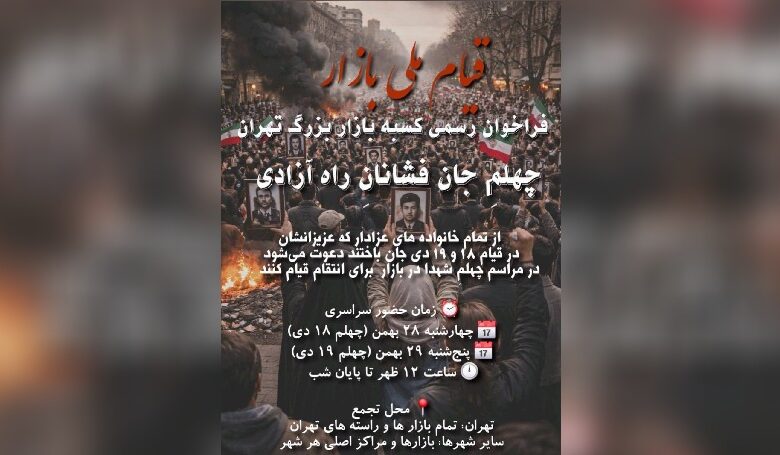
The Tehran market’s call for the commemoration of the forty days of those killed is a clear sign that not only has the national uprising not been extinguished, but popular protests have entered a new phase.
In the aftermath of widespread discontent and the bloody crackdown on protests on the 18th and 19th of Dey, a group of merchants from Tehran’s grand bazaar have announced the holding of a forty-day commemoration ceremony through an official call; a call that is being noted as a serious sign of the continuation and reproduction of popular protests and the return of the market as one of the historic centers of Iran’s social and political transformations.
Based on this call, which has been circulated among merchants and social networks in recent days, Tehran’s bazaar merchants have, in clear language, invited the families of those killed in the nationwide protests to attend the forty-day commemoration ceremony.
The full text of this call is as follows:
“All grieving families whose loved ones were killed in the uprising on the 18th and 19th of Dey are invited to hold a nationwide gathering at the forty-day commemoration ceremony of the martyrs in the market for vengeance and uprising. Time of nationwide attendance: Wednesday, the 29th of Bahman for the forty-day commemoration of those killed on the 18th of Dey and Thursday, the 29th of Bahman for the forty-day commemoration of those killed on the 19th of Dey, from 12 noon until the end of the night. Location of gathering: Tehran, all bazaars and streets of Tehran and other cities: in the bazaars and main centers of each city.”
The release of this call occurs in circumstances where the December protests were accompanied by widespread crackdowns, direct fire on protesters, internet shutdowns, and mass arrests, with thousands of citizens losing their lives in various cities. Despite this level of government violence, the bazaar’s new call demonstrates that the protest movement has not only not stopped, but is redefining itself within the framework of historic symbols of civil resistance.
The bazaar in contemporary Iranian history has always played a decisive role in political transformations, and its return to the protest scene is viewed by observers as a sign of the spread of discontent from social layers to the country’s economic body. In this context, many view this call not as an isolated event, but as another invitation to a national popular uprising; an uprising rooted in suppressed anger, collective grief, and the demand for justice.
However, serious concerns have simultaneously been raised about the possibility of a repeat of violence and an increase in casualties. Experience from previous protests has shown that the Islamic Republic’s security forces have not hesitated to use deadly force even in encounters with peaceful gatherings. For this reason, human rights activists warn that this call could put more citizens’ lives at risk.
In such circumstances, attention is focused on the reaction of the international community, human rights institutions, and international media. Silence or indifference toward this call and its potential consequences could lead to a repetition of the cycle of violence and impunity for those responsible for the crackdown.
Observers emphasize that international support, extensive media coverage, and diplomatic pressure could play an important role in reducing the human cost of these protests.
The call by Tehran’s bazaar merchants, regardless of its harsh and protesting tone, carries a clear message: “The national uprising of the Iranian people has not been extinguished.” Mourning has not turned into silence, and the forty-day commemoration of the fallen has once again become a point for reinterpreting public anger and demanding change.