Desecration of Caldean and Assyrian Christian Cemetery in Koya, Iraq
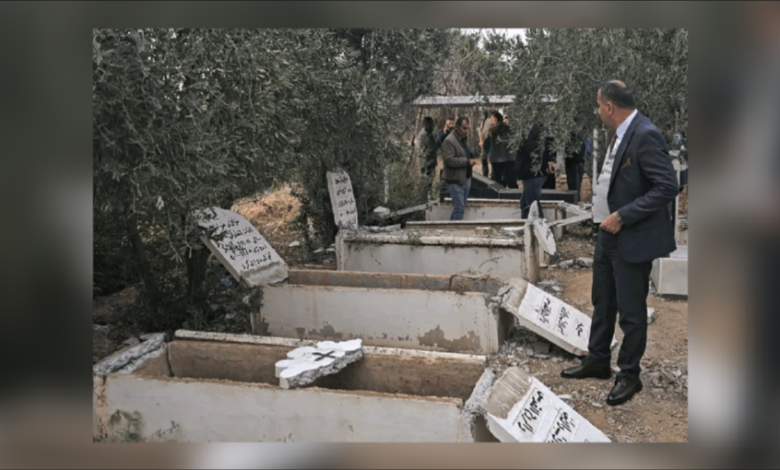
The cemetery of Caldean and Assyrian Christians in Koya, Iraq, has come under attack by Islamist groups, resulting in broken gravestones and the opening of several coffins.
On December 3, 2025, the Christian cemetery located in the “Harmouthe” area in the “Koya” section of Erbil province in northern Iraq, which belongs to Caldean, Assyrian, and Syriac communities, became a target of destruction and desecration.
According to reports published by various media outlets, more than 15 graves in this cemetery have come under attack, with gravestones broken and some graves opened. According to witness accounts, a large number of gravestones have been broken with hammers and various tools, and some graves have remained uncovered and open.
The Christian community of the region, expressing severe anger and grief, emphasized the point and said: “Even our eternal resting places have not been spared from the harm of Islamist groups.” This reaction reflects fears of renewed targeting of Christian heritage in Iraq.
In response to the attack, officials and institutions, while emphasizing pursuit and reconstruction of the graves, issued immediate orders to establish an investigation committee at the level of Erbil province. According to a statement by the Kurdistan Regional Government, a high-level committee has been formed to investigate the incident, and reconstruction of the cemetery will begin at official government expense.
“Masrour Barzani,” Prime Minister of the Kurdistan Region, described the attack as “a sabotage and shameful act” and emphasized that security authorities should quickly identify and punish those responsible. On the other hand, the Caldean Church of Erbil thanked the government for its reconstruction efforts and attempts to protect Christian dignity.
Christian representatives in the Kurdistan Regional Parliament also warned that this attack is not only against Christians, but is a direct blow to the foundations of coexistence and diversity in Koya and all of Kurdistan.
The Assyrian Democratic Movement (ZOWAA) and Beth Nahrain Patriotic Union have also described this incident as part of “a continuous pattern of attacks on Christian cemeteries and sacred places” and warned that these actions target not only Christian heritage, but also the foundations of social peace.
In a statement by representatives of the Christian community, it was said: “Muslims and Christians have lived together on this land for years; but the attack on our graves shows that the danger of division and hatred still exists.
In recent years, the Christian community in Iraq, including Caldeans, Assyrians, Syriacs, and Armenians, has suffered severely. It is estimated that before 2003, the Christian population of Iraq was between 1.2 to 1.5 million people, but over the past two decades, amid war, displacement, security and economic pressures, this number has dropped to below 250,000.
Although the Kurdistan Region of Iraq and cities such as Erbil and Koya have historically been known for religious and ethnic coexistence, this incident reminds us that even Christian cemeteries are under threat; a matter that concerns the Christian community about their future presence in this land.
The recent attack on the Christian cemetery in Koya is not merely an ordinary act of vandalism, but rather a shocking sign of the continuing threat against Iraqi Christians and their historical-religious heritage. Although officials have promised prosecution and reconstruction, this incident shows that religious minorities in Iraq continue to face the danger of hatred-mongering and violence, even against the dead. For the Iraqi Christian community and Christians around the world, this incident is a serious warning. To preserve the identity, history, and security of minorities, there is a need for vigilance, solidarity, and global support.