France: Iran Has Only Days to Accept JCPOA Revival Deal
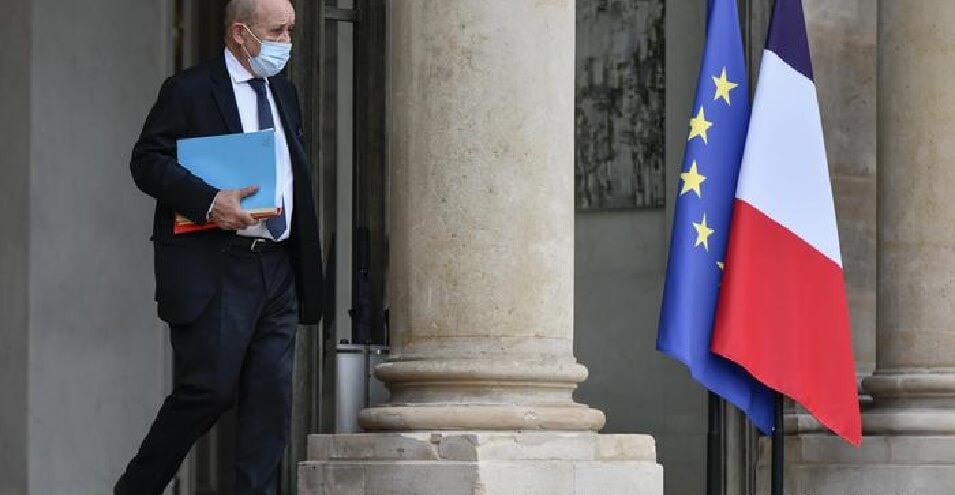
France’s foreign minister warned that Iran has only a few days, not weeks, to accept an agreement that would lead to the revival of the JCPOA. He says Vienna negotiations have reached a decisive point and are awaiting Iranian political decisions.
Jean-Yves Le Drian on Wednesday, February 16 (February 27 in Persian calendar) warned the Islamic Republic in the French Senate that the remaining time to accept a deal on reviving the JCPOA is only a few days.
According to Reuters, France’s foreign minister stated that Vienna negotiations have reached a decisive stage, adding that Iran in the coming days will either face a serious crisis or accept an agreement that meets the interests of all parties.
He emphasized that under current circumstances, Iran needs to make its political decisions, and they have a very clear choice ahead of them.
Meanwhile, Emmanuel Macron, president of France, and his Chinese counterpart Xi Jinping held a telephone conversation on Wednesday, during which they discussed Vienna negotiations among other topics.
The French presidency office stated in a statement that during this conversation, Macron and Xi Jinping agreed on the necessity of increasing joint efforts to reach an agreement with Iran on reviving the JCPOA.
A new phase of the eighth round of Vienna negotiations began last week. The three European signatories to the agreement and the United States, which participates indirectly in these negotiations, have repeatedly emphasized that due to rapid progress in Iran’s nuclear activities, the fate of JCPOA revival must be clarified as soon as possible and by the end of February.
According to FARS news agency, Iran’s foreign minister on Monday, February 14 (in Persian calendar), in a joint press conference with his Irish counterpart, called an agreement in Vienna negotiations “accessible.”
Tehran’s Contradictory Messages
According to the report, Hossein Amir-Abdollahian, while emphasizing Iran’s readiness to reach a “good agreement,” asked European countries and the United States to “instead of playing with text and time,” demonstrate their genuine intention to return to the JCPOA.
Regarding the prospects of JCPOA revival negotiations, he said: “For Iran, if an agreement is reached in Vienna today, that is better than if it happens tomorrow. We are in a hurry to reach a good agreement, but within the framework of rational negotiations and within the framework of achieving our nation’s rights and interests.”
Said Khatibzadeh, spokesman for the Foreign Ministry, also emphasized on Monday that despite remaining sensitive and key issues, there is “no deadlock in Vienna negotiations,” and if the “logic that Iran has put on the table” is respected by European and American parties, an agreement could be announced as soon as tomorrow.
Despite these emphases about willingness to reach an agreement in the near future, Ali Shamkhani, secretary of the Supreme National Security Council, wrote on Sunday in a tweet that after a telephone conversation with Ali Bagheri Kani, head of Iran’s negotiators, the “moment-by-moment increase in the difficulty of work” has become certain for him.
Shamkhani and the JCPOA Shell?
Shamkhani also wrote on his Twitter page Wednesday morning, accusing Europe and America of breach of commitment, stating: “Now the JCPOA has become an empty shell for Iran in the economic sphere and sanctions relief.”
The secretary of the Supreme National Security Council in this message considered “America’s breach of commitment and Europe’s inaction” as factors due to which “no negotiations beyond the JCPOA will take place.”
Western countries have consistently sought to add Iran’s missile programs and regional activities to JCPOA negotiations, and Shamkhani’s reference could mean that these requests have been seriously raised and could be one of the possible reasons for lack of progress in negotiations.
Iran in Vienna negotiations relies heavily on support from China and Russia. These countries signed all sanctions resolutions against the Islamic Republic before the nuclear agreement, and now France’s foreign minister says three European countries, China, Russia, and the United States have converged to reach an agreement.
Amir-Abdollahian’s Request to U.S. Congress
One of Iran’s preconditions for returning to fulfill JCPOA commitments is receiving guaranteed assurance from the United States that it will not withdraw from the nuclear agreement again.
The United States has called this request unacceptable and impractical because the current U.S. administration cannot provide such assurances on behalf of future administrations.
Amir-Abdollahian told the Financial Times that the U.S. Congress should issue a political statement on that country’s JCPOA commitments and return to the nuclear agreement.
Most members of the U.S. Congress, even some Democratic representatives and senators, are among the JCPOA critics, and it appears that raising such a request, if serious, would further fuel the “serious crisis” that Le Drian spoke of.
Source: DW