‘Ali Justice’ Provides ‘Confidential’ Correspondence from Evin Prison to Radio Farda
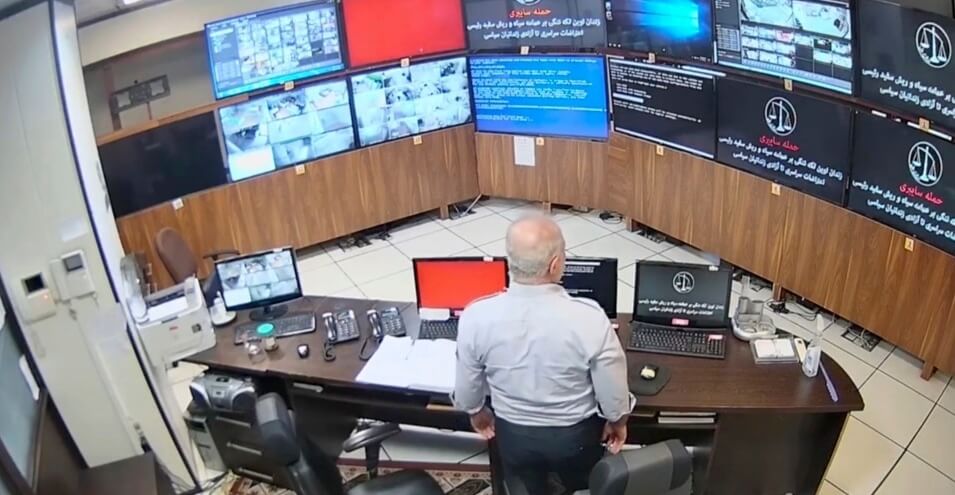
The cyber group ‘Ali Justice’ has provided Radio Farda with new ‘confidential’ documents from Evin Prison containing correspondence between prison officials regarding the conditions of some political and ideological prisoners.
According to these documents, any form of protest, hunger strike, and distribution of letters by prisoners has been treated as ‘criminal’ behavior.
In one of these letters, Gholamreza Mohammadi, then head of information protection at Evin Prison, called for the punishment of prisoners for distributing letters, statements, and audio files in cyberspace, and referred to the “successful benefit obtained from canceling in-person visits for Nazanin Zaghari,” which according to him “ultimately led to ending her strike.”
Addressing the then-head of Evin detention center, he called for “separating guilty prisoners and restricting their welfare facilities, such as in-person and private visits.” The first line of one letter states that “the number of prisoners in Evin detention center on 20 July 2020 was 2,695 people.”
The ‘Ali Justice’ group says it has prepared these documents for the purpose of disclosure. Radio Farda cannot independently verify the authenticity of these documents.
On August 22, the group provided Radio Farda and several other media outlets with videos that it said were obtained by hacking Evin Prison’s security cameras. The images contained footage of mistreatment of prisoners.
In another letter provided to Radio Farda, Ali Chaharmahal, director of Evin detention center, referring to Maryam Akbari Monfared’s hunger strike, accused her of “disrespecting and insulting officials” and wrote to the head of the protection and information department of prisons in Tehran Province that “based on inquiry from the women’s ward, the aforementioned prisoner, as previously, explicitly and maliciously expressed hostility toward Iran’s sacred Islamic Republic system and, if any events or incidents contrary to her values and ideology occur, shows no fear or apprehension of insulting prison officials.”
He called for transferring Ms. Akbari Monfared to Rey Prison.
At least two letters from the documents provided to Radio Farda are related to Mohammad Nourizad. In one of these letters, addressed to the performance, inspection, and complaint response department of Tehran Province prisons, it states that Mohammad Nourizad “according to the announcement from the head of Ward 6 of this center, continues his self-harm and hunger strike.”
In another letter, Gholamreza Mohammadi, then head of information protection at Evin detention center, reported to the head of protection and information of Tehran Province prisons that Mohammad Nourizad “has repeatedly engaged in publishing lies and issuing statements since his transfer to this detention center. His phone card had been blocked by court order for a period, but after obtaining a commitment from him not to conduct interviews and issue statements, his card was reactivated by court order, but after some time, the aforementioned person conducted interviews, published lies and issued statements.”
Gholamreza Mohammadi called for investigating this matter and claimed that Mr. Nourizad “in contact with his wife through conjugal visit, began conducting interviews with the ‘Kalmeh’ television network and in these interviews insulted Iran’s sacred Islamic Republic system, the great founder of the revolution, the supreme leader, and also made false statements about executed prisoner Navid Afkari.”
From the content of another letter, it appears that prison officials obstructed Nasrin Sotoudeh’s visits with her family in prison, and imposed conditions on her such as signing a written commitment to “observe hijab” according to officials’ preferences, putting her under pressure in this regard.
In one of these letters, Dervishes are mentioned under the title of one of the “terrorist groups” and on par with ISIS and Re-Start, and officials were asked to be “vigilant” against possible actions by Dervishes.
Disregard for Prisoners’ Health
In another confidential letter obtained by Radio Farda, the health condition of Khorein-Varamin Prison is described as “unsuitable,” noting that despite coronavirus conditions, “60 prisoners on the floor” are placed at minimum distance from each other, separation of sick prisoners from other prisoners is not conducted, and sending ill prisoners to medical centers “is rarely done.”
In another letter, it is stated that one of the Evin Prison “beneficiaries” went on a hunger strike in protest against “Sepah obstruction and human rights violations” regarding Arash Sadeghi, a human rights activist, because officials prevented his transfer to the hospital.
Prisoners’ hunger strikes due to legal problems and subsequent “monitoring of their vital signs” by officials, prisoners’ self-harm in the form of repeatedly hitting their heads against bathroom mirrors (and breaking five mirrors) because officials prevented them from being sent to medical centers, and guards’ indifference to the repeated movements of “unknown” individuals despite the coronavirus situation, are among other points mentioned in several of these letters.
Evin Prison is Iran’s most famous prison, where political prisoners are held in various wards. Some of its wards are also under the supervision of security bodies such as the Islamic Revolutionary Guard Corps intelligence service, over which there is no oversight.
The European Union in March this year added Evin Prison along with Tehran Central Prison (Fashafuyeh Prison) and Rajaei Shahr Prison to its sanctions list on charges of human rights violations and suppression of November 2019 protests.
Source: Radio Farda