Eight Baha’i Citizens Summoned in Birjand to Serve Prison Sentences
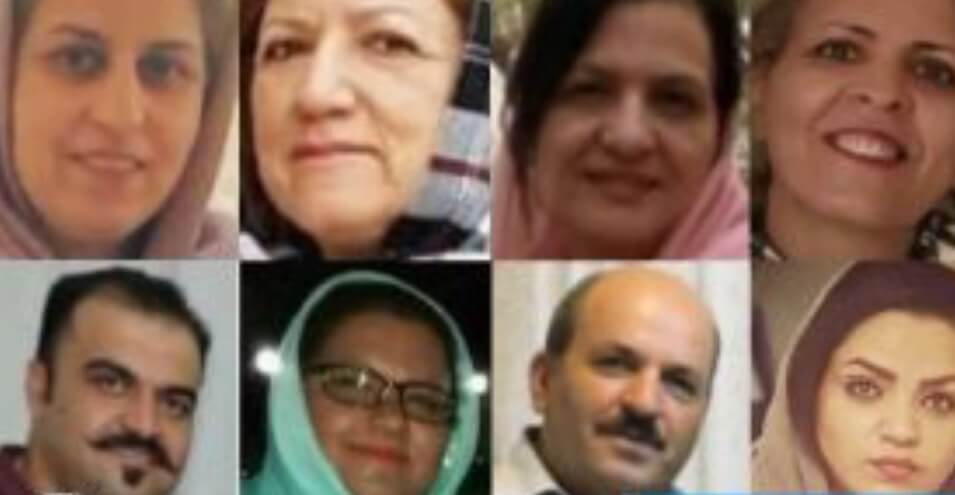
Atiyeh Salehi, Nasrin Qodiri, Banafsheh Mokhtari, Farzaneh Dimi, Arzoo Mohammadi, Atalollah Malaki, Roya Malaki, and Saeed Malaki—eight Baha’i citizens residing in Birjand—have been summoned through separate summonses to the enforcement unit of Birjand Court to serve their prison sentences. These Baha’i citizens were previously sentenced in September of this year by the Fourth Branch of the South Khorasan Provincial Court of Appeals to a total of 11 years and 3 months in punitive imprisonment.
According to Hrana news agency, the news organization of the Iranian human rights activists collective, eight Baha’i citizens residing in Birjand have been summoned to the enforcement unit of Birjand Court to serve their prison sentences.
Atiyeh Salehi, Nasrin Qodiri, Banafsheh Mokhtari, Farzaneh Dimi, Arzoo Mohammadi, Atalollah Malaki, Roya Malaki, and Saeed Malaki are eight Baha’i citizens who have been summoned through separate summonses to serve imprisonment. These individuals have been instructed to report to the enforcement unit of Birjand Court within ten days from receiving this notification to serve their prison sentences.
These citizens were previously tried at the primary stage alongside another Baha’i citizen named Rahmatollah Dimi and were sentenced to a combined total of 51 years and 8 months in punitive imprisonment. Based on this verdict, Atiyeh Salehi, Atalollah Malaki, Farzaneh Dimi, Nasrin Qodiri, Banafsheh Mokhtari, Arzoo Mohammadi, Saeed Malaki, and Roya Malaki were each sentenced by Branch 2 of the Revolutionary Court of Birjand, presided over by Judge Hojat Nabavi, to 6 years of punitive imprisonment, while Rahmatollah Dimi was sentenced to 3 years and 8 months of punitive imprisonment due to advanced age.
Following the defendants’ objections to the issued verdict, the Fourth Branch of the South Khorasan Provincial Court of Appeals, presided over by Judge Ibrahim Ramezani and with legal advisor Hamid Arab Zadeh, on September 7, 2020, sentenced Nasrin Qodiri, Farzaneh Dimi, and Banafsheh Mokhtari to 15 months of punitive imprisonment each on charges of “membership in illegal organizations and activities detrimental to security by the misguided Baha’i sect,” and sentenced Arzoo Mohammadi, Atalollah Malaki, Roya Malaki, Atiyeh Salehi, and Saeed Malaki to 18 months of punitive imprisonment each on the same charge. The court also acquitted Rahmatollah Dimi of the charges brought against him.
Additionally, a one-year prison sentence imposed on all defendants on the charge of “propaganda in favor of the Baha’i organization as a group and organization opposed to the sacred system of the Islamic Republic” was removed. The court stated the reason as follows: “Since this action of theirs has resulted in conviction under the first charge, therefore this action does not warrant a separate sentence.”
Previously, an informed source told Hrana’s reporter about the circumstances of these arrests: “During the bicentennial celebration of the birth of Baha’u’llah, the prophet of the Baha’i faith, arrests of Baha’is and sealing of their businesses took place in various cities across Iran. The city of Birjand was not spared from these attacks on the Baha’i community, and security forces in Birjand district visited the homes of these individuals in late October 2017, conducted house searches, and confiscated some of their belongings. These citizens were summoned to court twice for interrogation in 2019, with their court date scheduled for April 21, 2020, and they received notification of the verdict by text message on April 22, and their verdict was made available on the website on April 23.”
This informed source also told Hrana regarding the circumstances of Nasrin Qodiri, who is not originally considered a resident of this city: “Ms. Qodiri is 60 years old and resides in Mashhad. She only lived temporarily in Birjand from 2014 to the end of 2017 to care for her father who was ill. In October 2017, when the intelligence agency conducted home inspections of Baha’is, Ms. Qodiri was in Mashhad and was not in Birjand, but security forces still confiscated and took away her personal belongings when they visited her father’s home in Birjand. She had also been detained and imprisoned in 1983 and 2010.”
Baha’i citizens in Iran are deprived of freedoms related to religious beliefs. This systematic deprivation occurs despite Article 18 of the Universal Declaration of Human Rights and Article 18 of the International Covenant on Civil and Political Rights, which state that everyone has the right to freedom of thought, conscience, and religion, including the freedom to change religion, and the freedom to manifest these beliefs individually or collectively, publicly or privately.
Based on unofficial sources, there are more than 300,000 Baha’is in Iran, but Iran’s constitution only officially recognizes Islam, Christianity, Judaism, and Zoroastrianism, and does not recognize the Baha’i faith as an official religion. For this reason, the rights of Baha’is in Iran have been systematically violated over the past years.
Source: Hrana