Major Controversy Over ‘Desecration of Sanctity’ at Shrines in Qom and Mashhad
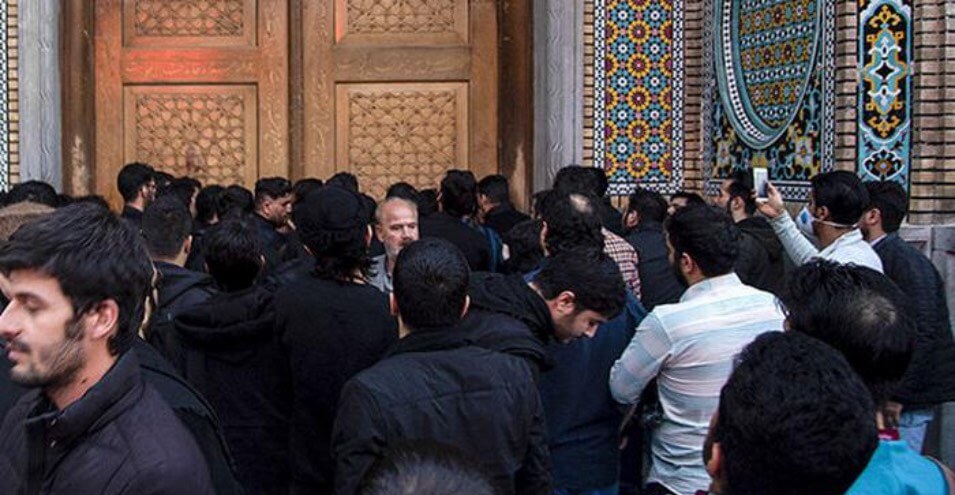
Following attacks by groups in the cities of Qom and Mashhad on the shrines of “Lady Masoumeh and Imam Reza,” the Management Center of Islamic Seminaries in Iran and many public figures have reacted to the incident. Some attackers and protesters have been labeled “English Shias.”
Following attacks on the “Shrine of Lady Masoumeh” in Qom and the shrine of the Eighth Imam of Shias in Mashhad, which occurred last night in protest against the temporary closure of these religious sites to pilgrims, the Management Center of Islamic Seminaries across the country issued a statement reacting to the “desecration of the sacred sanctuary of the Mistress of the Household of the Prophet.”
According to ISNA news agency, the center’s statement regarding the incidents at the “Shrine of Lady Masoumeh” in Qom stated: “Contrary to some misguided views and the malicious insinuations of ill-wishers and foreigners, the clergy and seminaries have been and will continue to be supportive and cooperative in all legal, expert, and national decisions, a principle that will continue to be upheld.”
The Management Center of Islamic Seminaries further noted: “It is clear that an approach combining focus with rationality and spirituality in overcoming these coronavirus days is the most important principle that should not be overlooked.”
In this statement, the attackers on the shrine were referred to as “ill-wishers and enemies of the nation, revolution, and Islam” who “have failed the worst test in this trial… and through extremist actions contrary to Islamic norms, have sought to strike blows against the nation and revolution.”
Why did they attack the shrine?
The doors of the “Shrine of Lady Masoumeh” in Qom and the “Shrine of Imam Reza” in Mashhad have been closed to prevent further spread of coronavirus.
This decision—to temporarily suspend shrine visits from Tuesday, the 27th of Esfand—was announced by the custodian of the Razavi Holy Shrine following directives from the National Coronavirus Taskforce and the Health and Medical Education Minister. Ayatollah Ahmad Marvi, announcing this news and referring to the “exceptional circumstances” which are not “slogans,” “political maneuvering,” or “rumors,” described coronavirus as a serious threat to the world that “is no laughing matter.”
With the closure of the doors, some gathered in protest of this decision in Qom and Mashhad outside the shrines, and in Qom, according to domestic websites, they broke one of the shrine’s doors. Iranian news agencies, reporting this incident, referred to these groups as “norm-breakers,” “extremists,” “rioters,” and “coordinated and pre-planned.”
Domestic news agencies write that individuals who had gathered in Qom, by chanting slogans, considered this decision “blind adherence to anti-religious recommendations from the World Health Organization.” In Mashhad as well, a group of “50 to 60 people” attempted to enter the shrine by attacking “the entrance of Bab-al-Jawad and several other entrances.” According to published reports, these individuals clashed with officials and addressed them with “profanities and vulgar language.”
According to domestic news agencies, the police commander of Qom Province announced the formation of a security council in the aftermath of this incident. Commander Aqakhani referred to full alert of police and security forces “inside and outside the shrine” and stated: “If orders are issued for police forces to enter the holy shrine, we will deal with the sit-in protesters.”
Meanwhile, an informed official in the police force told ILNA news agency that two of the “norm-breaking” protesters in Qom have been arrested.
Calls for action against “rigid-minded individuals”
The attack on the shrines, breaking of the shrine entrance door, and clashes with police have sparked numerous reactions. Ayatollah Chitsazian, a lawyer, in an interview with ISNA, described the “desecration of sanctity at the shrines” by “stubborn radical individuals” as “contrary to regulations” from a legal perspective and “improper” and “a form of opposition to the Supreme Leader” from a jurisprudential standpoint.
Ali Motahari reacted to this event in a tweet, calling those who attacked the shrine “rigid-minded,” and demanding their punishment “both for helping spread the coronavirus and for damaging Islam and Shia Islam.”
Mohammad Ali Abtahi, a reform-oriented activist who referred to the attackers as “religious extremists,” wrote: “One of the major challenges is dealing with these groups that have enjoyed comprehensive support thus far.”
Ahmad Mazni, representative of Tehran in the Islamic Consultative Assembly, called the breaking of “the sanctity of the Household of the Prophet’s shrine” “sacred ignorance” in his tweet and wrote: “Where were the authorities that they could not prevent such barbaric transgressions?”
Mohammadjavad Akbarin, a political activist and religious scholar residing in France, also tweeted: “Who would have thought that defenders of the shrine would attack the shrine of Imam Reza in Mashhad and his sister’s shrine in Qom while chanting ‘God is Great’? The coronavirus split the shells to reveal their core and essence!”
Who were the attackers—”English Shias” or “revolutionary youth”?
The ISNA news agency in its report from last night referred to the attackers and protesters as individuals whose “formal affiliation to a specific political and religious group or faction has not yet been determined.” Other news agencies also described the action as “a suspicious act” whose “possible affiliation to any political or religious current has not yet been determined.”
Hamshahri Online, citing an “informed source,” writes: “There are two to three factions that from the beginning insisted the shrine of Imam Reza should remain open, and it is not yet clear whether the presence of these individuals tonight was intentional or if they came to the shrine unknowingly. It has been scheduled for Tuesday morning to hold a meeting with religious councils at the provincial governorate regarding this matter.”
Many users known as principalists on Twitter attribute this action to “English Shias.” A Twitter user wrote: “In contrast to websites that call opponents of coronavirus restrictions and law-breakers who violated the shrine ‘a known group’ or ‘English Shias,’ this group themselves say they are none of these but rather ‘revolutionary youth and they all know each other.'”
On social media, videos have been shared in which protesters against the closure of the Mashhad shrine’s doors shout, among other things: “Tehran made a mistake, the minister made a mistake, the president made a mistake.”
One user tweeted: “The result of years of special attention and giving a field to a specific class is that they will no longer be bound by any law and see themselves above any law, becoming selfish and tyrannical. What happened yesterday in Qom and Mashhad is the result of years of monopolizing the discourse by a specific class that has rarely been held accountable and today stands against the people.”
Another user wrote: “As long as this group savagely attacked the people, they were ‘faithful, revolutionary, principled, and insightful people’ who ‘acted at their own discretion,’ and Khamenei and state media encouraged them, but now that this same group broke the door of the Shrine of Lady Masoumeh, they suddenly became ‘English Shias’!”
The tweet of Mohammad Reza Zaeri, a critic of the Iranian government’s approaches, regarding the identity of the shrine attackers has also sparked many reactions on Twitter. Ayatollah Zaeri wrote: “Did you see how they angrily shout out of their beliefs and howl out of their zeal and, for instance, break their faith in the shrine and want to set everything on fire and tear everyone’s stomach open! Gentlemen, don’t be surprised! You created and raised these people, there is no remedy for one’s own creation!”
Source: DW