Judiciary Responds to Criticism Over Heavy Sentences Against Civil Activists
Following mounting criticism over heavy sentences imposed on several civil and labor activists, the head of the judiciary has called for a swift review of these sentences. Seven defendants in the Haft Tappeh protest case have been sentenced to a total of 110 years in prison by the Revolutionary Court.
Tasnim News Agency reported on Sunday, September 17, citing the judiciary’s media center, that the head of the judiciary, Ibrahim Raisi, has ordered a swift review and fair examination of “rulings issued by one of the branches of the Revolutionary Court in some recent cases,” under the supervision of Tehran’s Chief Justice.
According to available evidence, Raisi’s order pertains to sentences issued by Branch 28 of Tehran’s Revolutionary Court against seven defendants in the Haft Tappeh labor protest case.
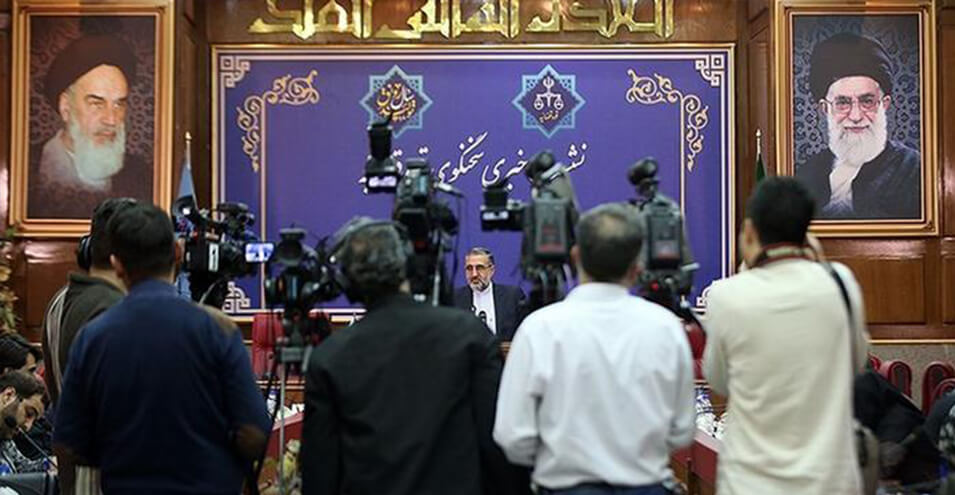
Judiciary spokesperson Gholamhossein Ismaili said: “The head of the judiciary emphasizes the importance of listening to workers’ voices and believes that instead of severe judicial and security measures, the wounds should be healed and labor and livelihood problems should be resolved, so that even if some people wanted to misuse this space for their corrupt purposes, there would be no opportunity for abuse.”
Hrana, the news outlet of the Human Rights Activists in Iran collective, wrote on Saturday regarding the sentences of seven defendants in the Haft Tappeh case: “According to Tehran’s Revolutionary Court ruling, Ismail Bakhshi has been sentenced to 14 years imprisonment and 74 lashes, Mohammad Khaniffer to six years imprisonment, and Sepideh Gholian, Amir Amirgholi, Amirhossein Mohammadi Fard, Sanaz Elahyari, and Asal Mohammadi each to 18 years imprisonment.”
Denial of 17 and 18-Year Prison Sentences
Ismaili has denied the 17 and 18-year prison sentences for the Haft Tappeh case defendants and told Mihan News Agency that the maximum sentence issued for the main defendants in the case is seven years and for some others five years.
Jamal Haidarimanesh, the lawyer of Sepideh Gholian, told the “Ensaf News” website on Saturday, September 16, that his client has been sentenced to a total of 18 years in prison according to the ruling served to her.
The discrepancy in the sentences of the Haft Tappeh case defendants may be due to the fact that a person may receive different sentences for various charges, and in the example of Sepideh Gholian “in total” reach 18 years, but considering the principle of “sentence aggregation” in the end only the highest sentence will be enforceable.
Gholian’s lawyer stated that his client was sentenced to seven years on charges of “gathering and conspiracy against national security,” seven years for “membership in a deviant group,” one and a half years for “propaganda activity against the system,” and two and a half years for “spreading falsehoods.”
In any case, the issuance of heavy sentences against those convicted on charges such as “gathering against national security” for participating in occupational protests has faced severe criticism.
Criticism of the Head of Judiciary
Parvaneh Salheshouri, Tehran’s representative in the Islamic Consultative Assembly, strongly criticized recent sentences against civil and occupational activists in a tweet and accused Ibrahim Raisi of dealing much more harshly than his predecessors.
Hessamoddin Ashena, an advisor to the president, wrote on his Twitter account: “Today the issue is not just a judgment about Haft Tappeh, but the problem is with seven tables of justice.”
Shahrbanu Imami, a representative in the fifth and sixth parliamentary sessions and current member of Tehran City Council, also tweeted a demand to annul sentences against those who exercised their right to participate in occupational protests, alluding to Ibrahim Raisi’s slogan regarding the implementation of justice.
Farzaneh Zilabi, lawyer for Haft Tappeh workers, in protest against the heavy sentences imposed by the Revolutionary Court on her clients, said that the issuance of such sentences was not unexpected “following political agitation and prejudgments by senior judiciary officials and some related media such as IRIB, Kayhan and Farsnews.”
“Judge’s Panic” and Hasty Sentences
She accused the judge of Branch 28 of Tehran’s Revolutionary Court of “panic” and said: “Judge Moghisseh, in fact, in an incomplete hearing, without holding a court session, suddenly and hastily proceeded to issue a ruling against one of my clients.”
The judiciary spokesperson, in response to such criticisms, said that as can be inferred from Ibrahim Raisi’s order for “review and fair examination” of this case, the issued sentences have not been final and opinions and judgments should be made after a final ruling is issued.
According to Mihan News, Gholamhossein Ismaili stated that in a case opened because of workers’ participation “in unlawful gathering and disruption of public order” in Khuzestan province, 41 people were charged, and orders to dismiss prosecution have been issued for all of them.
Nevertheless, the lawyer for the Haft Tappeh defendants said that “creating terror through issuing imprisonment and lashing sentences” is not effective for a worker who lacks basic sustenance.
Source: DW