Parliamentary representation in Iran prohibited for more than three consecutive terms
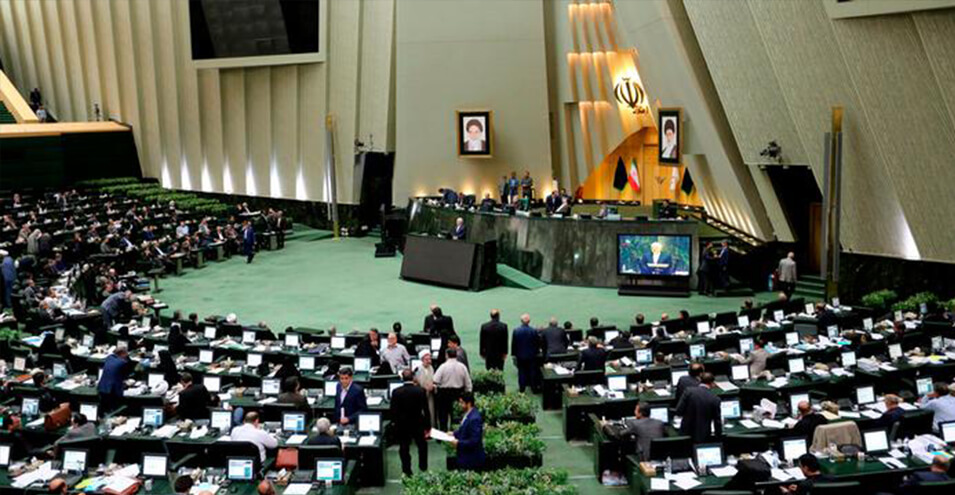
With the amendment of the electoral law, those who have been representatives in Iran’s parliament for three consecutive terms will not be able to run as candidates for the fourth term. During the amendment of this law, the provincialization and politicization of parliamentary elections have also been raised and in some cases approved.
The majority of representatives present in the open session of the Islamic Consultative Assembly on Sunday, March 3rd, voted in favor of a proposal by Hossein Amiri Khamkani to attach a clause to Article 3 of the draft amendment to certain provisions of the election law.
Based on this resolution, the candidacy of individuals who have been parliamentary representatives for three consecutive terms is prohibited in the next election.
Mohammad Reza Tabesh, a reformist representative in parliament, welcomed this resolution and told ISNA news agency that this proposal was presented by a large group of representatives who had three or more terms of service in parliament, and its approval would give young people the opportunity to enter “legislative and legislative branches.”
Major absences from the future parliament
There are doubts about the effect of the aforementioned resolution on youth orientation in parliament as Tabesh mentioned. The clause attached to Article 3 also stipulates that individuals who have been present in parliament for three consecutive terms can participate in parliamentary elections after one term of “rest.”
Nevertheless, with the implementation of the new election law, a significant number of the most famous current representatives, including Amiri Khamkani as the proposer and Tabesh as the supporter of the proposal, will not be able to compete in the eleventh parliament elections.
If the prohibition on candidacy of representatives who have served three terms of parliament is implemented for the next election to be held in December 2019, Ali Larijani, the Speaker and his two deputies Ali Motahari and Masoud Pezeshkian will be among the major absences from the eleventh parliament.
In such a situation, the list of famous absences would be long and would include people such as Alaeddin Boroujerdi, Nader Ghazipour, Javad Karimi Ghodoosi, Kazem Jalali, Alireza Mahjoob, Ezzatollah Yousefiyan Molla, Hossein Naqavi Hosseini, Hosseinali Shahriari and a number of others who have three or more terms of service in parliament.
Possibility of contradiction with the Constitution
Of course, this matter will only occur if the parliament’s resolution is approved by the Guardian Council; currently and before this resolution is reviewed in the council, the head of the commission on councils and internal affairs has declared in a letter to Ali Larijani that this resolution contradicts the constitution.
Mohammadjavad Kuliyevand told ISNA in this regard: “The constitution clearly specifies for the presidency that a person can only be president for two consecutive terms, but there is no such thing regarding parliament representatives and councils, which means there is no temporal restriction in this regard.”
Kuliyevand suggests that the Guardian Council may reject the parliament’s resolution. He also said that the councils commission is reviewing this resolution and will present an amendment proposal to the floor on Monday, which if approved by two-thirds of the representatives, the resolution will be annulled.
According to Mehr news agency, the majority of parliament representatives in Sunday’s session also voted in favor of another clause of the electoral law amendment that stipulates: “Registration of candidates is carried out through a list presented by parties or legal groups and organizations, or individually.”
Many political activists and experts consider the politicization of parliamentary elections as a prerequisite for greater accountability of representatives and political organizations, while at the same time they consider the condition for its realization as the formation of real and powerful parties and political organizations.
Authoritarians’ problem with party activities
The authoritarians of the Islamic Republic do not tolerate the activities of truly independent parties and also have a problem with the continuation of powerful organizations of the reformist faction; an example of this issue is the prohibition of activities of the Front for the Participation and the Organization of Mujahedin of the Islamic Revolution, which were considered the most important political organizations of this faction.
Ismail Grami-Moqaddam, a political activist and spokesman for the National Trust Party, called the politicization of elections one of the “fundamental ideals of reformists” and expressed satisfaction that “the comprehensive election bill has addressed some of the reformists’ criticisms of the election method.”
Grami-Moqaddam told ISNA on Sunday: “This bill in itself makes parties accountable, because instead of selecting individuals in elections, parties are selected.”
Party-based and provincial elections
He considered the requirement of five thousand members for political organizations to present electoral lists as useful and added that this limitation strengthens parties and if a party does not have the ability to mobilize five thousand people, it must either leave the arena or pursue coalition with other parties and create a unified front.
In Iran, there are hundreds of registered political parties and organizations, a large portion of which are only active during election periods and lack strong party organizations. These organizations are called seasonal parties that disappear from the political scene again after elections.
One other issue discussed in the amendment of the election law is the provincialization of parliamentary elections. Some experts believe this could reduce representatives’ focus on the issues of their electoral districts and direct them toward larger regional and national problems.
One other issue emphasized by supporters of the provincialization of elections is a topic that the legislative branch of the Islamic Republic has always faced. In elections based on electoral districts, sometimes individuals with a few thousand votes from a small city enter parliament.
Source: DW