Third Round of Nationwide Teachers’ Strike in Iran
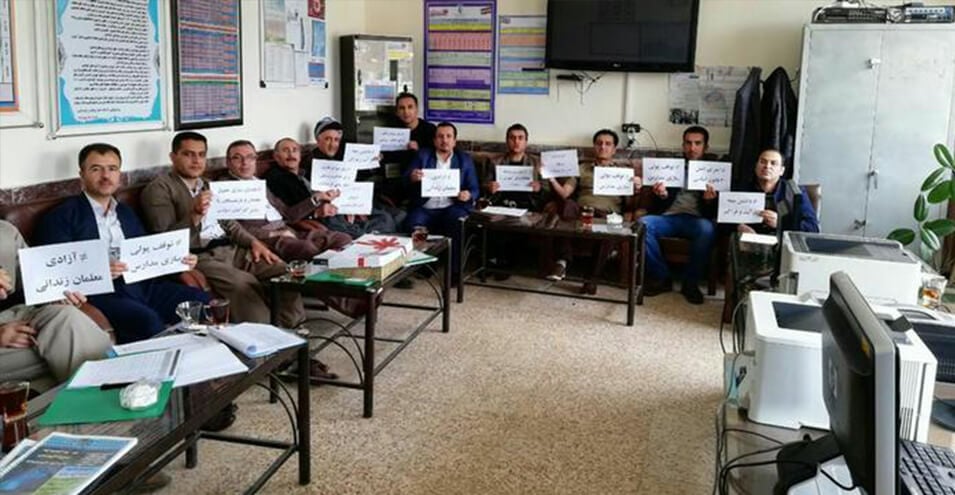
A large number of Iranian teachers, in response to a call from the Coordination Council of Teachers’ Trade Associations, have stopped work in dozens of cities and staged sit-ins to achieve their professional demands. This is the third round of teacher strikes in Iran since the beginning of the 1397-1398 academic year.
Based on reports published on social media and some domestic media outlets, teachers have abstained from entering classrooms since yesterday, Sunday, 12th Esfand (March 3rd), in schools across various provinces in Iran and staged sit-ins at school offices as a sign of protest.
According to these reports, the sit-in has so far been welcomed in the provinces of Kurdistan, Kermanshah, Alborz, Hamadan, Isfahan, Razavi Khorasan, South Khorasan, Tehran, East and West Azerbaijan, Mazandaran, Khuzestan, Fars, Gilan, Sistan and Baluchestan, Yazd, Qazvin, Zanjan, and Chaharmahal and Bakhtiari.
The Coordination Council of Teachers’ Trade Associations announced that teachers, by refraining from attending classes and remaining present in school offices on the 12th, 13th, and 14th of Esfand of the current year (1397), will inform students and their parents of their goals “by all possible means.”
According to the Coordination Council, the decision to stage a sit-in was made “in response to colleagues’ requests and in protest against the accumulation of demands that have been caused by officials’ indifference for years.”
In the statement of the Coordination Council of Teachers’ Trade Associations, the freedom of education activists and “removal of all legal obstacles to the free activity of trade associations” is mentioned as one of the main demands of teachers.
Teachers participating in the third round of their protests in the 1397-1398 academic year, holding signs including “Freedom for imprisoned teachers,” “Quality education, fair budget,” “Stop file-making against trade activists,” “Independent unionization is a teacher’s right,” “End discrimination,” “Effective and comprehensive insurance,” “Establishment of educational justice,” and “Equalization of retired educators’ salaries,” presented their demands and expressed their protest.
On the 6th of Esfand, the Coordination Council of Teachers’ Trade Associations had issued a statement calling on teachers across Iran to stage a sit-in and abstain from attending classes.
The demands of educators, which were summarized in six points in this statement, are as follows: “1- Freedom of education activists and closure of all files in this regard. 2- Removal of all legal obstacles to the official and free activity of teachers’ trade associations throughout the country. 3- Allocation of sufficient budget in the 1398 budget for education to resolve numerous school problems, fundamental improvement of educators’ salaries, and payment of all their arrears, including demands of contract teachers, teaching allowances, etc. 4- Equalization of retired educators’ salaries with those of active employees and raising it above the poverty line. 5- Cancellation of the current ineffective supplementary insurance contract and its replacement with an efficient and responsive insurance for active and retired educators. 6- Halt to the monetization policy of schools and implementation of Article 30 of the Constitution.”
The Coordination Council of Teachers’ Trade Associations also announced: “If the legitimate demands of educators are not met, the Coordination Council will announce its subsequent protest programs.” This trade association emphasized that “effective and tangible actions by officials to address the numerous problems of educators will be considered in the Coordination Council’s future programs.”
Protest Against “Injustice and Inequality”
Iranian cities have repeatedly witnessed widespread teacher protests in recent months regarding working conditions and economic situation. They gathered on the 25th of Bahman in at least the cities of Sanandaj, Urmia, Marivan, Ardabil, Mashhad, and Kermanshah in front of education buildings. On the 6th of Dey, teachers in Isfahan also staged a protest gathering in front of the province’s education office. However, security forces dispersed the protesters by firing tear gas and arrested some of them. On the 19th of Azar, the cities of Isfahan, Rasht, Yazd, and Abhar witnessed protest gatherings of teachers and retired educators demanding improved economic conditions and freedom for imprisoned teachers.
During the second round of Iranian teachers’ sit-in on the 22nd and 23rd of Mehr, a large number of them joined this strike in many small and large cities across Iran. This two-day sit-in was accompanied by slogans against “injustice and inequality.” Although teachers’ demands in this sit-in were met with promises of government officials to address them, they also resulted in clashes with professional gatherings and arrests of their activists.
The arrest and subsequent release of Mohammad Reza Ramezanzadeh, head of the Coordination Council of Teachers’ Trade Associations in Bojnurd, and Hashem Khastegar, member of the board of directors of the Mashhad Teachers’ Trade Association, by the Revolutionary Guards intelligence officers were among the consequences of the second round of teacher protest movements in the current academic year.
Teacher protest movements in Iran have significantly increased in recent months and years. In addition to demands for improved salary conditions and freedom for imprisoned teachers, demands such as effective and comprehensive insurance, school safety, ending discrimination in the education structure, halting the privatization and monetization of education, and ensuring public access to free education are among the demands of Iranian teachers.
Several education activists and prominent figures among Iranian teachers, such as Mohammad Habibi, Mahmoud Beheshti Langaroodi, and Ismail Abdi, have faced prison sentences due to their professional activities and are serving time in prison.
Source: DW