Jahangiri: We May Be Forced to Ration Some Goods
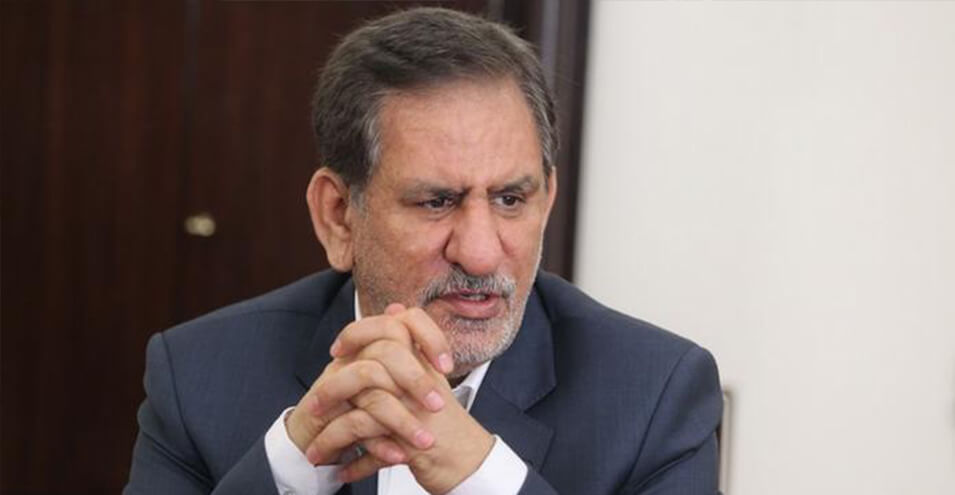
Iran’s First Vice President, alluding to the current economic situation, announced the possibility of returning to rationing and issuing coupons for some goods. In recent days, rumors of gasoline rationing have faced considerable opposition.
With the intensification of American sanctions against the Islamic Republic, securing essential goods and preventing rampant price increases has become one of the major challenges facing Hassan Rouhani’s government.
The latest statements by the First Vice President regarding different views on how to secure essential goods and the possibility of rationing them reflect the government’s indecision in this area.
Isaac Jahangiri said yesterday (Saturday, May 4) during a visit to Tehran’s book exhibition, while speaking to journalists, that during the Iran-Iraq War, almost all imports were conducted by the government and distributed through a coupon system.
He added that after the war, a policy of free market economy and privatization was placed on the agenda, and now although the government is responsible for providing currency for importing essential goods, importers are from the private sector.
According to ISNA news agency, Jahangiri then outlined two solutions the government has for controlling the upcoming economic situation, saying: “Now, considering the new economic conditions, two discussions have emerged. We are moving towards greater restrictions, so the government’s role will likely become more prominent. We may be forced to move towards rationing and issuing coupons for some goods.”
The First Vice President says this theory has supporters both within and outside the government, and its prerequisite is the executive apparatus re-entering economic activities.
He continued: “Some economic activists oppose this theory. They believe that in such difficult conditions, we should move towards liberalizing the economy; even remove restrictions that we previously had. Instead of securing goods for the weak through rationing, we should free the economy and provide hidden subsidies to people in cash.”
A Decision-Making and Government Indecision
Isaac Jahangiri then asked experts to clearly express their views and criticism of these two approaches, as the government needs to make a decision “soon” that “will affect the country’s future.”
Jahangiri acknowledges that thirty years after the end of the war, when policies have at least apparently moved towards liberalizing the economy and shrinking the government, suddenly reinstating all past laws and regulations and reviving extensive regulatory and executive organizations “is not easily possible.”
Although returning to distributing essential goods through coupons has many opponents and obstacles, the majority of Islamic Consultative Assembly representatives during the review of the 1398 budget approved a proposal from the Budget Integration Commission according to which the government is obliged to provide “commodity cards” to citizens for securing essential goods.
According to some rumors and media reports, a return to rationing and providing goods through an “electronic commodity card” was supposed to begin with gasoline, but after opposition reactions, the Interior Ministry described the publication of this news in media outlets such as Tasnim and Farsnews as “a very dangerous game.”
Gasoline Rationing “Currently” Suspended
Nevertheless, evidence shows that such a discussion was on the agenda and its groundwork has been laid. Behrouz Nemati, spokesman for the Presidium of Parliament, announced after a closed session on Sunday, May 5, that gasoline rationing “is currently suspended.”
Ali-Asghar Yousefi-Nejad, a member of the Presidium of Parliament, in an interview with Tasnim, referring to the government’s decision for gasoline rationing, said: “This matter has currently been dropped by the government and no timeline has been announced for it.”
Yousefi-Nejad, emphasizing the high risk and consequences of increasing energy carrier prices, said: “The government, due to social and economic issues, must reconsider its decision so that we can seek a solution in a professional atmosphere.”
Tasknim and Farsnews news agencies, both affiliated with the Islamic Revolutionary Guard Corps, reported on April 30 that 60 liters of gasoline per month would be rationed at 1,000 tomans per liter for car owners, and free gasoline would be 2,500 tomans per liter.
Bijan Zanganeh, Oil Minister, without referring to these news agencies, denied gasoline rationing and a free gasoline price increase, saying: “The issues raised in this regard by some media outlets are false and, as always, they lie.”
Nevertheless, the statements of the two members of the Presidium of Parliament confirm the existence of such programs that “currently” have been dropped or suspended, and Jahangiri’s remarks support the fact that some government members favor returning to rationing and distributing commodity coupons in the current critical state of Iran’s economy.
Warnings About the Consequences of “Reviving Coupons”
A return to the “coupon era,” particularly among private sector activists, has many critics. Mohsen Jalaalpour, former president of Iran’s Chamber of Commerce, one day after Parliament’s resolution obligating the government to distribute essential goods through commodity cards, warned about the harmful consequences of this measure.
In a note he published on his Telegram channel, he wrote: “From now on, you have a multi-tiered controlled economy where free exchange is not possible. In this space, the private sector cannot grow. The result is that monopoly is formed. Once monopoly is formed, all kinds of corruption emerge, and a major part of the government’s capacity and resources must be spent on combating hoarding and commodity speculation.”
This economic activist, referring to the experience of distributing commodity coupons in the 1980s, warned that “reviving coupons” strengthens the foundations of state production and distribution, and this process will have harmful consequences.
Source: DW