Removal of Four Zeros from Iran’s National Currency Becomes More Serious Than Ever

The Central Bank has submitted a bill to the government to remove four zeros from the national currency and hopes this action will be completed “as soon as possible.” Given the authorities that the heads of three branches of government have granted to the Central Bank governor, this measure could be implemented soon.
The debate about reforming Iran’s national currency and removing several zeros is not new; this discussion has been ongoing at least since the late 1980s with the collapse of the rial’s value, and the Central Bank even launched a website in the early 1990s to survey the public about this issue and the name of the new currency.
The new round of these discussions, especially with Abdolnaser Hemmati taking the helm of the Central Bank, appears more serious than ever before, and there are signs that implementing the national currency reform plan could occur in the near future.
According to the Central Bank’s public relations office, Hemmati announced on Sunday morning, December 16 (January 6), during a meeting with members of the parliamentary “Velayati” faction: “The bill to remove four zeros from the national currency was submitted to the government yesterday by the Central Bank, and I hope this important matter will be completed as soon as possible.”
Hemmati succeeded Valiollah Seif on June 27 of this year while severe foreign exchange market turmoil and the free fall of the national currency’s value were continuing, and the United States had announced its withdrawal from the nuclear deal with Iran and the Joint Comprehensive Plan of Action (JCPOA) and announced plans to reimpose previously suspended or lifted sanctions.
Captain of the “Storm-Tossed Ship”
At that time, many experts, including economist Mohammad Reza Sabzalipur and head of Iran’s World Trade Center, believed that Hemmati took a great risk by taking “the helm to guide this storm-tossed ship” in that critical situation and amid acute economic problems and severe monetary and foreign exchange crises.
The foreign exchange market crisis and the collapse of the rial’s value had become so serious that the heads of three branches of government, by establishing a supreme economic coordination council in early September, while approving the new Central Bank governor’s reform proposals and to regulate the foreign exchange market, granted him broad authorities.
The Central Bank’s measures in recent months and comprehensive support from the government, parliament, and judiciary for Hemmati and his colleagues have at least so far resulted in controlling the rapidly accelerating process of dollar price increases and other major foreign currencies in the free market and placed prices on a declining slope.
These relative successes and the support of the three branches’ leaders indicate that the Central Bank’s proposed bill to remove four zeros from the national currency is likely a matter that was previously agreed upon in the supreme economic coordination council, and its implementation is more possible than before.
Another sign that strengthens the possibility of implementing the removal of four zeros from the national currency is the Central Bank’s new 500,000-rial Iran check that was unveiled a few days ago (December 11).
The Absence of Four Zeros on the New Iran Check
On Monday, Hemmati expressed hope during the unveiling ceremony of this Iran check, which was held at the organization of banknotes and coins in the presence of Farhad Dejpasand, the Minister of Economy and Finance, that with production growth and economic development and the Central Bank’s efforts in managing the money and foreign exchange market, “we will witness increasingly strengthening of the national currency’s value.”
According to the Central Bank’s public relations office, Dejpasand also said at this ceremony: “Today, a document was unveiled that reflects hope for Iran’s future based on the country’s assets, and this demonstrates the Central Bank’s firm determination to help Iran’s economy occupy a position befitting the values of this land.”
What draws attention in the new Iran check plan more than previous samples is the emphasis on the number 50 and the absence of four zeros after it. The Central Bank in its explanations about this Iran check has referred to the number 50 in three cases and among them wrote: “The number 50 is printed with invisible ink that appears in red and blue colors in a complementary manner under ultraviolet light.”
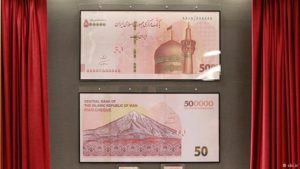
The seriousness of the Central Bank’s program to remove four zeros is more clearly stated in the seventh explanation related to the “complementary design”: “This design is printed in such a way that part of the design is on the front and another part is on the back of the Iran check, and when held against light, they complete each other.” This “value number” is 50. Based on this, Iran’s currency unit will be changed from rial to toman, and 500,000 rials will become 50 tomans.
A Plan for Dollar-Toman Parity?
The price of each U.S. dollar in Iran’s free market, which had risen to 18,000 tomans a few months ago, is now settling at around 10,000 tomans with the Central Bank’s recent policies. If the plan to remove four zeros is implemented when the dollar reaches 10,000 tomans, each U.S. dollar would equal one Iranian toman.
The government council announced in December 2016 that it approved the Central Bank’s proposed bill to change Iran’s currency unit to toman equivalent to 10 rials. This bill remained silent afterward and was not sent to parliament for review.
Valiollah Seif, the then Central Bank governor, had said: “The conclusion was that an independent proposal should be sent from the government and Central Bank to parliament, which if approved would result in removing four zeros from the national currency.” He added that the government has currently abandoned pursuing this plan and postponed it to “one or two years ahead.”
Preconditions for Removing Zeros
Seif had cited “sustained single-digit inflation” as one of the preconditions for removing zeros. With the beginning of the collapse of the national currency’s value and the jump in exchange rates, inflation has intensified, and for months now inflation has again become double-digit.
The Central Bank governor, in his meeting with representatives of the parliamentary “Velayati” faction, referring to the decline in the growth of prices of goods and services in November and December and the trend of exchange rate decline, expressed hope that controlling the inflation process would be better achieved than before. Apparently, this hope was one of the reasons for presenting the proposed bill to remove zeros to the government council.
Although signs indicate the seriousness of the Central Bank’s monetary reform program, its implementation would first require approval by the government council. Then that government bill would be presented to parliament, and if the majority of representatives vote in favor, it would become law.
Removing zeros from the national currency unit has many supporters and opponents, but it is not an unprecedented act. Germany after World War II is considered a pioneer in doing this to strengthen the value of its national currency and counter rampant inflation. Since then, dozens of other countries have followed this path, and many of them, including Turkey, have been successful in this regard.
Supporters and Opponents of Removing Zeros
Supporters argue that since 1929 when the rial replaced the toman, particularly in the last half century, people have never abandoned the toman and did not accept the rial as the real currency unit. On this basis, changing the currency unit to toman could be easily accepted.
Regarding removing zeros, it is also said that this action leads to inflation reduction, reduces the enormous cost of banknote printing, and facilitates cash transactions. Moreover, for many years people in their oral transactions in the market have removed four zeros and known the currency unit as toman; they call 10,000 rials or 1,000 tomans as one toman.
On this basis, removing four zeros means conforming the national currency unit to an existing and accepted reality. Moreover, today in larger transactions, ten million rials or one million tomans are also called one toman.
Savings in time and auditing and accounting costs are among other reasons supporters of removing four zeros cite, which most opponents also accept. Reducing cash in circulation, which could lead to decreased liquidity and inflation, is another argument of supporters.
One of the most important reasons supporters cite for removing four zeros is the psychological aspect and increasing public confidence in the national currency, especially compared to major foreign currencies. And this is where one of the main arguments of opponents takes shape; which is that all the benefits mentioned for removing zeros would only become reality if monetary reform is part of a set of measures and policies that bring economic prosperity, inflation reduction, and increased employment.
Opponents say it is true that currently the number of banknotes in circulation in a country like Iran is more than ten times that of developed countries and the cost of printing them is enormous, but changing the currency unit is also not inexpensive due to printing new banknotes and minting new coins.
Possible price increases and inflation and the reduction of export revenues if the national currency becomes stronger are among other reasons some opponents cite for opposing the removal of four zeros.
The Uncertain Future of Rial and Toman
On the whole, there may be one point that many agree on; removing zeros and changing the national currency unit, if not accompanied by broad economic, political, and social reform policies, will not necessarily result in a positive outcome and may even have negative effects on the economy and people’s conditions.
While the determination of the government and Central Bank to remove four zeros and convert the rial to toman appears more serious than ever before, without controlling inflation and improving economic conditions, the prospect of the effectiveness of this decision is unclear.
Parliament’s Research Center recently estimated that if economic recession continues in the same way and oil exports fall below one million barrels per day due to sanctions pressure, Iran’s economic growth in 2020 could decrease to negative 5.5 percent.
For this reason, despite the Central Bank submitting a bill to remove four zeros to the government council and highlighting 50 instead of 500,000 rials on the new Iran check, the government’s seriousness in replacing the rial with the toman only becomes clear when the bill is sent to parliament.
Source: DW