Ahmad Shahid: Human Rights Situation Under Rouhani Government Unchanged
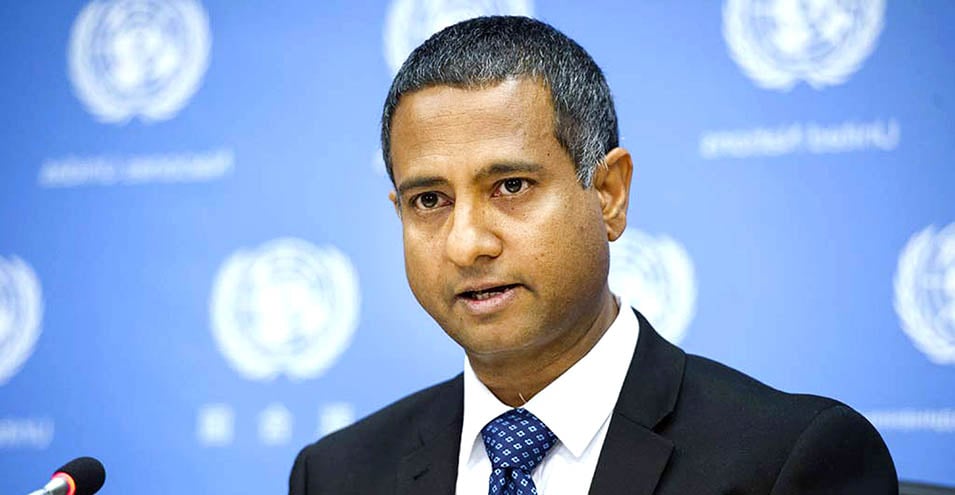
Ahmad Shahid’s reports as the UN Special Rapporteur on human rights in Iran have long been a sensitive matter for the Islamic Republic’s judicial system, yet this has not caused him to change course;
He defends his methodology and says he obtains information about Iran in various ways; government reports that are published, government websites that write about various issues, and through Iranians inside the country who are in contact with him. What follows is his response to questions from “Rooz” about the state of human rights under the Rouhani government, criticisms that exist about his working methods, and the outlook for the future. He remains dissatisfied with the human rights situation in Iran and under the Rouhani government, but says cooperation with Hassan Rouhani is possible.
Mr. Shahid, you were responsible for Iran’s human rights file during two different governments in Iran (the Ahmadinejad and Rouhani administrations). Has the change of government in Iran caused a change in the approach to human rights in Iran or not?
There have been some changes and improvements in the situation, but these changes have not been significant. Changes in the new government have been such that, for example, diplomats talk to me more or provide me with more information.”
And has this led to a significant change in Iran’s human rights situation?
Not because of these conversations, but because of my reports and the fact that there is discussion about the human rights situation in Iran, there is more willingness to talk and resolve some of these issues. No country declares that it did something because the United Nations requested it.
Do you hope that conversations with Islamic Republic officials will lead to you visiting Iran?
It is highly unlikely. I do not think Iran has the desire to allow an independent rapporteur to enter the country and prepare a report. Because they believe—as Mr. Larijani once said—that there are various issues within the country that will be mentioned in the report.
And does this inability to visit Iran cause the reports to be deficient?
You cannot find a substitute for two things: government cooperation and the ability to visit Iran. But if you could visit Iran without government cooperation, there would be much bigger problems. Suppose I visit Iran and meet with people. After the meetings, the government detains them. This itself becomes a much bigger problem. I obtain information about Iran in various ways. Government reports that are published, government websites that write about various issues, and I communicate with Iranians from inside the country and collect information. However, I agree that visiting Iran could help. But without visiting Iran, I can still report on issues and problems. In any case, given the various reports that the United Nations publishes about Iran and draws attention to, you can see that Iran also tries to address some of these problems, though not necessarily in the positive way that is expected. One example of this is the discussion about replacing life imprisonment with execution for drug traffickers.
I asked this question because particularly government officials often point out that your information comes through government opposition, and this causes imbalance and failure to maintain impartiality in your reports.
Look, in any type of human rights research methodology, you must look for examples to draw attention to the subject matter in question. All the information in my reports is collected not from opposition but from “victims” of human rights violations. Much of this information is actually reported by state media or mentioned in parliamentary reports or government institutions. For example, when I write about the budget in my reports, my source of information is Iranian parliamentary reports, or when I write about marriage age or child marriage, my information is extracted from official government sources.
An example in this regard goes back to one of your reports about the disqualification of two footballers (Seyed Reza Heydari and Mohammad Nosrati) for celebrating after a goal and linking it to homophobia. An issue that not only the government but even some government critics challenged and protested against reporting it in that way.
This issue was not about the punishment of two footballers or a football matter. The punishment that was considered for them was specifically an example of homophobia. Homophobia is widespread in Iranian society. Regarding issues like homophobia, Iranian society has not yet accepted this issue, which does not mean I should refrain from reporting on it. Or regarding the issue of retaliation, many government officials say that this comes from religion and from Islamic laws. But international law says something different in this regard. I agree that if I went to Iran, perhaps there would be an opportunity for a more detailed look at the issues, but this does not change international laws.
Mr. Shahid, you were a supporter of the nuclear agreement between Iran and the 5+1 group. Could this agreement lead to an improvement in the human rights situation in Iran?
Not the nuclear agreement itself, but the events that follow it, including the lifting of sanctions that pressure people, can help improve human rights. Like the lifting of restrictions on the entry of certain essential goods and medicines, etc. I also believe that opening the country’s doors and commercial relations will lead to the reduction of some restrictions and also more rule of law. Investors will not be willing to invest their capital in a place where laws are not respected. These relations also create a newer perspective on the world in Iran. Of course, the issue is not just about commercial profit. Many companies in Europe and America are places where human rights is also a concern. I think in these circumstances, human rights activists will have more opportunity to pressure the government to comply with standards.
But might these same commercial relations cause Western governments to turn a blind eye to human rights violations in Iran?
Certainly, a different approach than what has been employed until now is needed, but sometimes it is not the governments that invest that consider human rights policies, but civil society that pressures governments to respect human rights in different countries. In any case, even if some companies are purely profit-seeking and some governments support them, there are enough different voices in these countries that loudly draw attention to human rights concerns. I think that this ultimately causes the government to come under pressure to respect human rights.
You mentioned conversations with some government officials. What issues do these officials discuss with you? For example, do they have the freedom to discuss each individual heading of your report with you?
They never discuss some issues. For example, they do not talk about LGBTs, or about Baha’is, or about Christian converts. But they are willing to discuss most other issues, which is why there are many issues we can discuss together.
And have these conversations—even in an informal way—led to resolving any issue or problem in Iran?
I have several main functions: one is to raise awareness and public attention, the second is to highlight problems and create pressure on them. I am not in this position to solve or judge. Yes, there have been issues that we sometimes discussed and later changed in some way in Iran. For example, there have been cases that received attention, or for example, plans and bills that were raised in parliament that were suspended or amended because there were discussions about their implications. What I do is help create narratives and discourse around topics related to human rights. Yes, there have been cases where they made changes in some cases or their behavior, but despite this, these cases were very minor, and there was no fundamental change in the Iranian government’s human rights performance over the past four and some years.
Have you requested a meeting with senior government officials? Or has such a discussion ever been raised?
No, according to UN laws I am based in Geneva. I tried to meet with some government officials in the area of human rights, but I did not try to have a meeting with the President or the Head of the Judiciary. I do not think such a meeting would be fundamentally useful. Because I cannot discuss specific problems with them. I talk to people who have specific information about events or with people from whom I am supposed to get information on a particular subject. I do not think as a human rights expert at the United Nations, there is a need for me to talk to senior government officials.
Who do you mean by government officials in the field of human rights?
I met with the head of human rights in the judiciary, some members of parliament, some officials involved in combating drugs, one of the prosecutors pursuing drug cases, etc. These meetings lasted a few hours and in my view were more useful than meetings with political officials.
Do you mean by the usefulness of these meetings that the conversations led to a result?
Yes
Can we say that your reports are one of the reasons for raising the issue of replacing the punishment of drug offenders in Iran?
I cannot say there is a direct relationship between the two. But we have discussed this issue many times and have debated it. As a result, when they are looking for a solution to the drug problem, one can say that they are engaged in resolving these discussions. I am not saying that I did this, but clearly due to international concern about the rate of executions in Iran, the country has tried to find a solution for it. I can give a specific example in this regard. It was about two years ago that Javad Larijani, when asked in an interview about the high rate of executions in Iran, said that 80 percent of executions are because of drugs and if we reform this law, this figure will also change. Here you can see a direct relationship between the concerns and worries that existed in UN reports and Iran’s reaction. Or regarding issues related to torture in Iran’s prisons, which I mentioned in one of my reports. Iran took steps to correct some behaviors in this regard, and although this issue continues, I have received reports that the situation in this area has changed somewhat, although concerns remain.
You welcomed Mr. Rouhani’s election, but in your more recent reports you have mentioned that the human rights situation in Iran has in some ways worsened compared to a few years ago. Two and a half years ago, did you have such a picture of the human rights situation in Iran during Mr. Rouhani’s tenure?
I do not remember supporting Rouhani; I remember speaking about the election process. Moreover, my welcome was for Rouhani’s promise of reforms. Human rights issues were not a priority for Rouhani from the beginning, and after becoming president, his main effort was directed at resolving the nuclear issue. He made some remarks about gender equality (though we did not witness much in his policymaking), he has a very active deputy for women’s affairs [Shahindokht Molaverdi] in this regard, he made efforts regarding academic freedoms including the return of some fired professors to the university or the establishment of a Kurdish language major in Kurdistan. Nevertheless, human rights changes during the Rouhani period have been very minimal, but given that he continues to articulate a moderate approach, I still think it is possible to cooperate with him as a good option.