From “Preserving Iran” to Auctioning It Off: Islamic Republic’s Authoritarianism Has Opened the Door to Foreign Powers’ Greed
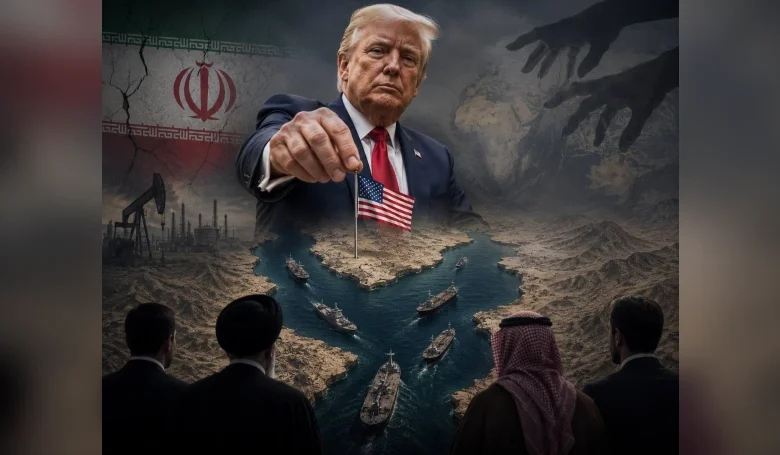
Trump’s vision of the Strait of Hormuz as a “new U.S. territory” is not merely a media controversy; it is a stark warning of a world in which the Islamic Republic, through years of confrontational policies, adventurism, and sacrificing Iran’s interests for regime survival, has made the country more vulnerable to the appetites of foreign powers. From Washington to regional actors, Iran’s wealth, security, and even territorial integrity are now more than ever subject to negotiation and encroachment.
Donald Trump, the U.S. President, has once again stirred controversy over the future of the Strait of Hormuz by posting an image on the social media platform “Truth Social.” In the image, the Strait of Hormuz is placed alongside a collection of U.S. territories with the caption “NEW U.S. Territory” inscribed upon it.
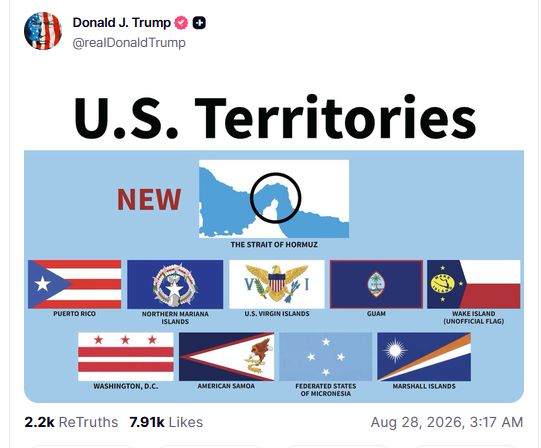
The image was posted as the U.S. government claims its forces have gained greater operational control over the Hormuz shipping route, and the U.S. military has announced it has cleared sea mines attributed to the Islamic Revolutionary Guards Corps from international shipping lanes.
Yet the matter goes deeper than a symbolic image. Trump had previously stated his intention to declare the Strait of Hormuz a U.S. territory. On August 14, he said he would soon take such action, and days later in South Carolina declared: “I consider the Strait of Hormuz a U.S. territory right now.”
Therefore, the reposting of the map cannot be dismissed merely as a visual joke; especially since Washington has simultaneously intensified its military and economic pressure on the Islamic Republic in recent days, and the issue of controlling vessel traffic in Hormuz has become one of the principal flashpoints between Tehran and Washington.
From an international law perspective, publishing such a map in itself creates no new legal status. The Strait of Hormuz lies between Iran and Oman, and the legal framework governing straits used for international navigation separates the sovereignty of coastal states from the right of international passage. The United Nations Convention on the Law of the Sea stipulates that the regime of transit passage does not impair the sovereignty or jurisdiction of coastal states over the waters of the strait. The same convention recognizes the right of transit passage for vessels in straits subject to this regime.
The British government also stated in a formal response to Parliament in June 2026 that London, in cooperation with international partners, is working to keep Hormuz open “without charges or conditions” and to protect freedom of navigation in accordance with international law.
Consequently, Trump’s pictorial claim should be understood less as a legal change and more as an indicator of American geopolitical ambition to consolidate practical control over one of the world’s most critical energy chokepoints.
Tehran has also responded to Trump’s threatening message. Kazem Gharibabadi, Deputy Foreign Minister of the Islamic Republic, said following Trump’s remarks about turning Hormuz into a U.S. territory: “Accept the reality once and for all—you have suffered heavy strategic defeats; the Strait of Hormuz has been Iranian, is Iranian, and will remain Iranian.”
Yet this response also reveals a critical contradiction: on one hand, the Islamic Republic emphasizes its sovereignty and role in Hormuz, while on the other hand, in recent months it has used this very strait as a tool of political and military pressure and restricted vessel traffic.
According to Reuters reports, maritime traffic in Hormuz has plummeted severely, with the number of vessels passing through in recent weeks roughly 90 percent lower than pre-war levels. This situation has not only denied America an opportunity; the Arab states of the Persian Gulf have also begun seeking alternative routes for energy exports, and efforts to reduce dependence on Hormuz have intensified. This is where the more significant aspect of the matter takes shape for the Iranian people.
The Islamic Republic has long presented the Strait of Hormuz as one of its instruments of regional power; however, transforming a geographical and economic position into a permanent tool of threat can ultimately backfire.
When a government turns a vital pathway of global commerce into a zone of military confrontation, opposing parties strive to eliminate this dependency. When vessel passage is accompanied by threats, mine-laying, missiles, drones, or political extortion, major powers intervene to secure the route.
The result can be what we witness today: the Islamic Republic, in the name of defending “Iran’s interests,” has created such crisis and insecurity that now America speaks not only of how vessels should pass, but of the future control of Hormuz itself.
This is the point at which we can speak of a political tragedy: a government claiming to preserve Iran’s independence, through policies costing far more to maintain its own power structure, has paved the way for greater presence and intervention by foreign powers.
Of course, this does not justify America’s expansionist claims. Any potential encroachment by a foreign power on Iran’s interests or territory cannot be legitimized by any mistaken policy of the Islamic Republic, but the Islamic Republic’s political responsibility in creating conditions that make such claims more feasible is a separate matter that cannot be overlooked.
In the latest development, Admiral Brad Cooper, commander of CENTCOM, announced that American forces have cleared sea mines from international shipping lanes. He called the operation “a major achievement” and stated: “The internationally recognized transit routes in the strait have been cleared of Iranian sea mines thanks to the extraordinary work of the U.S. military.”
Cooper also announced that American forces have facilitated the passage of nearly 1,500 commercial vessels through Hormuz in recent months; vessels that, according to him, have transported approximately 750 million barrels of crude oil to global markets. Nevertheless, America’s claim about complete mine clearance has been met with skepticism, and some American allies have suggested that some mines may still remain in the area.
Meanwhile, Islamic Republic officials have rejected America’s claims. Kazem Gharibabadi questioned America’s claim about the complete opening of the route, asking why, if Hormuz is truly open, vessels continue to face serious restrictions. New Reuters data also shows that only seven cargo-carrying vessels passed through Hormuz on Thursday—a figure still far from normal pre-war conditions.
Reactions to Trump’s claim show that Hormuz has become a battleground for power competition. The response to Trump’s map was not only from Tehran. Islamic Republic officials, in addition to rejecting Trump’s claim, released another image in which California was labeled a “new territory of the Islamic Republic of Iran”—a sarcastic response to Trump’s map.
Within America, this action has also been viewed in the context of Trump’s broader policy of advancing territorial claims and increasing pressure on U.S. allies and competitors. American media, including the Washington Post, have reported that the posted map even included portions of the coasts of Iran, Oman, and the UAE within its boundaries, which sparked widespread reactions.
Simultaneously, Oman, which has served as a mediator between Tehran and Washington in recent months, has faced mounting pressures. The country had previously considered any attack on passing vessels as a violation of international law and the sovereignty of territorial waters, and had emphasized continuing negotiations over shipping arrangements.
In recent days, Iran and Oman have been negotiating the establishment of a temporary corridor for vessel passage and a program for mine clearance; a plan intended to ultimately lead to long-term arrangements for managing Hormuz traffic.
The bitter reality is that today the issue is not merely the Strait of Hormuz. The question is: why should a country with such geographical position, enormous energy resources, and one of the world’s most critical commerce chokepoints, reach a point where foreign powers make decisions about the future of navigation near its shores?
The answer cannot be sought solely in America’s behavior. The policies of the Islamic Republic also bear significant responsibility in shaping this situation: years of tension-creation, instrumental use of the Strait of Hormuz, shipping threats, regional and global enemy-making, and prioritizing the government’s ideological and security survival over Iran’s long-term interests have exacted a heavy toll on the nation.
Yet on the other hand, it must not be concealed that the weakness or error of the Islamic Republic is no license for any foreign power to seize Iranian soil, resources, or waterways related to Iran.
What is witnessed today in Hormuz is, in fact, a greater warning for Iran’s future: if a government becomes so consumed with preserving its own power that it depletes national capital, foreign relations, economic security, and international credibility, the vacuum created will sooner or later be filled by others.
And perhaps the most bitter part of the story is this: the Islamic Republic claimed to be fighting the world to preserve Iran, but its policies may lead to a point where others stand in line for their share of Iran and its wealth.
Today Trump names Hormuz on a map as a “new U.S. territory.” This map does not legally deprive Iran of its ownership; but politically, it paints a warning picture of how vulnerable a country is when its government preaches independence but through its own policies has expanded the grounds for foreign powers’ interference.
The question is not merely who will control the Strait of Hormuz; the question is whether Iranians will be able to determine the fate of their nation’s resources, security, and future themselves or not.