Conviction of Bahai Couple to Prison in Isfahan; Continued Repression of Religious and Belief Freedom
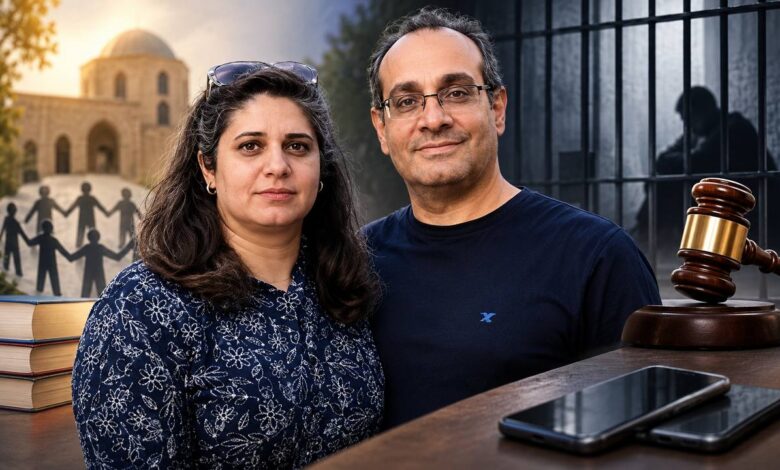
Navid Tashakkor and his wife Elham Khales Ardestani, two Bahai citizens residing in Isfahan, have been sentenced to a combined total of three years and eleven months in punitive detention. The ruling, which includes confiscation of their mobile phones, was issued due to their religious activities, educational work, and participation in Bahai community programs. This case once again demonstrates that the Islamic Republic responds to peaceful religious and educational activities of minorities with security and propaganda charges—an approach that is not limited to Bahais, as Christians and other religious and faith minorities are also victims of it.
According to human rights organizations’ reports, Navid Tashakkor, a Bahai citizen residing in Baharestan, Isfahan, has been sentenced to three years of punitive detention by the Revolutionary Court of the city. The charge against him has been described as “propaganda and deviant activities contrary to the sacred law of Islam through promotion and propagation of the Bahai faith.” However, he was acquitted of the charge of “propaganda activity against the system.”
His wife, Elham Khales Ardestani, has been sentenced to eleven months of punitive detention on charges of “propaganda activity against the system” and was acquitted of the charge of propaganda and deviant activities contrary to Islamic law. The court also issued an order for the confiscation of this couple’s mobile phones.
Thus, the total prison sentence imposed on these two citizens amounts to three years and eleven months—a punishment that, along with confiscation of personal devices, affects their family life and social and educational activities.
Based on information released by informed sources, forming youth groups, keeping religious materials, sending religious pamphlets, and participating in planning Bahai meetings were among the charges cited in Navid Tashakkor’s case.
In Elham Khales Ardestani’s case, teaching educational materials, sending educational content to the Bahai virtual university (BIHE), and describing the Islamic Republic as an oppressive government in academic texts were among the matters that formed the basis of charges against her.
These details raise an important question about the boundary between peaceful religious activity and security criminalization: Why should forming educational groups, maintaining religious texts, holding religious meetings, and participating in virtual education lead to criminal prosecution and imprisonment?
The Bahai virtual university was established in response to the widespread deprivation of Bahai citizens from equal access to higher education in Iran. Exclusion from universities and restrictions on educational activities have been among the problems facing the Bahai community for decades. In such circumstances, the conviction of a citizen for sending educational content to this university heightens concerns about the continuation of educational deprivation of Bahais.
Elham Khales Ardestani was arrested in early September 2026 after reporting to the Office of the Public Prosecutor and Revolutionary Court in Isfahan and being informed of the charges against her, and was transferred to Dowlatabad Prison. She was finally temporarily released on September 28 of the same year after posting bail.
Navid Tashakkor was arrested earlier on July 1, 2025, at his private residence in Baharestan and was released on July 17 after posting bail. He was arrested again on December 22, 2025, after reporting to the Office of the Public Prosecutor and Revolutionary Court in Isfahan and was transferred to Dastgerd Prison.
Repeated arrests, the opening of criminal cases, and the issuance of prison sentences for religious and educational activities demonstrate continuous pressure on this family. Temporary release on bail did not mean an end to legal proceedings, and ultimately this couple faced prison sentences and confiscation of their mobile phones.
What is witnessed in the cases of Navid Tashakkor and Elham Khales Ardestani is part of a broader problem of violations of freedom of religion and belief in Iran. The Islamic Republic’s pressures are not limited to Bahais; Christians, Jews, Zoroastrians, Sunni Muslims, followers of Yarsanism, and other religious and faith groups also face discrimination and restrictions, each in different ways.
The U.S. Commission on International Religious Freedom’s 2026 report states that the state of religious freedom in Iran remained unfavorable in 2025, and the government has intensified systematic pressure on non-Shiite religious minorities, including Bahais, Jews, Christians, Sufi dervishes, and Sunnis. The report also documents arrests and imprisonment of individuals for practicing their religious beliefs, expressing opinions, or defending religious freedom.
The situation for Christians is also particularly concerning, especially for converted Christian citizens. The Human Rights Watch report on Iran for 2026 discusses discrimination against Bahais, Christians, Gonabadi dervishes, Jews, Sunni Muslims, and followers of Yarsanism in law and practice. The organization also notes waves of arrests of members of certain religious communities following military conflicts in 2025 and charges related to connections with Israel.
Therefore, religious repression in Iran should not be limited to one community or one faith. The intensity, form, and legal basis of pressures on different groups are not the same; however, what is common to many of these cases is restricting the right to choose and practice religious beliefs, criminalizing peaceful activities, and using vague charges to apply judicial and security pressure.
Under Article 18 of the Universal Declaration of Human Rights, every person has the right to freedom of thought, conscience, and religion. This right includes freedom to change religion or belief and also the freedom to express it, individually or collectively, in public or private settings, and through education, worship, and performance of religious rites.
This right should not be conditional upon acceptance of an official religion or government approval of a particular belief. Bahai, Christian, Jewish, Zoroastrian, Sunni, Yarsan, and other believers, like all other citizens, have the right to practice their beliefs without fear of arrest, educational deprivation, security pressure, or judicial punishment.
The conviction of Navid Tashakkor and Elham Khales Ardestani once again demonstrates that in the Islamic Republic, the religious and educational activities of citizens can become the subject of criminal prosecution. In such circumstances, demanding the freedom of this couple and ending pressure on the Bahai community is part of a larger demand to end discrimination and oppression against all religious and faith minorities in Iran.
Freedom of religion and belief is meaningful only when guaranteed for all citizens—not when the government creates restrictions for one group and ignores the suffering of another. The right to belief, education, worship, and peaceful assembly is not a government privilege; it is a fundamental right belonging to all humans.