"Women's cycling is not prohibited if it is not accompanied by a crime"
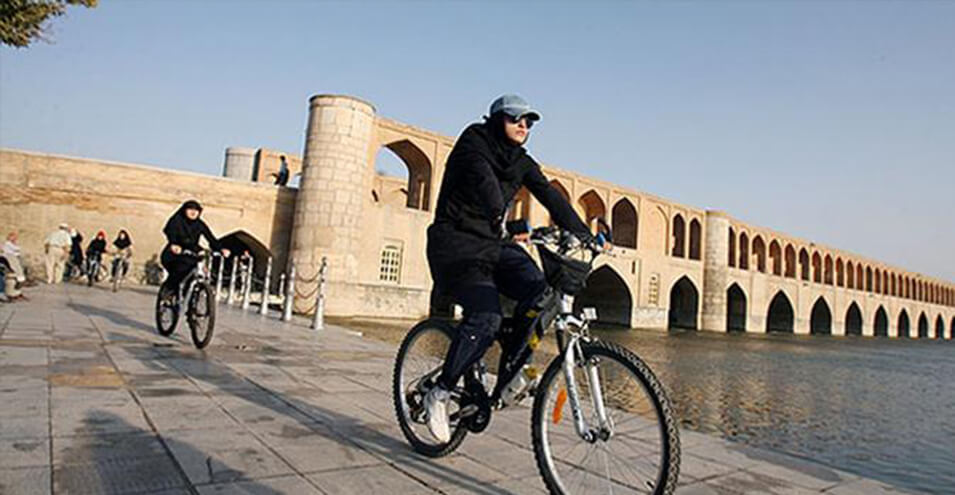
The Judiciary Spokesperson has said that the Isfahan prosecutor's letter regarding women's cycling was misinterpreted and that he did not say "cycling by women is absolutely prohibited." Khamenei had once said that there was no problem as long as it was not in the view of non-mahrams.
ISNA quoted Gholamhossein Esmaeili, a spokesman for the judiciary, as saying that the interpretation of the Isfahan prosecutor's remarks was "incomplete" and that he did not say that women riding bicycles was a crime, "but rather that women appearing in public without a hijab is a crime." Esmaeili added that "cycling is not a problem if it is not accompanied by a crime."
Ali Esfahani, the Public Prosecutor and Revolutionary Prosecutor of Isfahan, told IRNA last week: “According to the fatwa of scholars and also according to the law, women cycling in public spaces is forbidden.” He also said, “The police were informed that if cases of women cycling are seen in the city, they should first give a very respectful warning and if the person has identification documents, they should take them away, otherwise they should confiscate the person’s bicycle.”
The Isfahan Public and Revolutionary Prosecutor added that those whose identity documents are taken away "should go to the security police, and the police will take a commitment from them for the first time and return their documents or bicycles without punishment. If this action continues for the second and third time, the forbidden act will be dealt with according to the Islamic Penal Code."
Providing places for women to ride bicycles
These remarks were met with widespread protests on social media, with some officials calling them contrary to efforts to reduce air pollution. Others said they were reducing the tourist appeal of Isfahan.
The judiciary spokesman now says that the Isfahan prosecutor's circular is essentially "an order to prevent and deal with manifestations of acts that violate modesty, improper veiling or lack of veiling, and encouraging others to corruption and prostitution, and the like," and "I wish those who commented on the internet would have seen the context of this order."
According to him, based on the order, the municipality is supposed to "establish places for women to ride bicycles... On the other hand, the letter recommends that, in order to protect women's honor and dignity, it would be good to make special bicycles for them, which is not a ban on cycling."
Esmaili claims that these recommendations are “to protect and prevent crimes and to preserve the dignity and worth of women.” It is not clear how “places,” or more simply, lanes for women to cycle on the streets, should be constructed.
Public transportation culture and leadership orders
The possibility of women riding bicycles, which has spread in some cities of Iran despite all the intellectual, religious and traditional obstacles, was something that no woman could have imagined in the early years of the revolution and at the height of the strictures of the Islamic Republic. Before the revolution, and despite the fact that the cumbersome regulations of an Islamic government did not burden people's lives, it was rare for women to appear on the streets of Iranian cities with bicycles. Basically, cycling did not have much place in the transportation culture of society.
Now the situation is different. For many, both men and women, using bicycles is a way to move for their health and improve the city's air quality. The need to change the culture of transportation and bicycle use was first raised during the term of Gholamhossein Karbaschi, the mayor of Tehran. In this regard, a seminar was held in Chitgar Park. In this seminar, the use of bicycles as a means of transportation was evaluated. One of the speakers at this seminar was Faezeh Hashemi, a former member of parliament and former president of the Islamic Women's Sports Federation. She said in this seminar, "If bicycles are to be a means of transportation, we cannot expect that only men will use them. Because the city consists of men and women, and a culture must be created for women to ride bicycles as well." These words were later the subject of harsh attacks on her.
Various cultural and sports activities in Iran can be accompanied by more or less difficulties depending on the city and the Friday prayer leader, the local judiciary and executive, and municipal officials. If women's cycling in Isfahan had not faced resistance from society, it could have suffered the same fate as a music concert in Mashhad.
There is no law in the Islamic Republic prohibiting women from riding bicycles. However, the fatwa of the Leader of the Islamic Republic is more than a law, the basis for the work of a number of officials. In September 2016, Ayatollah Khamenei's office, in response to a Fars News Agency inquiry, said: "Women's cycling in public gatherings and in a non-mahram area often attracts the attention of men and exposes them to sedition and corruption in society, and is contrary to the chastity of women, and it is necessary to stop it, and if it is not in a non-mahram area, there is no problem." Critics believe that the Isfahan prosecutor is in a way repeating the same words when he talks about "establishing special places for women."
Source: DW